



Question: 1. Green's Theorem relates a line integral to a double integral over some region while Stoke's Theorem relates a line integral to a surface integral.
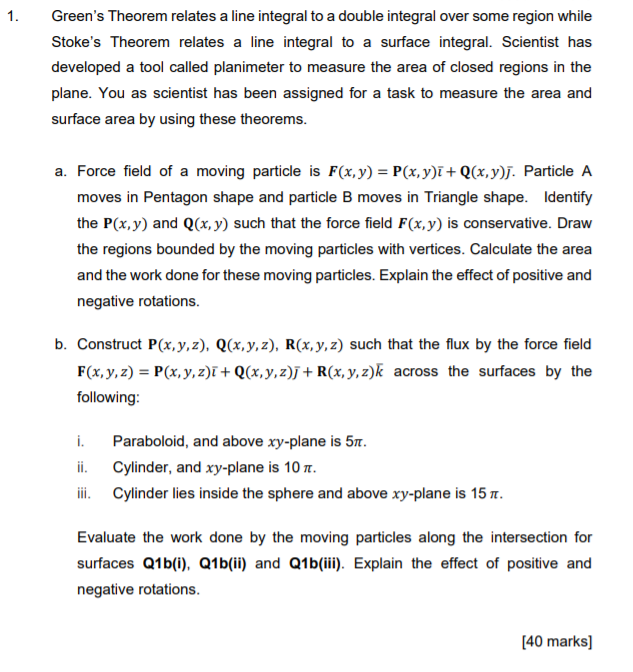
1. Green's Theorem relates a line integral to a double integral over some region while Stoke's Theorem relates a line integral to a surface integral. Scientist has developed a tool called planimeter to measure the area of closed regions in the plane. You as scientist has been assigned for a task to measure the area and surface area by using these theorems. a. Force field of a moving particle is F(x, y) = P(x,y) + Q(x,y)). Particle A moves in Pentagon shape and particle B moves in Triangle shape. Identify the P(x,y) and Q(x, y) such that the force field F(x,y) is conservative. Draw the regions bounded by the moving particles with vertices. Calculate the area and the work done for these moving particles. Explain the effect of positive and negative rotations. b. Construct P(x,y,z), Q(x,y,z), R(x, y, z) such that the flux by the force field F(x,y,z) = P(x, y, z)i + Q(x,y,z)j + R(x, y, z)k across the surfaces by the following: i. Paraboloid, and above xy-plane is 51. ii. Cylinder, and xy-plane is 107. iii. Cylinder lies inside the sphere and above xy-plane is 15 n. Evaluate the work done by the moving particles along the intersection for surfaces Q1b(i), Q1b(ii) and Q1b(i). Explain the effect of positive and negative rotations. [40 marks) 1. Green's Theorem relates a line integral to a double integral over some region while Stoke's Theorem relates a line integral to a surface integral. Scientist has developed a tool called planimeter to measure the area of closed regions in the plane. You as scientist has been assigned for a task to measure the area and surface area by using these theorems. a. Force field of a moving particle is F(x, y) = P(x,y) + Q(x,y)). Particle A moves in Pentagon shape and particle B moves in Triangle shape. Identify the P(x,y) and Q(x, y) such that the force field F(x,y) is conservative. Draw the regions bounded by the moving particles with vertices. Calculate the area and the work done for these moving particles. Explain the effect of positive and negative rotations. b. Construct P(x,y,z), Q(x,y,z), R(x, y, z) such that the flux by the force field F(x,y,z) = P(x, y, z)i + Q(x,y,z)j + R(x, y, z)k across the surfaces by the following: i. Paraboloid, and above xy-plane is 51. ii. Cylinder, and xy-plane is 107. iii. Cylinder lies inside the sphere and above xy-plane is 15 n. Evaluate the work done by the moving particles along the intersection for surfaces Q1b(i), Q1b(ii) and Q1b(i). Explain the effect of positive and negative rotations. [40 marks)
Step by Step Solution
There are 3 Steps involved in it

Get step-by-step solutions from verified subject matter experts