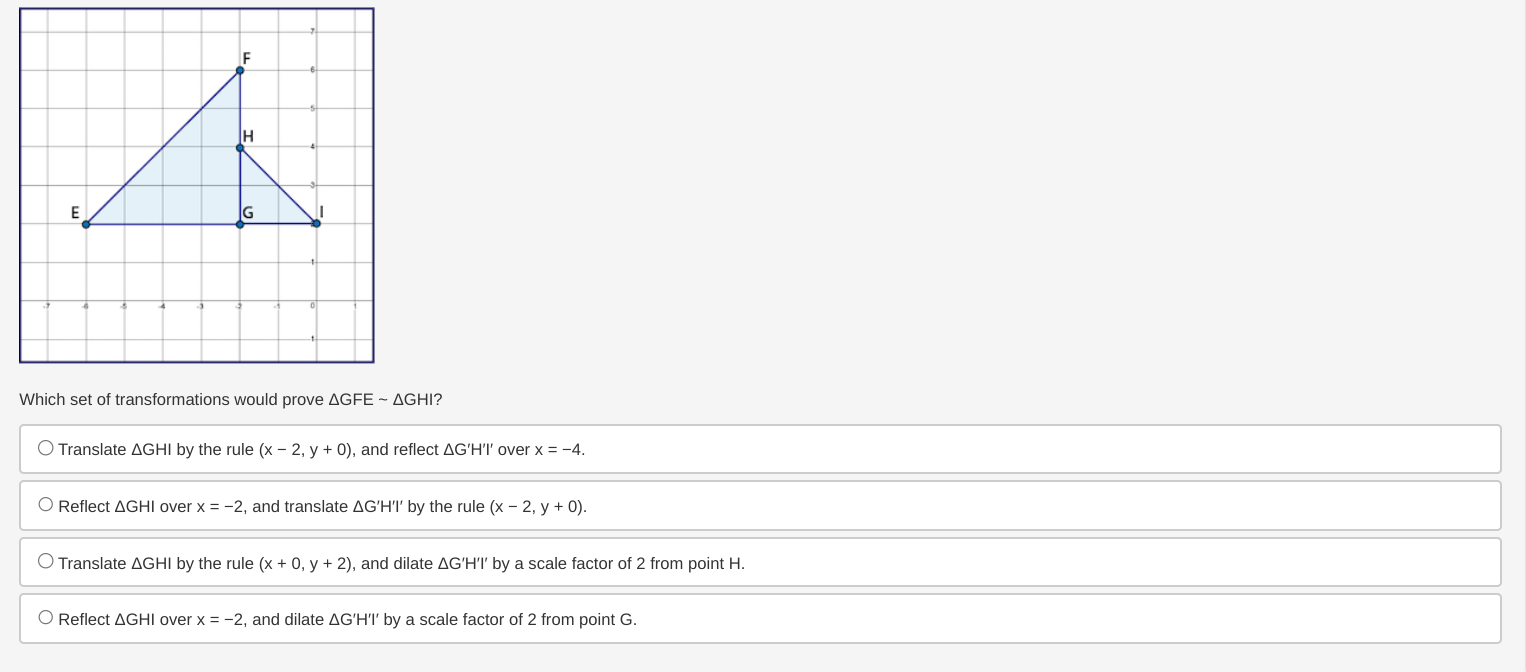
Question: 1. H E G Which set of transformations would prove AGFE ~ AGHI? O Translate AGHI by the rule (x - 2, y + 0),
1.
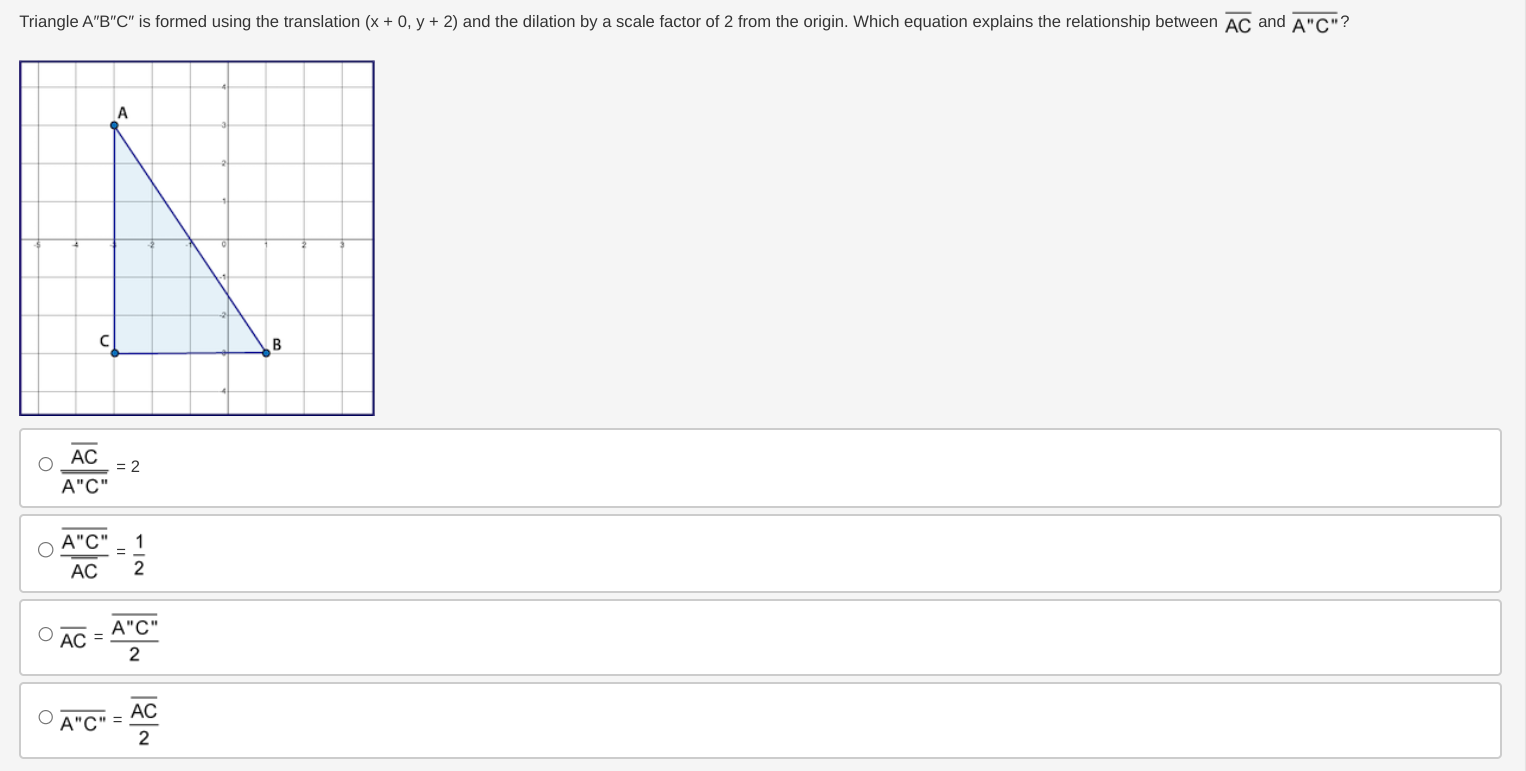
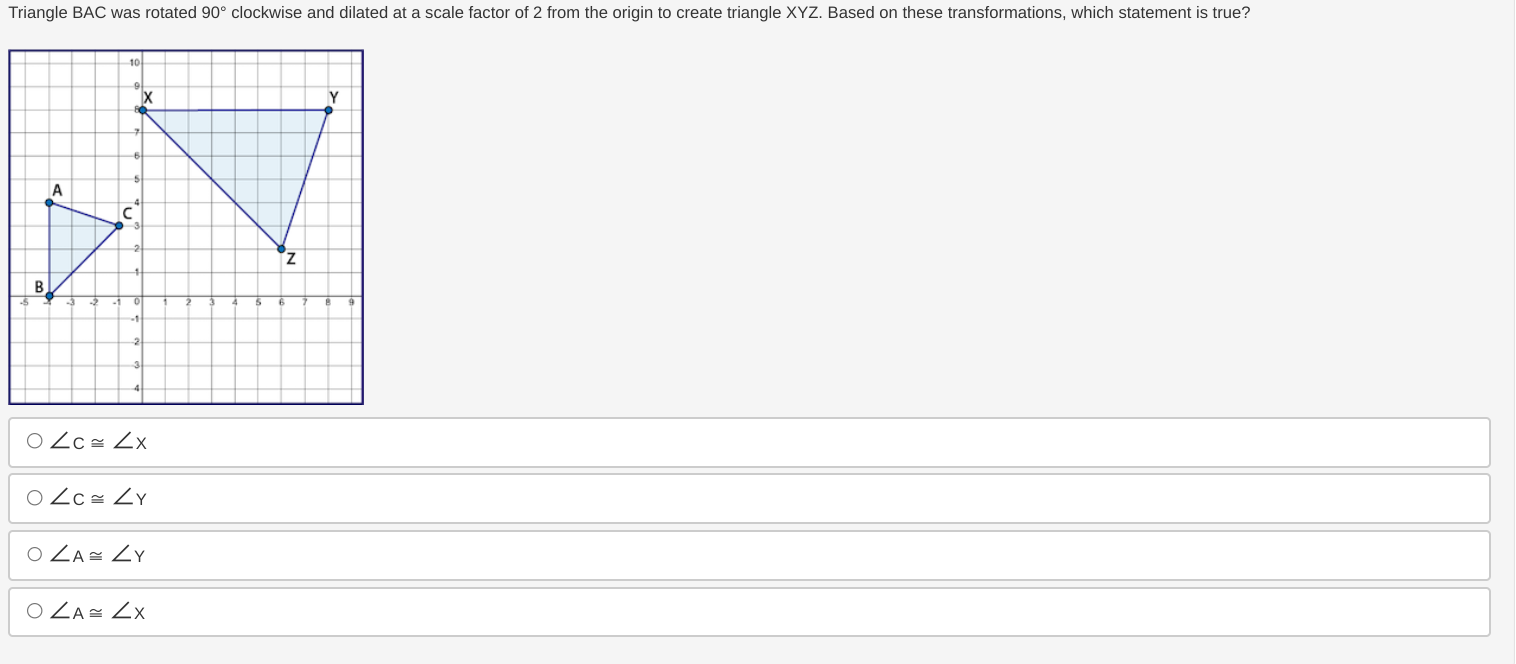
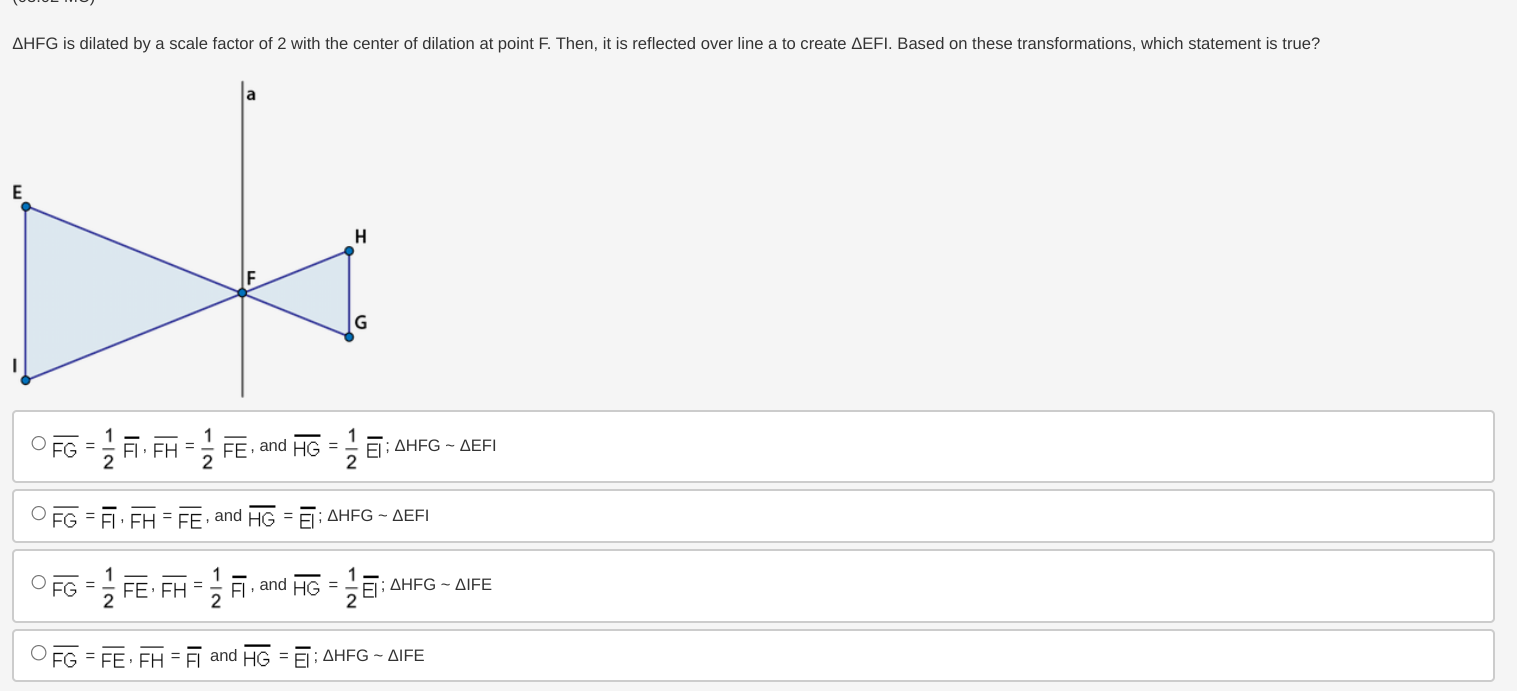
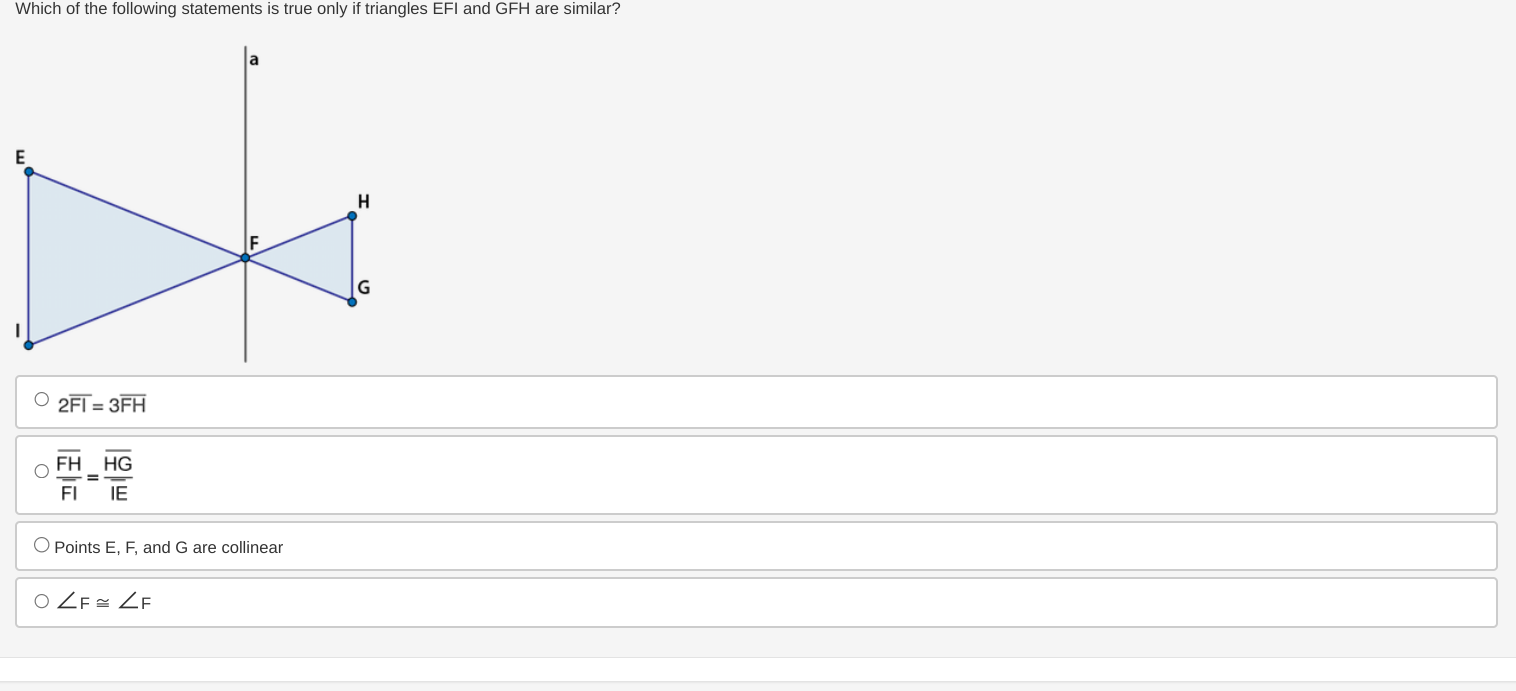
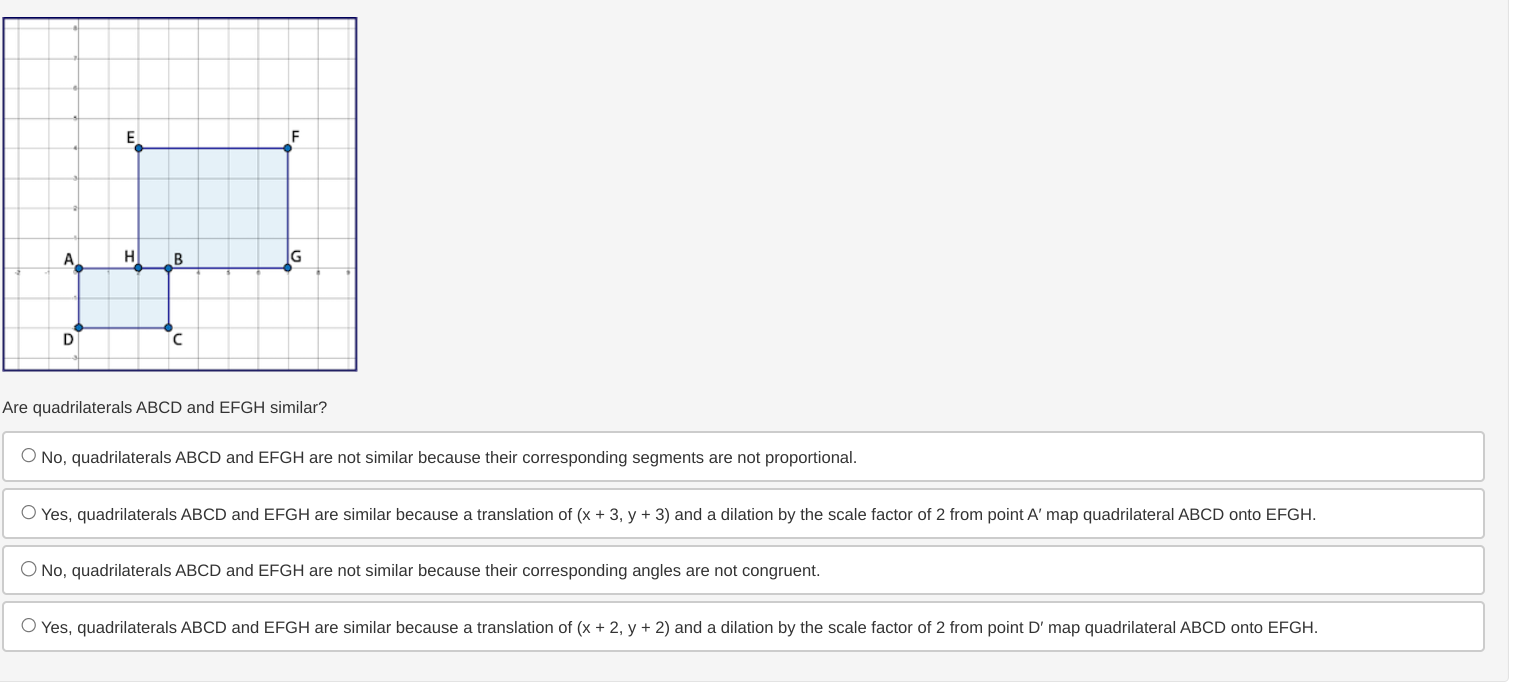
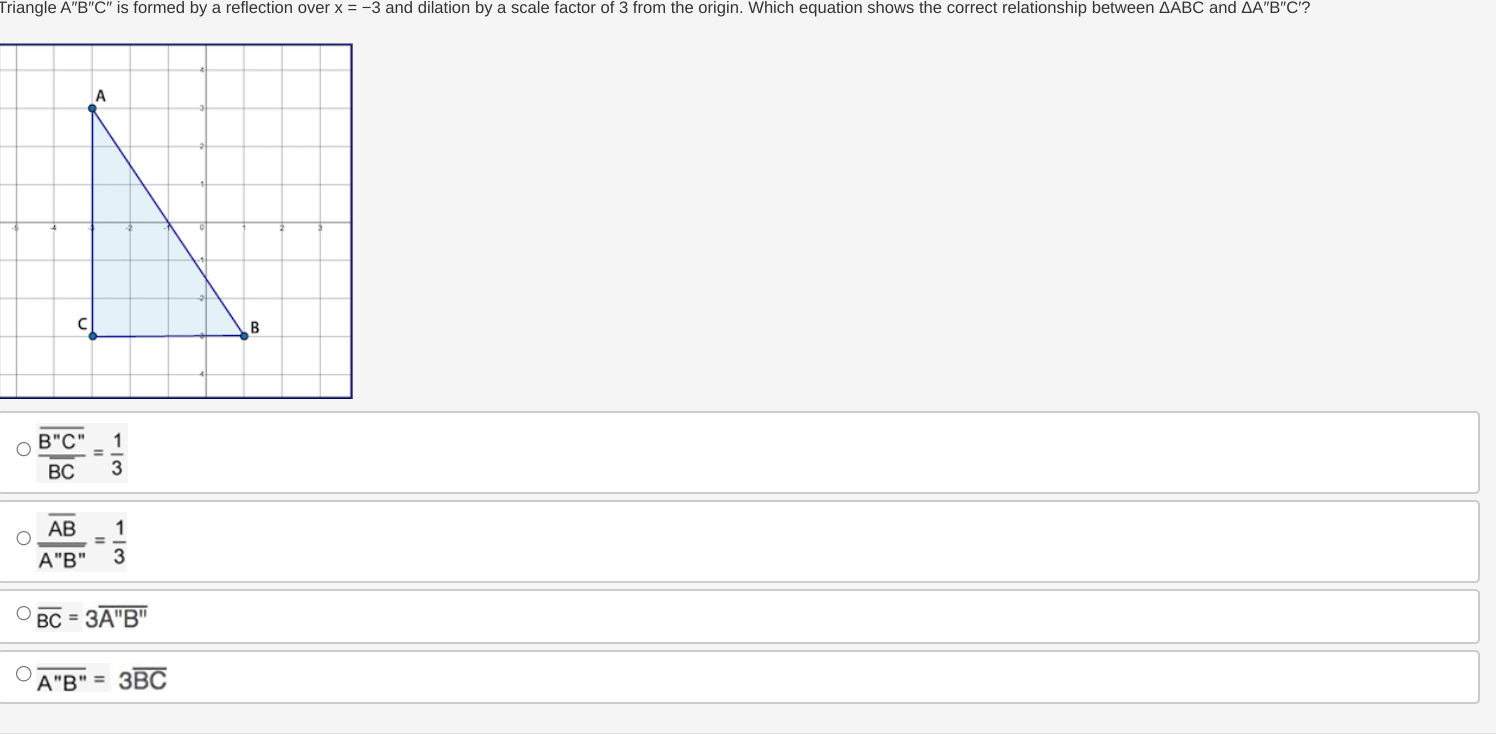
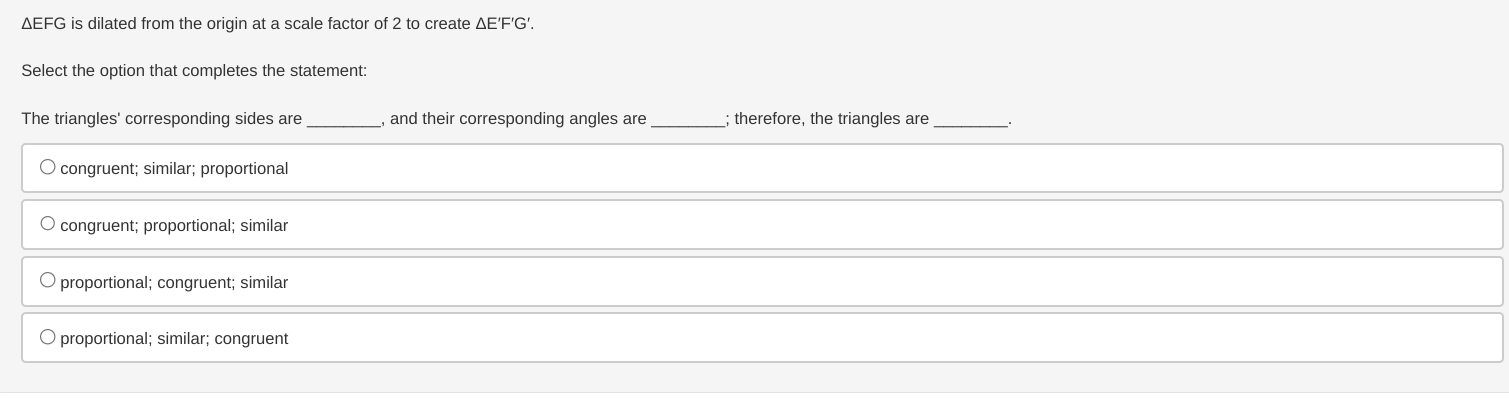
H E G Which set of transformations would prove AGFE ~ AGHI? O Translate AGHI by the rule (x - 2, y + 0), and reflect AG'H'l' over x = -4. O Reflect AGHI over x = -2, and translate AG'H'l' by the rule (x - 2, y + 0). Translate AGHI by the rule (x + 0, y + 2), and dilate AG'H'I' by a scale factor of 2 from point H. O Reflect AGHI over x = -2, and dilate AG'H'l' by a scale factor of 2 from point G.Triangle A\"B"C" is formed using the translation (x + 0' y + 2) and the dilation by a scale factor of 2 from the origin. Which equation explains the relationship between E and A"C Ir? 0 AC :2 A"C" 0 221 AC 2 0:W A 2 o " u AC 2 Triangle BAC was rotated 90 clockwise and dilated at a scale factor of 2 from the origin to create triangle XYZ. Based on these transformations, which statement is true? 10 X A Z B O LC = ZX O LC = LY O LA= LY O ZA= LXAHFG is dilated by a scale factor of 2 with the center of dilation at point F. Then, it is reflected over line a to create AEFI. Based on these transformations, which statement is true? E H F G OFG = ~ FI . FH = = FE, and HG = N/ - EI : AHFG - AEFI OFG = FI . FH = FE , and HG = EI ; AHFG ~ AEFI OFG = N/ - FE . FH = = FI , and HG = N/- EI; AHFG ~ AIFE OFG = FE . FH = FI and HG = EI ; AHFG - AIFEWhich of the following statements is true only if triangles EFI and GFH are similar? E H F G 2FI = 3FH O FH HG FI IE O Points E, F, and G are collinear O LF = LFAABC was dilated from the origin by a scale factor of 2 to create AA'B'C'. Which statement explains why the triangles are similar? O Dilations preserve side length; therefore, the corresponding sides of AABC and AA'B'C' are congruent. O Dilations preserve betweenness of points; therefore, the corresponding sides of AABC and AA'B'C' are congruent. O Dilations preserve orientation; therefore, the corresponding angles of AABC and AA'B'C' are congruent. O Dilations preserve angle measure; therefore the corresponding angles of AABC and AA'B'C' are congruent.E F A H B G D C Are quadrilaterals ABCD and EFGH similar? O No, quadrilaterals ABCD and EFGH are not similar because their corresponding segments are not proportional. Yes, quadrilaterals ABCD and EFGH are similar because a translation of (x + 3, y + 3) and a dilation by the scale factor of 2 from point A' map quadrilateral ABCD onto EFGH. No, quadrilaterals ABCD and EFGH are not similar because their corresponding angles are not congruent. Yes, quadrilaterals ABCD and EFGH are similar because a translation of (x + 2, y + 2) and a dilation by the scale factor of 2 from point D' map quadrilateral ABCD onto EFGH.Triangle A"B"C" is formed by a reflection over x = -3 and dilation by a scale factor of 3 from the origin. Which equation shows the correct relationship between AABC and AA"B"C'? C O B"C" = W / - BC O AB A"B" BC = 3A"B" A"B" = 3BCGiven rectangles LMNO and PQRS, which statement explains a way to determine ii the two gures are similar? 0 Verify corresponding pairs of angles are proportional by translation. 0 Verify corresponding pairs of sides are proportional by dilation. 0 Verify corresponding pairs of angles are congruent by dilation. 0 Verify corresponding pairs of Sides are congruent by translation. AEFG is dilated from the origin at a scale factor of 2 to create AE'F'G'. Select the option that completes the statement: The triangles' corresponding sides are , and their corresponding angles are ; therefore. the triangles are 0 congruent; similar; proportional O congruent; proportional; similar 0 proportional; congruent; Similar O proportional: similar; congruent
Step by Step Solution
There are 3 Steps involved in it
1 Expert Approved Answer
Step: 1 Unlock
Question Has Been Solved by an Expert!
Get step-by-step solutions from verified subject matter experts
Step: 2 Unlock
Step: 3 Unlock
Students Have Also Explored These Related Mathematics Questions!











 Study Help