







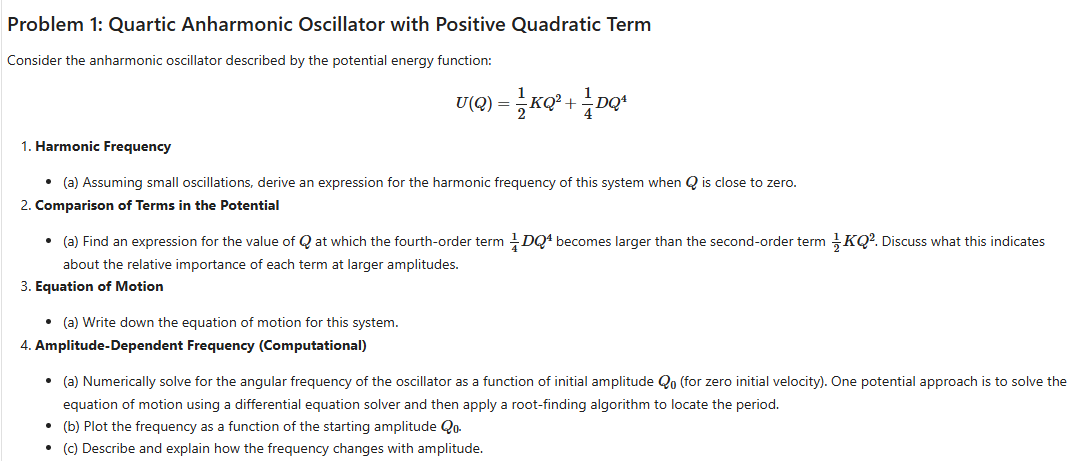
Question: 1 . Harmonic Frequency - ( a ) Assuming small oscillations, derive an expression for the harmonic frequency of this system when ( Q
Harmonic Frequency
a Assuming small oscillations, derive an expression for the harmonic frequency of this system when Q is close to zero.
Comparison of Terms in the Potential
a Find an expression for the value of Q at which the fourthorder term frac D Q becomes larger than the secondorder term frac K Q Discuss what this indicates about the relative importance of each term at larger amplitudes.
Equation of Motion
a Write down the equation of motion for this system.
AmplitudeDependent Frequency Computational
a Numerically solve for the angular frequency of the oscillator as a function of initial amplitude Qfor zero initial velocity One potential approach is to solve the equation of motion using a differential equation solver and then apply a rootfinding algorithm to locate the period.
b Plot the frequency as a function of the starting amplitude Q
c Describe and explain how the frequency changes with amplitude.
Step by Step Solution
There are 3 Steps involved in it
1 Expert Approved Answer
Step: 1 Unlock

Question Has Been Solved by an Expert!
Get step-by-step solutions from verified subject matter experts
Step: 2 Unlock
Step: 3 Unlock
 Study Help