







Question: 1. Here we will explore a bit further the concept of Eddington luminosity, that is, the luminosity where pressure from light stops the infall of
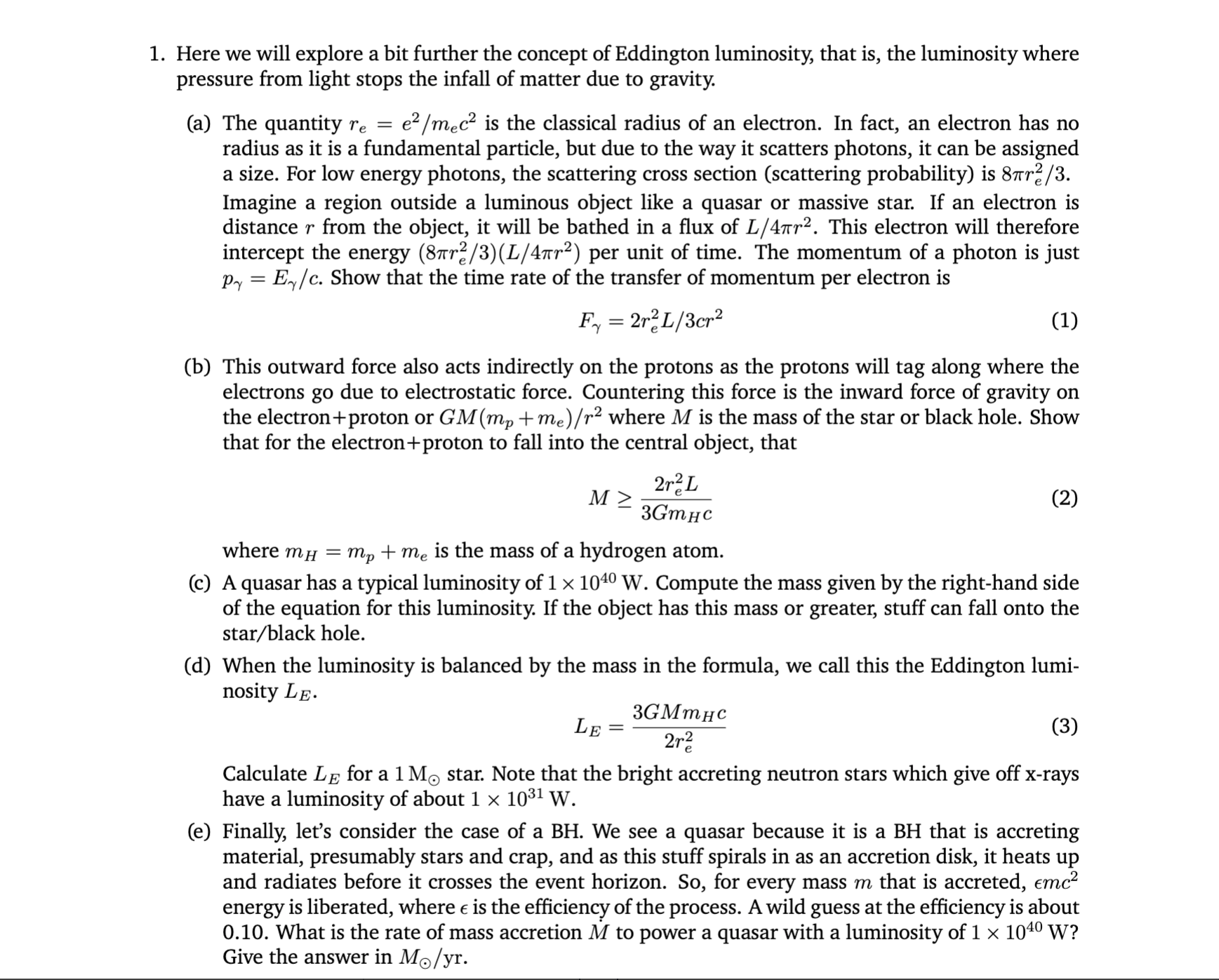
1. Here we will explore a bit further the concept of Eddington luminosity, that is, the luminosity where pressure from light stops the infall of matter due to gravity. (a) (b) (C) (d) (c) The quantity re = (22/mec2 is the classical radius of an electron. In fact, an electron has no radius as it is a fundamental particle, but due to the way it scatters photons, it can be assigned a size. For low energy photons, the scattering cross section (scattering probability) is 81m": / 3. Imagine a region outside a luminous object like a quasar or massive star. If an electron is distance r from the object, it will be bathed in a ux of L /47rr2. This electron will therefore intercept the energy (87rrf/3)(L/41rr2) per unit of time. The momentum of a photon is just pa, = v/C- Show that the time rate of the transfer of momentum per electron is F, = 2TgL/3CT'2 (1) This outward force also acts indirectly on the protons as the protons will tag along where the electrons go due to electrostatic force. Countering this force is the inward force of gravity on the electron+proton or GM (mp + me) /1'2 where M is the mass of the star or black hole. Show that for the electron+proton to fall into the central object, that 27'2L M > '3 _ 36'ch (2) where m H = 711.1) + me is the mass of a hydrogen atom. A quasar has a typical luminosity of 1 x 10'10 W. Compute the mass given by the right-hand side of the equation for this luminosity. If the object has this mass or greater; stuff can fall onto the star/black hole. When the luminosity is balanced by the mass in the formula, we call this the Eddington lumi- nosity L 3. 30M _ ch 2 Zn Calculate L E for a 1 MG star. Note that the bright accreting neutron stars which give off x-rays have a luminosity of about 1 x 1031 W. L E (3) Finally, let's consider the case of a BH. We see a quasar because it is a BH that is accreting material, presumably stars and crap, and as this stuff spirals in as an accretion disk, it heats up and radiates before it crosses the event horizon. So, for every mass m that is accreted, emc2 energy is liberated, where e is the efficiency of the process. A wild guess at the efciency is about 0.10. What is the rate of mass accretion M to power a quasar with a luminosity of 1 x 10\"0 W? Give the answer in MO / yr
Step by Step Solution
There are 3 Steps involved in it

Get step-by-step solutions from verified subject matter experts
 Study Help