







Question: 1. HOMEWORK PROBLEM #14 -- AGGREGATE EQUILIBRIUM AND THE MULTIPLIER -- ROUND 1 PRINT YOUR NAME (LAST) (FIRST) PART 1, MODEL I Model I deals
1.
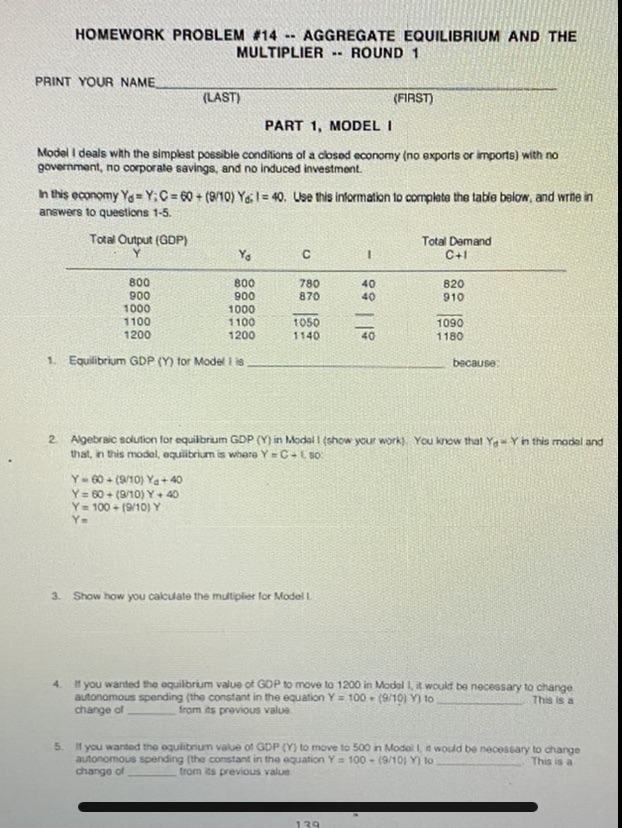
HOMEWORK PROBLEM #14 -- AGGREGATE EQUILIBRIUM AND THE MULTIPLIER -- ROUND 1 PRINT YOUR NAME (LAST) (FIRST) PART 1, MODEL I Model I deals with the simplest possible conditions of a closed economy (no exports or imports) with no government, no corporate savings, and no induced investment. In this economy Ya = Y:C= 60 + (9/10) Ye: 1= 40. Use this information to complete the table below, and write in answers to questions 1-5. Total Output (GDP) Total Demand Ya C C+1 800 780 40 820 900 900 870 40 910 1000 1000 1100 1100 1050 1090 1200 1200 1140 40 1180 1. Equilibrium GDP (Y) for Model 1 is because 2. Algebraic solution for equilibrium GDP (Y) in Modal I (show your work), You know that Y. = Y in this model and that, in this model, equilibrium is where Y = C + L 50 Y - 60 + (9/10) Ya + 40 Y = 60 + (9/10) Y + 40 Y = 100 - (9/10) Y 3. Show how you calculate the multiplier for Model 4 If you wanted the equilibrium value of GOP to move to 1200 in Model I, it would be necessary to change autonomous spending (the constant in the equation Y = 100 . (9/10] Y] to This is a change of from it's previous value. 5. If you wanted the equilibrium value of GDP (Y) to move to 500 in Modal I, it would be necessary to change autonomous spending (the constant in the equation Y = 100 - (9/101 1] 10 This is a chango of from its previous value
Step by Step Solution
There are 3 Steps involved in it

Get step-by-step solutions from verified subject matter experts
 Study Help