Question: 1. How big should the sample be for a statistically accurate standard (at, say, the 99.73% confidence level and accuracy of 5%) CASE STUDIES Jackson
1. How big should the sample be for a statistically accurate standard (at, say, the 99.73% confidence level and accuracy of 5%)
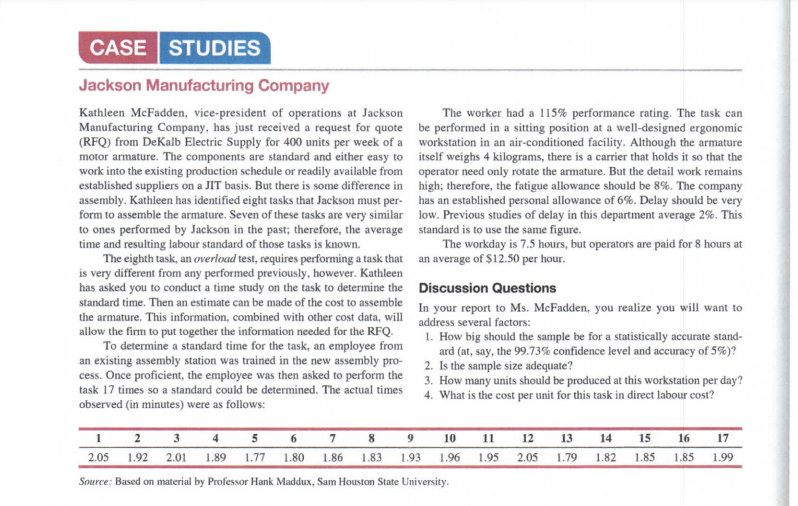
CASE STUDIES Jackson Manufacturing Company Kathleen McFadden, vice-president of operations at Jackson The worker had a 115% performance rating. The task can Manufacturing Company, has just received a request for quote be performed in a sitting position at a well-designed ergonomic (RFQ) from DeKalb Electric Supply for 400 units per week of a workstation in an air-conditioned facility. Although the armature motor armature. The components are standard and either easy to itself weighs 4 kilograms, there is a carrier that holds it so that the work into the existing production schedule or readily available from operator need only rotate the armature. But the detail work remains established suppliers on a JIT basis. But there is some difference in high; therefore, the fatigue allowance should be 8%. The company assembly. Kathleen has identified eight tasks that Jackson must per- has an established personal allowance of 6%. Delay should be very form to assemble the armature. Seven of these tasks are very similar low. Previous studies of delay in this department average 2%. This to ones performed by Jackson in the past; therefore, the average standard is to use the same figure. time and resulting labour standard of those tasks is known. The workday is 7.5 hours, but operators are paid for 8 hours at The eighth task, an overload test, requires performing a task that an average of $12.50 per hour. is very different from any performed previously, however. Kathleen has asked you to conduct a time study on the task to determine the Discussion Questions standard time. Then an estimate can be made of the cost to assemble in your report to Ms. McFadden, you realize you will want to the armature. This information, combined with other cost data, will address several factors: allow the firm to put together the information needed for the RFQ. 1. How big should the sample be for a statistically accurate stand- To determine a standard time for the task, an employee from ard (at, say, the 99.73% confidence level and accuracy of 5%)? an existing assembly station was trained in the new assembly pro- cess. Once proficient, the employee was then asked to perform the 2. Is the sample size adequate? 3. How many units should be produced at this workstation per day? task 17 times so a standard could be determined. The actual times 4. What is the cost per unit for this task in direct labour cost? observed (in minutes) were as follows: 3 4 10 11 12 13 1 2 2.05 1.92 5 6 1.77 1.80 7 8 9 1.86 1.83 1.93 14 15 1.82 1.85 16 17 1.85 1.99 2.01 1.89 1.96 1.95 2.05 1.79 Source: Based on material by Professor Hank Maddux, Sam Houston State University









 Study Help