







Question: 1. How do she come up with the idea(s)? 2. What problem(s) do they faced? 3. What is Morphology? 4. What do Reiling do to
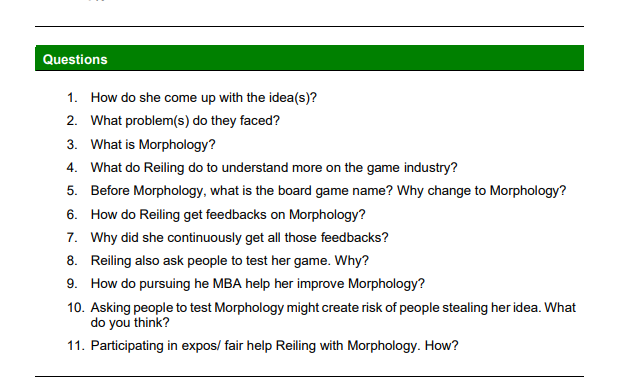
1. How do she come up with the idea(s)?
2. What problem(s) do they faced?
3. What is Morphology?
4. What do Reiling do to understand more on the game industry?
5. Before Morphology, what is the board game name? Why change to Morphology?
6. How do Reiling get feedbacks on Morphology?
7. Why did she continuously get all those feedbacks?
8. Reiling also ask people to test her game. Why?
9. How do pursuing he MBA help her improve Morphology?
10. Asking people to test Morphology might create risk of people stealing her idea. What do you think?
11. Participating in expos/ fair help Reiling with Morphology. How?
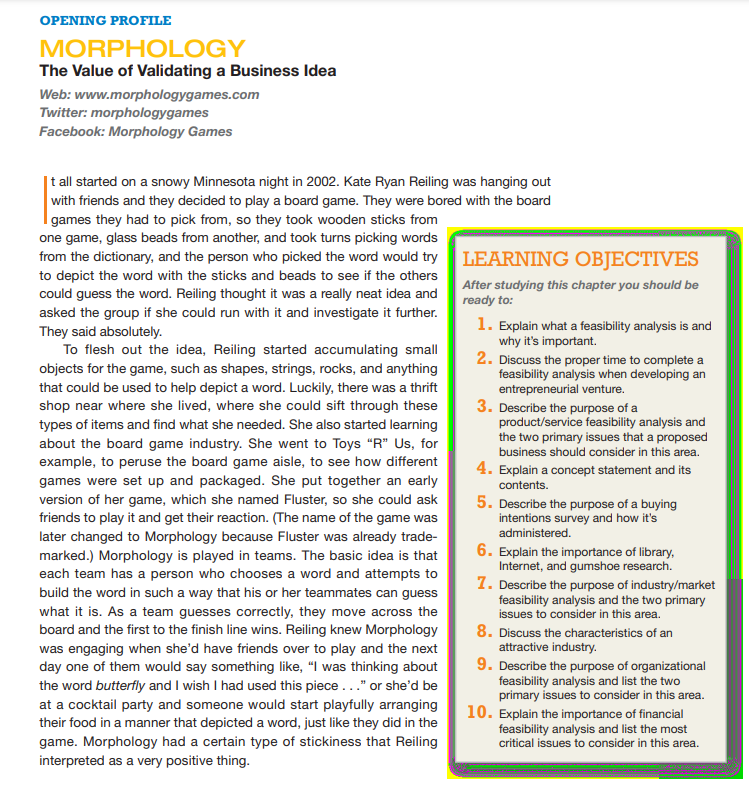
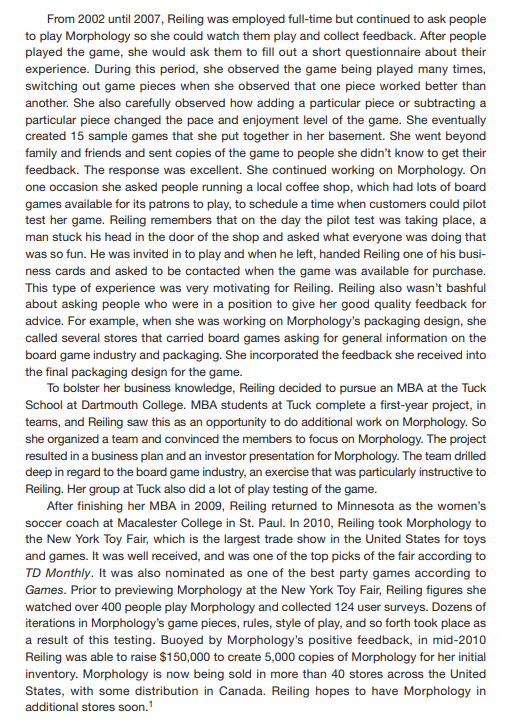
OPENING PROFILE MORPHOLOGY The Value of Validating a Business Idea Web: www.morphologygames.com Twitter: morphologygames Facebook: Morphology Games It all started on a snowy Minnesota night in 2002. Kate Ryan Reiling was hanging out with friends and they decided to play a board game. They were bored with the board games they had to pick from, so they took wooden sticks from one game, glass beads from another, and took turns picking words from the dictionary, and the person who picked the word would try LEARNING OBJECTIVES to depict the word with the sticks and beads to see if the others could guess the word. Reiling thought it was a really neat idea and asked the group if she could run with it and investigate it further. They said absolutely To flesh out the idea, Reiling started accumulating small objects for the game, such as shapes, strings, rocks, and anything that could be used to help depict a word. Luckily, there was a thrift shop near where she lived, where she could sift through these types of items and find what she needed. She also started learning about the board game industry. She went to Toys R Us, for example, to peruse the board game aisle, to see how different games were set up and packaged. She put together an early version of her game, which she named Fluster, so she could ask friends to play it and get their reaction. (The name of the game was later changed to Morphology because Fluster was already trade- marked.) Morphology is played in teams. The basic idea is that each team has a person who chooses a word and attempts to build the word in such a way that his or her teammates can guess what it is. As a team guesses correctly, they move across the board and the first to the finish line wins. Reiling knew Morphology was engaging when she'd have friends over to play and the next day one of them would say something like, I was thinking about the word butterfly and I wish I had used this piece..." or she'd be at a cocktail party and someone would start playfully arranging their food in a manner that depicted a word, just like they did in the game. Morphology had a certain type of stickiness that Reiling interpreted as a very positive thing. After studying this chapter you should be ready to: 1. Explain what a feasibility analysis is and why it's important 2. Discuss the proper time to complete a feasibility analysis when developing an entrepreneurial venture. 3. Describe the purpose of a product/service feasibility analysis and the two primary issues that a proposed business should consider in this area. 4. Explain a concept statement and its contents. 5. Describe the purpose of a buying intentions survey and how it's administered 6. Explain the importance of library, Internet, and gumshoe research. 7. Describe the purpose of industry/market feasibility analysis and the two primary issues to consider in this area. 8. Discuss the characteristics of an attractive industry. 9. Describe the purpose of organizational feasibility analysis and list the two primary issues to consider in this area. 10. Explain the importance of financial feasibility analysis and list the most critical issues to consider in this area. From 2002 until 2007, Reiling was employed full-time but continued to ask people to play Morphology so she could watch them play and collect feedback. After people played the game, she would ask them to fill out a short questionnaire about their experience. During this period, she observed the game being played many times, switching out game pieces when she observed that one piece worked better than another. She also carefully observed how adding a particular piece or subtracting a particular piece changed the pace and enjoyment level of the game. She eventually created 15 sample games that she put together in her basement. She went beyond family and friends and sent copies of the game to people she didn't know to get their feedback. The response was excellent. She continued working on Morphology. On one occasion she asked people running a local coffee shop, which had lots of board games available for its patrons to play, to schedule a time when customers could pilot test her game. Reiling remembers that on the day the pilot test was taking place, a man stuck his head in the door of the shop and asked what everyone was doing that was so fun. He was invited in to play and when he left, handed Reiling one of his busi- ness cards and asked to be contacted when the game was available for purchase. This type of experience was very motivating for Reiling. Reiling also wasn't bashful about asking people who were in a position to give her good quality feedback for advice. For example, when she was working on Morphology's packaging design, she called several stores that carried board games asking for general information on the board game industry and packaging. She incorporated the feedback she received into the final packaging design for the game. To bolster her business knowledge, Reiling decided to pursue an MBA at the Tuck School at Dartmouth College. MBA students at Tuck complete a first-year project, in teams, and Reiling saw this as an opportunity to do additional work on Morphology. So she organized a team and convinced the members to focus on Morphology. The project resulted in a business plan and an investor presentation for Morphology. The team drilled deep in regard to the board game industry, an exercise that was particularly instructive to Reiling. Her group at Tuck also did a lot of play testing of the game. After finishing her MBA in 2009, Reiling returned to Minnesota as the women's soccer coach at Macalester College in St. Paul. In 2010, Reiling took Morphology to the New York Toy Fair, which is the largest trade show in the United States for toys and games. It was well received, and was one of the top picks of the fair according to TD Monthly. It was also nominated as one of the best party games according to Games. Prior to previewing Morphology at the New York Toy Fair, Reiling figures she watched over 400 people play Morphology and collected 124 user surveys. Dozens of iterations in Morphology's game pieces, rules, style of play, and so forth took place as a result of this testing. Buoyed by Morphology's positive feedback, in mid-2010 Reiling was able to raise $150,000 to create 5,000 copies of Morphology for her initial inventory. Morphology is now being sold in more than 40 stores across the United States, with some distribution in Canada. Reiling hopes to have morphology in additional stores soon.' Questions 1. How do she come up with the idea(s)? 2. What problem(s) do they faced? 3. What is Morphology? 4. What do Reiling do to understand more on the game industry? 5. Before Morphology, what is the board game name? Why change to Morphology? 6. How do Reiling get feedbacks on Morphology? 7. Why did she continuously get all those feedbacks? 8. Reiling also ask people to test her game. Why? 9. How do pursuing he MBA help her improve Morphology? 10. Asking people to test Morphology might create risk of people stealing her idea. What do you think? 11. Participating in expos/ fair help Reiling with Morphology. HowStep by Step Solution
There are 3 Steps involved in it
1 Expert Approved Answer
Step: 1 Unlock

Question Has Been Solved by an Expert!
Get step-by-step solutions from verified subject matter experts
Step: 2 Unlock
Step: 3 Unlock
 Study Help