



Question: 1) How do the major problems at Acme manifest themselves? 2) What are some of the root causes of Acme's problems? 3) Develop a quick
1) How do the major problems at Acme manifest themselves?
2) What are some of the root causes of Acme's problems?
3) Develop a "quick win" strategy for increasing intranet usage across Acme
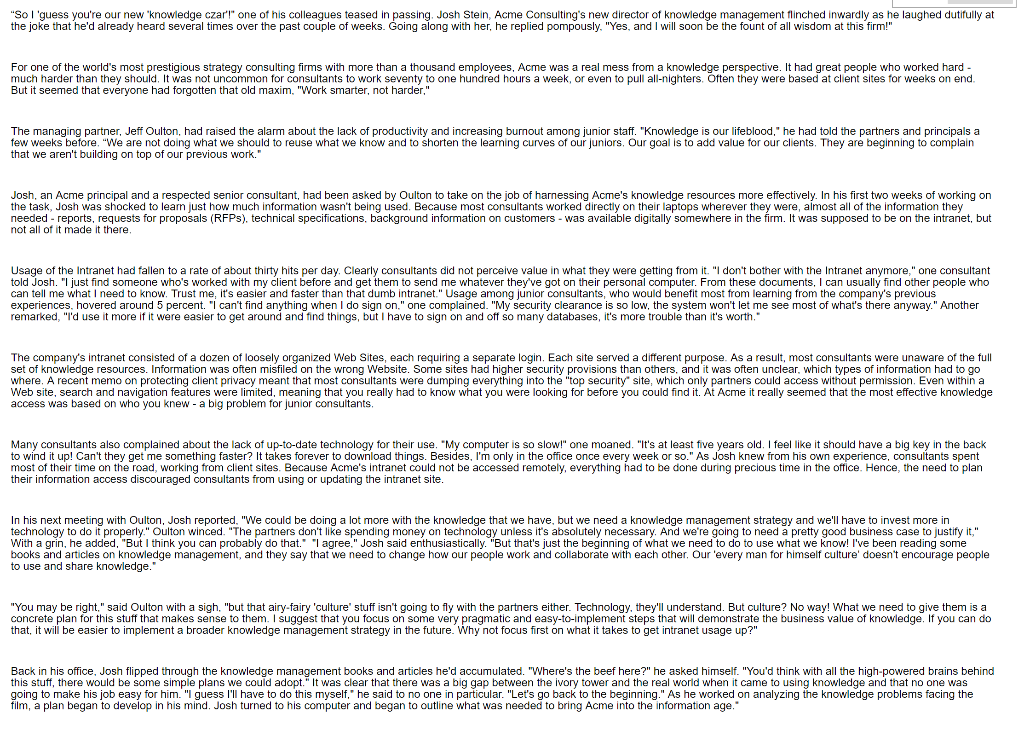
"So I guess you're our new knowledge czar'l" one of his colleagues teased in passing, Josh Stein, Acme Consulting's new director of knowledge management flinched inwardly as he laughed dutifully at the joke that he'd already heard several times over the past couple of weeks. Going along with her, he replied pompously, "Yes, and I will soon be the fount of all wisdom at this firm!" For one of the world's most prestigious strategy consulting firms with more than a thousand employees, Acme was a real mess from a knowledge perspective. It had great people who worked hard much harder than they should. It was not uncommon for consultants to work seventy to one hundred hours a week, or even to pull all-nighters. Often they were based at client sites for weeks on end. But it seemed that everyone had forgotten that old maxim, "Work smarter, not harder," The managing partner, Jeff Oulton, had raised the alarm about the lack of productivity and increasing burnout among junior staff. "Knowledge is our lifeblood," he had told the partners and principals a few weeks before. "We are not doing what we should to reuse what we know and to shorten the leaming curves of our juniors. Our goal is to add value for our clients. They are beginning to complain that we aren't building on top of our previous work." Josh, an Acme principal and a respected senior consultant, had been asked by Oulton to take on the job of harnessing Acme's knowledge resources more effectively. In his first two weeks of working on the task, Josh was shocked to learn just how much information wasn't being used. Because most consultants worked directly on their laptops wherever they were, almost all of the information they needed - reports, requests for proposals (RFPs), technical specifications, background information on customers - was available digitally somewhere in the firm. It was supposed to be on the intranet, but not all of it made it there, Usage of the Intranet had fallen to a rate of about thirty hits per day. Clearly consultants did not perceive value in what they were getting from it. "I don't bother with the Intranet anymore," one consultant told Josh. "I just find someone who's worked with my client before and get them to send me whatever they've got on their personal computer. From these documents, I can usually find other people who can tell me what I need to know. Trust me, it's easier and faster than that dumb intranet." Usage among junior consultants, who would benefit most from learning from the company's previous experiences, hovered around 5 percent. "I can't find anything when I do sign on," one complained. "My security clearance is so low, the system won't let me see most of what's there anyway." Another remarked, "I'd use it more if it were easier to get around and find things, but I have to sign on and off so many databases, it's more trouble than it's worth. The company's intranet consisted of a dozen of loosely organized Web Sites, each requiring a separate login. Each site served a different purpose. As a result, most consultants were unaware of the full set of knowledge resources. Information was often misfiled on the wrong Website. Some sites had higher security provisions than others, and it was often unclear, which types of information had to go where. A recent memo on protecting client privacy meant that most consultants were dumping everything into the top security site, which only partners could access without permission. Even within a Web site, search and navigation features were limited, meaning that you really had to know what you were looking for before you could find it. At Acme it really seemed that the most effective knowledge access was based on who you knew - a big problem for Junior Consultants Many consultants also complained about the lack of up-to-date technology for their use. "My computer is so slow!" one moaned. "It's at least five years old. I feel like it should have a big key in the back to wind it up! Can't they get me something faster? It takes forever to download things. Besides, I'm only in the office once every week or so." As Josh knew from his own experience, consultants spent most of their time on the road, working from client sites. Because Acme's intranet could not be accessed remotely, everything had to be done during precious time in the office. Hence, the need to plan their information access discouraged consultants from using or updating the intranet site. In his next meeting with Oulton, Josh reported, "We could be doing a lot more with the knowledge that we have, but we need a knowledge management strategy and we'll have to invest more in technology to do it properly." Oulton winced. "The partners don't like spending money on technology unless it's absolutely necessary. And we're going to need a pretty good business case to justify it," With a grin, he added, "But I think you can probably do that." "I agree." Josh said enthusiastically. "But that's just the beginning of what we need to do to use what we know! I've been reading some books and articles on knowledge management, and they say that we need to change how our people work and collaborate with each other. Our every man for himself culture' doesn't encourage people to use and share knowledge." "You may be right," said Oulton with a sigh, "but that airy-fairy 'culture' stuff isn't going to fly with the partners either. Technology, they'll understand. But culture? No way! What we need to give them is a concrete plan for this stuff that makes sense to them. I suggest that you focus on some very pragmatic and easy-to-implement steps that will demonstrate the business value of knowledge. If you can do that, it will be easier to implement a broader knowledge management strategy in the future. Why not focus first on what it takes to get intranet usage up?" Back in his office, Josh flipped through the knowledge management books and articles he'd accumulated. "Where's the beef here?" he asked himself. "You'd think with all the high-powered brains behind this stuff, there would be some simple plans we could adopt." It was clear that there was a big gap between the ivory tower and the real world when it came to using knowledge and that no one was going to make his job easy for him. "I guess I'll have to do this myself," he said to no one in particular. "Let's go back to the beginning." As he worked on analyzing the knowledge problems facing the film, a plan began to develop in his mind. Josh turned to his computer and began to outline what was needed to bring Acme into the information ageStep by Step Solution
There are 3 Steps involved in it
1 Expert Approved Answer
Step: 1 Unlock

Question Has Been Solved by an Expert!
Get step-by-step solutions from verified subject matter experts
Step: 2 Unlock
Step: 3 Unlock