







Question: 1. How does HRM in the united states differ from HRM in japan? 2. What do you see as the basic advantages and disadvantages of
1. How does HRM in the united states differ from HRM in japan?
2. What do you see as the basic advantages and disadvantages of each system?
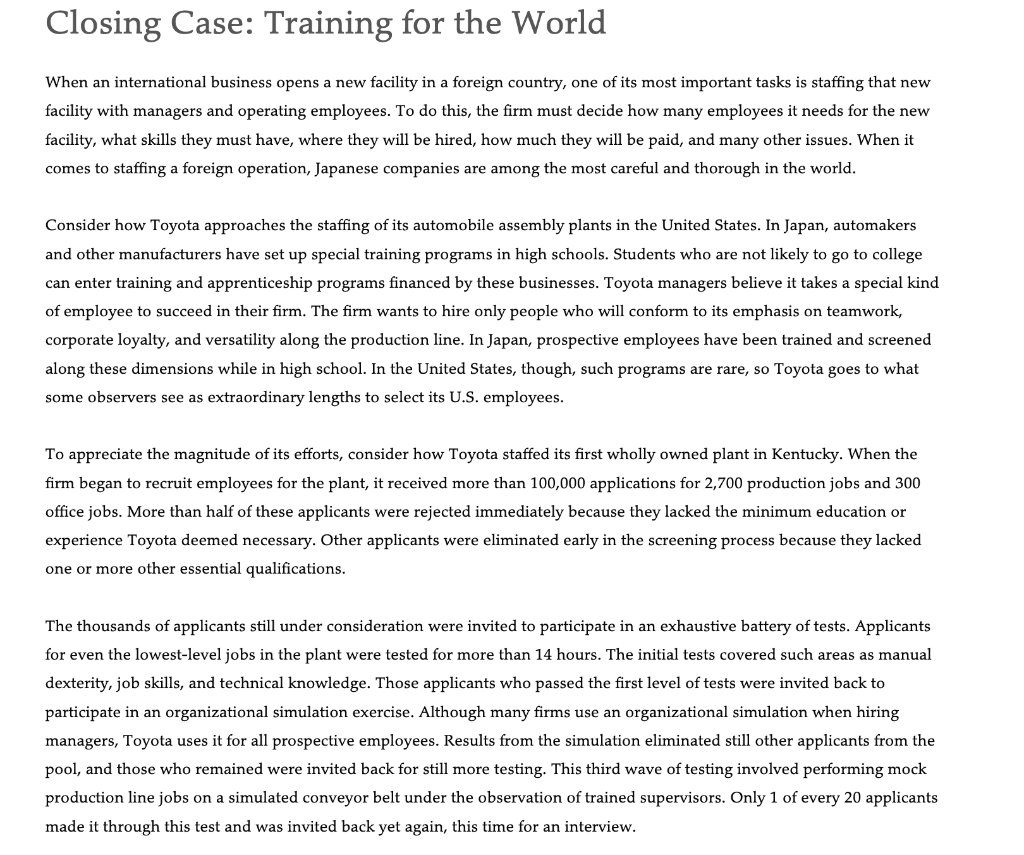
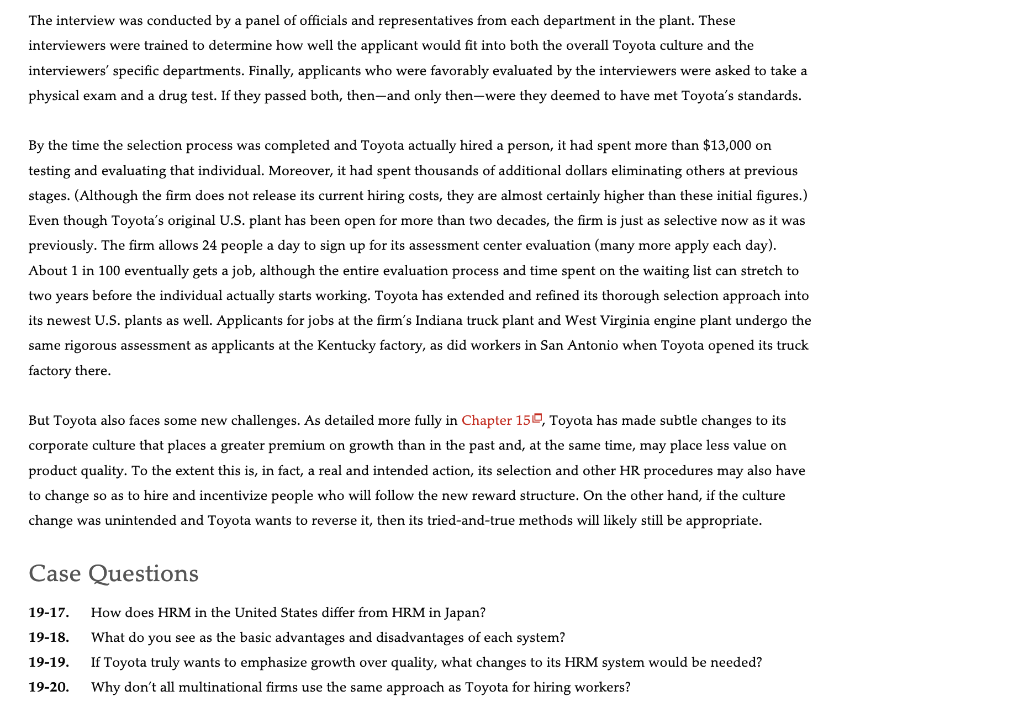
Closing Case: Training for the World When an international business opens a new facility in a foreign country, one of its most important tasks is staffing that new facility with managers and operating employees. To do this, the firm must decide how many employees it needs for the new facility, what skills they must have, where they will be hired, how much they will be paid, and many other issues. When it comes to staffing a foreign operation, Japanese companies are among the most careful and thorough in the world. Consider how Toyota approaches the staffing of its automobile assembly plants in the United States. In Japan, automakers and other manufacturers have set up special training programs in high schools. Students who are not likely to go to college can enter training and apprenticeship programs financed by these businesses. Toyota managers believe it takes a special kind of employee to succeed in their firm. The firm wants to hire only people who will conform to its emphasis on teamwork, corporate loyalty, and versatility along the production line. In Japan, prospective employees have been trained and screened along these dimensions while in high school. In the United States, though, such programs are rare, so Toyota goes to what some observers see as extraordinary lengths to select its U.S. employees. To appreciate the magnitude of its efforts, consider how Toyota staffed its first wholly owned plant in Kentucky. When the firm began to recruit employees for the plant, it received more than 100,000 applications for 2,700 production jobs and 300 office jobs. More than half of these applicants were rejected immediately because they lacked the minimum education or experience Toyota deemed necessary. Other applicants were eliminated early in the screening process because they lacked one or more other essential qualifications. The thousands of applicants still under consideration were invited to participate in an exhaustive battery of tests. Applicants for even the lowest-level jobs in the plant were tested for more than 14 hours. The initial tests covered such areas as manual dexterity, job skills, and technical knowledge. Those applicants who passed the first level of tests were invited back to participate in an organizational simulation exercise. Although many firms use an organizational simulation when hiring managers, Toyota uses it for all prospective employees. Results from the simulation eliminated still other applicants from the pool, and those who remained were invited back for still more testing. This third wave of testing involved performing mock production line jobs on a simulated conveyor belt under the observation of trained supervisors. Only 1 of every 20 applicants made it through this test and was invited back yet again, this time for an interview. The interview was conducted by a panel of officials and representatives from each department in the plant. These interviewers were trained to determine how well the applicant would fit into both the overall Toyota culture and the interviewers' specific departments. Finally, applicants who were favorably evaluated by the interviewers were asked to take a physical exam and a drug test. If they passed both, then-and only then-were they deemed to have met Toyota's standards. By the time the selection process was completed and Toyota actually hired a person, it had spent more than $13,000 on testing and evaluating that individual. Moreover, it had spent thousands of additional dollars eliminating others at previous stages. (Although the firm does not release its current hiring costs, they are almost certainly higher than these initial figures.) Even though Toyota's original U.S. plant has been open for more than two decades, the firm is just as selective now as it was previously. The firm allows 24 people a day to sign up for its assessment center evaluation (many more apply each day). About 1 in 100 eventually gets a job, although the entire evaluation process and time spent on the waiting list can stretch to two years before the individual actually starts working. Toyota has extended and refined its thorough selection approach into its newest U.S. plants as well. Applicants for jobs at the firm's Indiana truck plant and West Virginia engine plant undergo the same rigorous assessment as applicants at the Kentucky factory, as did workers in San Antonio when Toyota opened its truck factory there. But Toyota also faces some new challenges. As detailed more fully in Chapter 150, Toyota has made subtle changes to its corporate culture that places a greater premium on growth than in the past and, at the same time, may place less value on product quality. To the extent this is, in fact, a real and intended action, its selection and other HR procedures may also have to change so as to hire and incentivize people who will follow the new reward structure. On the other hand, if the culture change was unintended and Toyota wants to reverse it, then its tried-and-true methods will likely still be appropriate. Case Questions 19-17. 19-18. How does HRM in the United States differ from HRM in Japan? What do you see as the basic advantages and disadvantages of each system? If Toyota truly wants to emphasize growth over quality, what changes to its HRM system would be needed? Why don't all multinational firms use the same approach as Toyota for hiring workers? 19-19. 19-20Step by Step Solution
There are 3 Steps involved in it
1 Expert Approved Answer
Step: 1 Unlock

Question Has Been Solved by an Expert!
Get step-by-step solutions from verified subject matter experts
Step: 2 Unlock
Step: 3 Unlock
 Study Help