







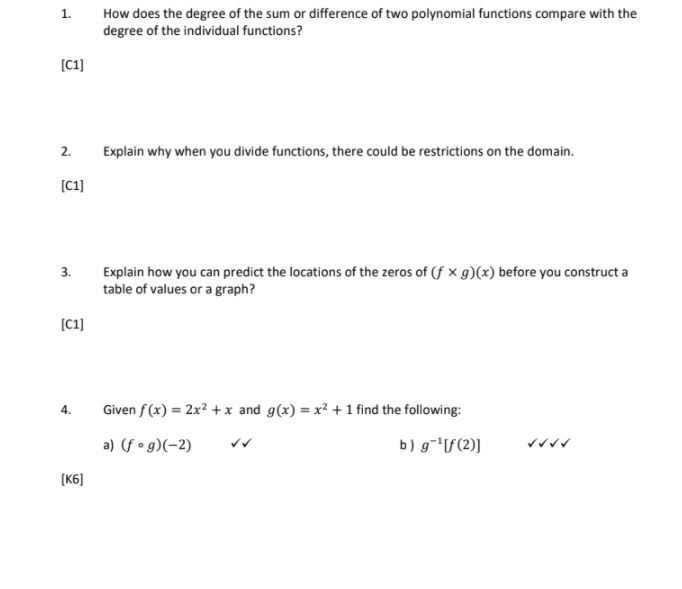
Question: 1. How does the degree of the sum or difference of two polynomial functions compare with the degree of the individual functions? [C1] 2. Explain
![two polynomial functions compare with the degree of the individual functions? [C1]](https://dsd5zvtm8ll6.cloudfront.net/si.experts.images/questions/2024/10/67139229022c2_84867139228c7eba.jpg)
![the domain. [C1] 3. Explain how you can predict the locations of](https://dsd5zvtm8ll6.cloudfront.net/si.experts.images/questions/2024/10/6713922a67cd7_8506713922a5a311.jpg)
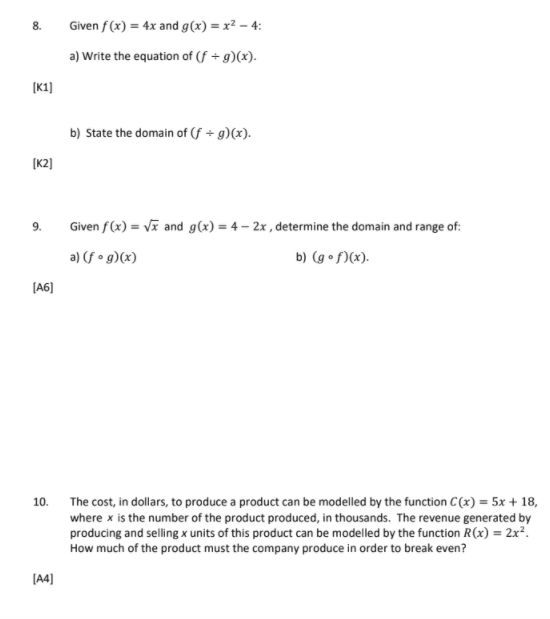
1. How does the degree of the sum or difference of two polynomial functions compare with the degree of the individual functions? [C1] 2. Explain why when you divide functions, there could be restrictions on the domain. [C1] 3. Explain how you can predict the locations of the zeros of (f x g) (x) before you construct a table of values or a graph? [C1] 4. Given f (x) = 2x2 + x and g(x) = x2 + 1 find the following: a) (f . g)(-2) b) g '[f (2)] [K6]5. Given the graphs of f(x) and g(x), a) Draw the graph of (f - 9)(x). [K2] 10 8- RX) 6 2 g(x) -10 -B -6 4 6 8 10 X 2 b) State where f(x)
Step by Step Solution
There are 3 Steps involved in it
1 Expert Approved Answer
Step: 1 Unlock

Question Has Been Solved by an Expert!
Get step-by-step solutions from verified subject matter experts
Step: 2 Unlock
Step: 3 Unlock
 Study Help