







Question: 1) How was the production process a problem in this case? 2) Explain the relevant issue of the case in your own words. 3) What
1) How was the production process a problem in this case? 2) Explain the relevant issue of the case in your own words. 3) What was the role of training in this case pay system?
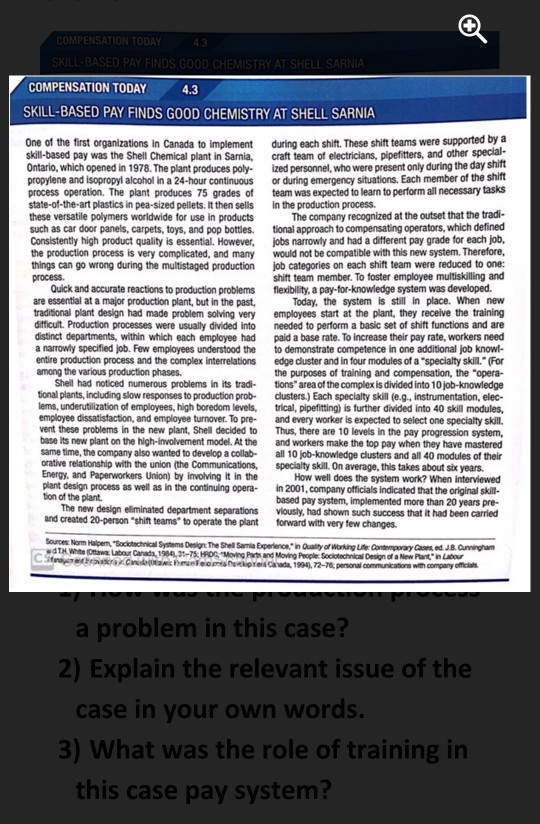
4.3 COMPENSATION TODAY SKILL-BASED PAY FINDS GOOD CHEMISTRY AT SHELL SARNIA COMPENSATION TODAY SKILL-BASED PAY FINDS GOOD CHEMISTRY AT SHELL SARNIA One of the first organizations in Canada to implement during each shift. These shift teams were supported by a skill-based pay was the Shell Chemical plant in Sarnia, craft team of electricians, pipefitters, and other special- Ontario, which opened in 1978. The plant produces poly ized personnel, who were present only during the day shift propylene and isopropyl alcohol in a 24-hour continuous or during emergency situations. Each member of the shift process operation. The plant produces 75 grades of team was expected to learn to perform all necessary tasks state-of-the-art plastics in pea-sized pellets. It then sells In the production process. these versatile polymers worldwide for use in products The company recognized at the outset that the tradi- such as car door panels, carpets, toys, and pop bottles. tional approach to compensating operators, which defined Consistently high product quality is essential. However, jobs narrowly and had a different pay grade for each job, the production process is very complicated, and many would not be compatible with this new system. Therefore, things can go wrong during the multistaged production job categories on each shift team were reduced to one: process. shift team member. To foster employee multiskilling and Quick and accurate reactions to production problems flexibility, a pay-for-knowledge system was developed are essential at a major production plant, but in the past, Today, the system is still in place. When new traditional plant design had made problem solving very employees start at the plant, they receive the training difficult. Production processes were usually divided into needed to perform a basic set of shift functions and are distinct departments, within which each employee had paid a base rate. To increase their pay rate, workers need a narrowly specified job. Few employees understood the to demonstrate competence in one additional job knowl- entire production process and the complex interrelations edge cluster and in four modules of a "specialty skill." (For among the various production phases. the purposes of training and compensation, the "opera- Shell had noticed numerous problems in its tradi tions" area of the complex is divided into 10 job-knowledge tional plants, including slow responses to production prob clusters.) Each specialty skill (e.g., instrumentation, elec- lems, under utilization of employees, high boredom levels, trical, pipefitting) is further divided into 40 skill modules, employee dissatisfaction, and employee turnover. To pre and every worker is expected to select one specialty skill vent these problems in the new plant, Shell decided to Thus, there are 10 levels in the pay progression system, base its new plant on the high-involvement model. At the and workers make the top pay when they have mastered same time, the company also wanted to develop a collab all 10 job-knowledge clusters and all 40 modules of their orative relationship with the union (the Communications, Specialty skill. On average, this takes about six years. Energy, and Paperworkers Union) by involving it in the How well does the system work? When interviewed plant design process as well as in the continuing opera in 2001, company officials indicated that the original skill- tion of the plant based pay system, implemented more than 20 years pre- The new design eliminated department separations viously, had shown such success that it had been carried and created 20-person shift teams to operate the plant forward with very few changes. Sources: Norm Halpern "Societechnical Systems Design The Shel Saria Experience in Quality of Working Contemporary Casesed J.B. Cunningham City di White Ottawa Labour Canada, 1980.31-75. HROG "Moving Parts and Moving People Sociotechnical Design of a New Pant in Latur Tax Coches Portes Canada, 1994.72-76 pensional communications with company officials a problem in this case? 2) Explain the relevant issue of the case in your own words. 3) What was the role of training in this case pay systemStep by Step Solution
There are 3 Steps involved in it
1 Expert Approved Answer
Step: 1 Unlock

Question Has Been Solved by an Expert!
Get step-by-step solutions from verified subject matter experts
Step: 2 Unlock
Step: 3 Unlock
 Study Help