







Question: 1 hypothesis test for single population mean Question 1 The average American gets a haircut every 38 days. Is the average larger for college students?
1 hypothesis test for single population mean
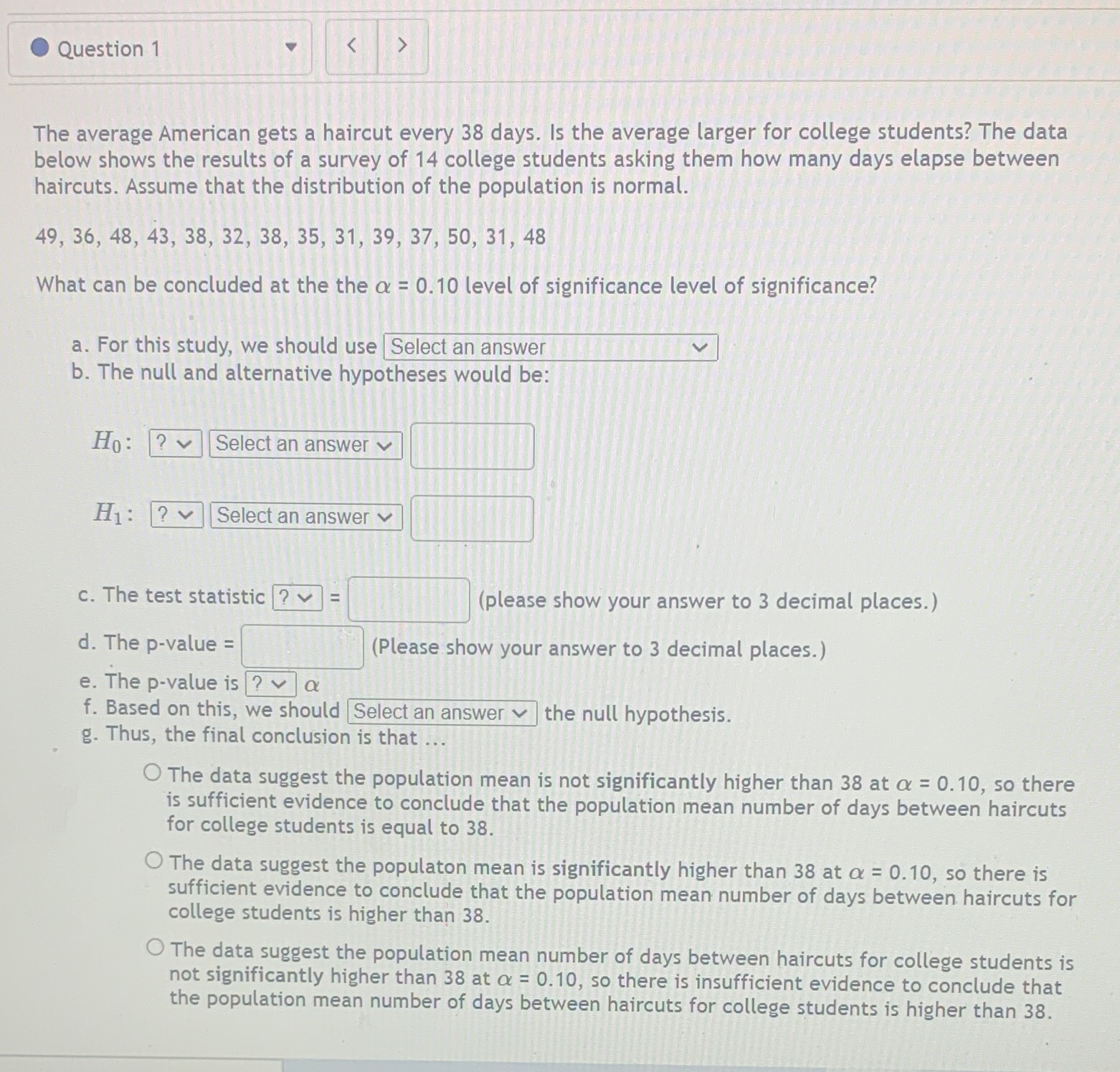
Question 1 The average American gets a haircut every 38 days. Is the average larger for college students? The data below shows the results of a survey of 14 college students asking them how many days elapse between haircuts. Assume that the distribution of the population is normal. 49, 36, 48, 43, 38, 32, 38, 35, 31, 39, 37, 50, 31, 48 What can be concluded at the the a = 0. 10 level of significance level of significance? a. For this study, we should use |Select an answer b. The null and alternative hypotheses would be: Ho: ? Select an answer v H1 : ? Select an answer v c. The test statistic |? v = (please show your answer to 3 decimal places.) d. The p-value = (Please show your answer to 3 decimal places.) e. The p-value is ? va f. Based on this, we should |Select an answer v | the null hypothesis. g. Thus, the final conclusion is that ... O The data suggest the population mean is not significantly higher than 38 at a = 0.10, so there is sufficient evidence to conclude that the population mean number of days between haircuts for college students is equal to 38. The data suggest the populaton mean is significantly higher than 38 at a = 0.10, so there is sufficient evidence to conclude that the population mean number of days between haircuts for college students is higher than 38. O The data suggest the population mean number of days between haircuts for college students is not significantly higher than 38 at a = 0. 10, so there is insufficient evidence to conclude that the population mean number of days between haircuts for college students is higher than 38
Step by Step Solution
There are 3 Steps involved in it

Get step-by-step solutions from verified subject matter experts
 Study Help