







Question: 1/ Hypothesis Testing using the Rejection Region Method The head librarian at our county library says that 65 %% of residents use the library's services
1/
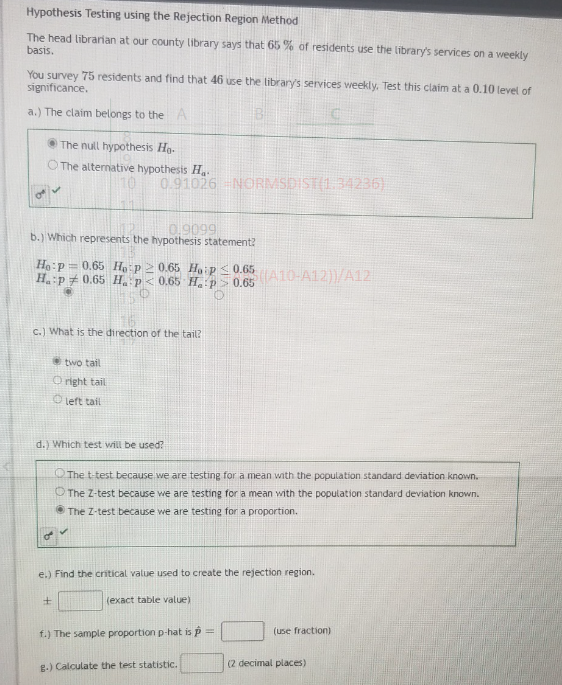
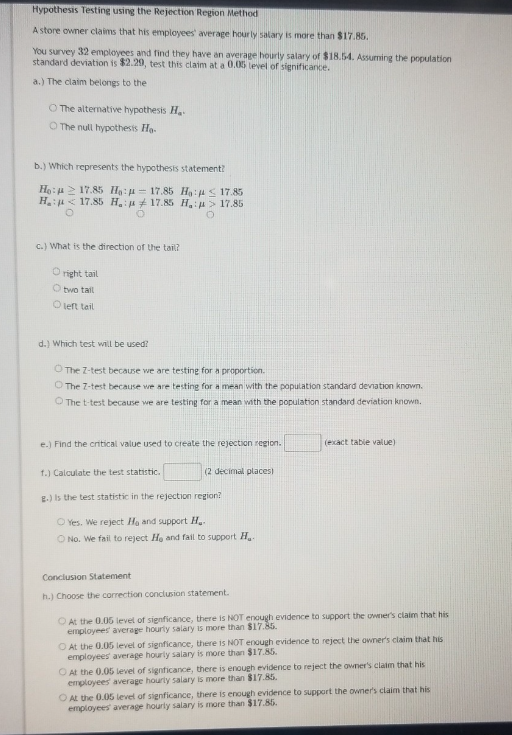
Hypothesis Testing using the Rejection Region Method The head librarian at our county library says that 65 %% of residents use the library's services on a weekly basis. You survey 75 residents and find that 46 use the library's services weekly. Test this claim at a 0.10 level of significance. a.) The claim belongs to the A B The null hypothesis Ha- The alternative hypothesis Ha. 10 0.91026 NORMSDIST(1. 34236) 0.9099 b. ) Which represents the hypothesis statement? Ha:p = 0.65 Hop _ 0.65 Ho p 17.85 Hip - 17.85 Hip s 17.85 H.: 14 17.85 c.} What is the direction of the tail? O right tail two tail Olen tail d.) Which test will be used? O The Z-test because we are testing for a proportion. The 7-test because we are testing for a mean with the population standard deviation known. The t-test because we are testing for a mean with the population standard deviation known. e.) Find the critical value used to create the rejection region. (exact table value) 1.) Calculate the test statistic. (2 decimal places) B. ) Is the test statistic in the rejection region? O'Yes. We reject Mo and support He- O No. We fail to reject Me and fail to support H. Conclusion Statement h.) Choose the correction conclusion statement. QAt the 0.05 level of signficance, there is NOT enough evidence to support the owner's claim that his employees average hourly salary is more than $17.85. O At the 0.05 level of signficance, there is NOT enough evidence to reject the owner's claim that his employees' average hourly salary is more than $17.85. O At the 0.05 level of signficance, there is enough evidence to reject the owner's claim that his employees average hourly salary is more than $17.85. O At the 0.05 level of signficance, there is enough evidence to support the owner's claim that his employees average hourly salary is more than $17.85
Step by Step Solution
There are 3 Steps involved in it

Get step-by-step solutions from verified subject matter experts
 Study Help