







Question: 1. Identify: a. The cases b. The response variable and its type) c. If applicable, the explanatory variable (and its type) d. The most appropriate
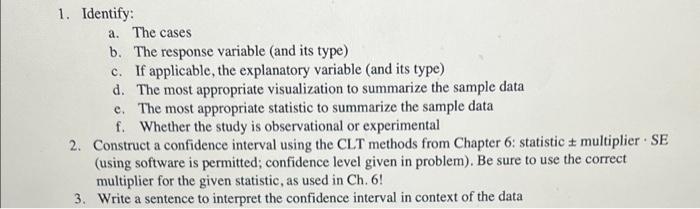
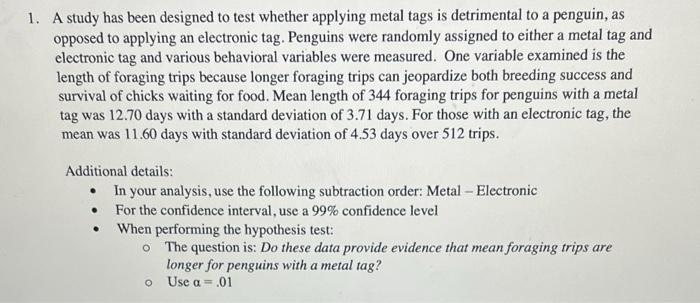
1. Identify: a. The cases b. The response variable and its type) c. If applicable, the explanatory variable (and its type) d. The most appropriate visualization to summarize the sample data e. The most appropriate statistic to summarize the sample data f. Whether the study is observational or experimental 2. Construct a confidence interval using the CLT methods from Chapter 6: statistic + multiplier SE (using software is permitted; confidence level given in problem). Be sure to use the correct multiplier for the given statistic, as used in Ch. 6! 3. Write a sentence to interpret the confidence interval in context of the data 1. A study has been designed to test whether applying metal tags is detrimental to a penguin, as opposed to applying an electronic tag. Penguins were randomly assigned to either a metal tag and electronic tag and various behavioral variables were measured. One variable examined is the length of foraging trips because longer foraging trips can jeopardize both breeding success and survival of chicks waiting for food. Mean length of 344 foraging trips for penguins with a metal tag was 12.70 days with a standard deviation of 3.71 days. For those with an electronic tag, the mean was 11.60 days with standard deviation of 4.53 days over 512 trips. Additional details: In your analysis, use the following subtraction order: Metal - Electronic For the confidence interval, use a 99% confidence level When performing the hypothesis test: o The question is: Do these data provide evidence that mean foraging trips are longer for penguins with a metal tag? Use a = .01 . . o
Step by Step Solution
There are 3 Steps involved in it

Get step-by-step solutions from verified subject matter experts
 Study Help