







Question: 1. If gravity increases, what will happen to horizontal range of the projectile ball? 2. If gravity decreases, what will happen to horizontal range

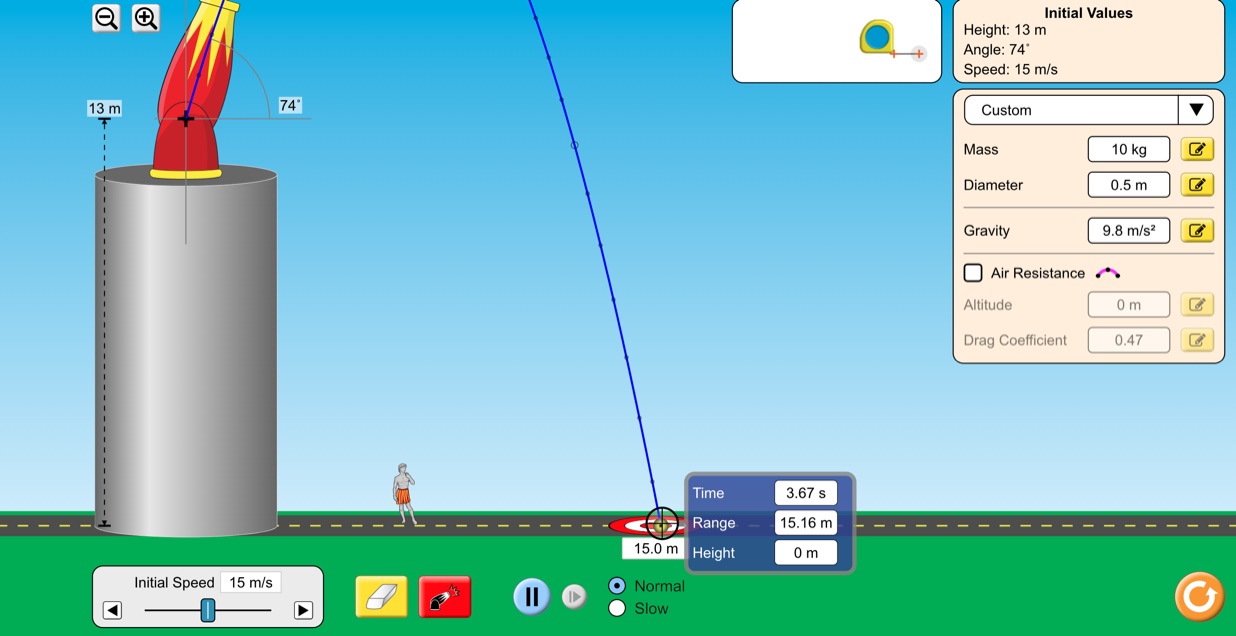
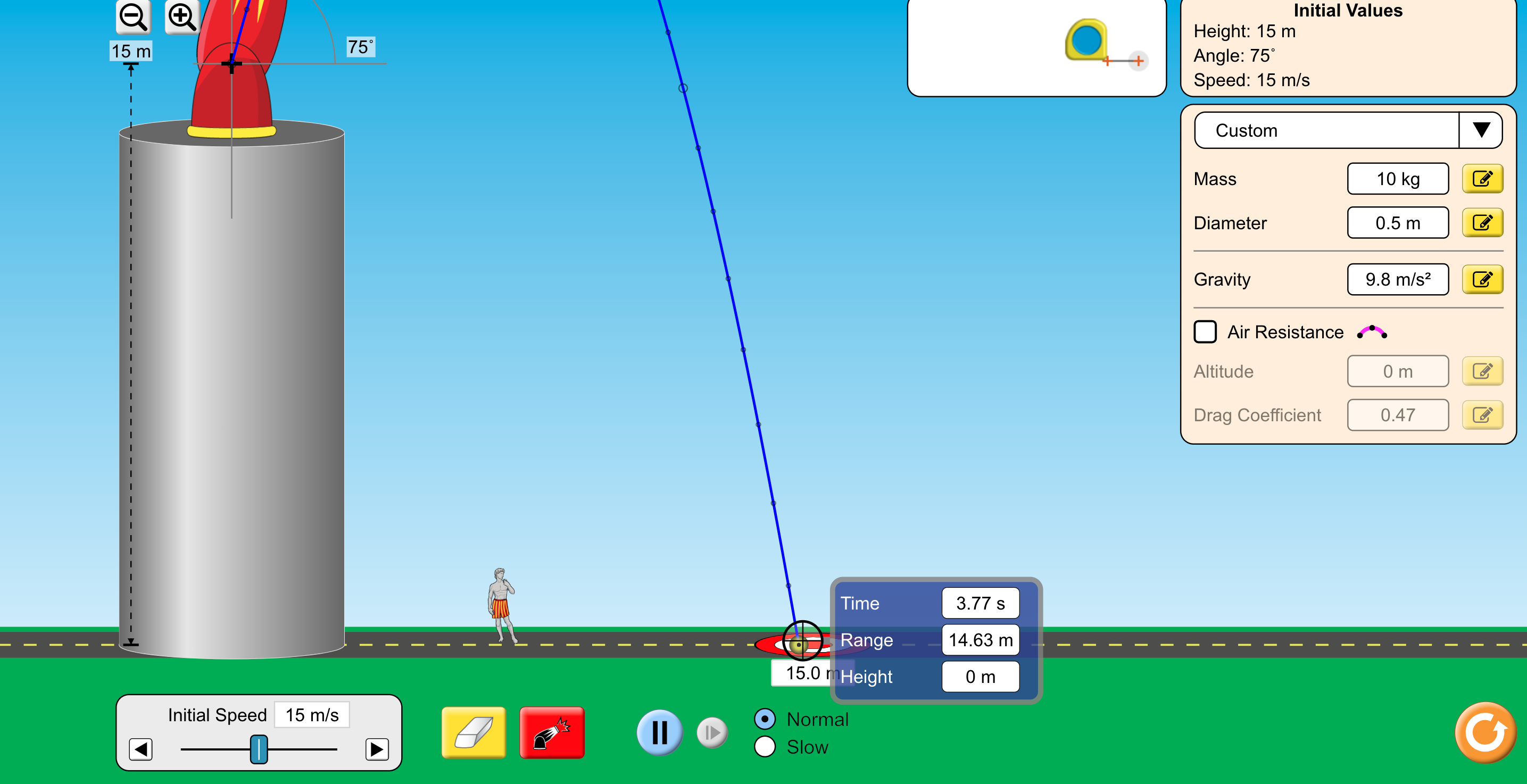
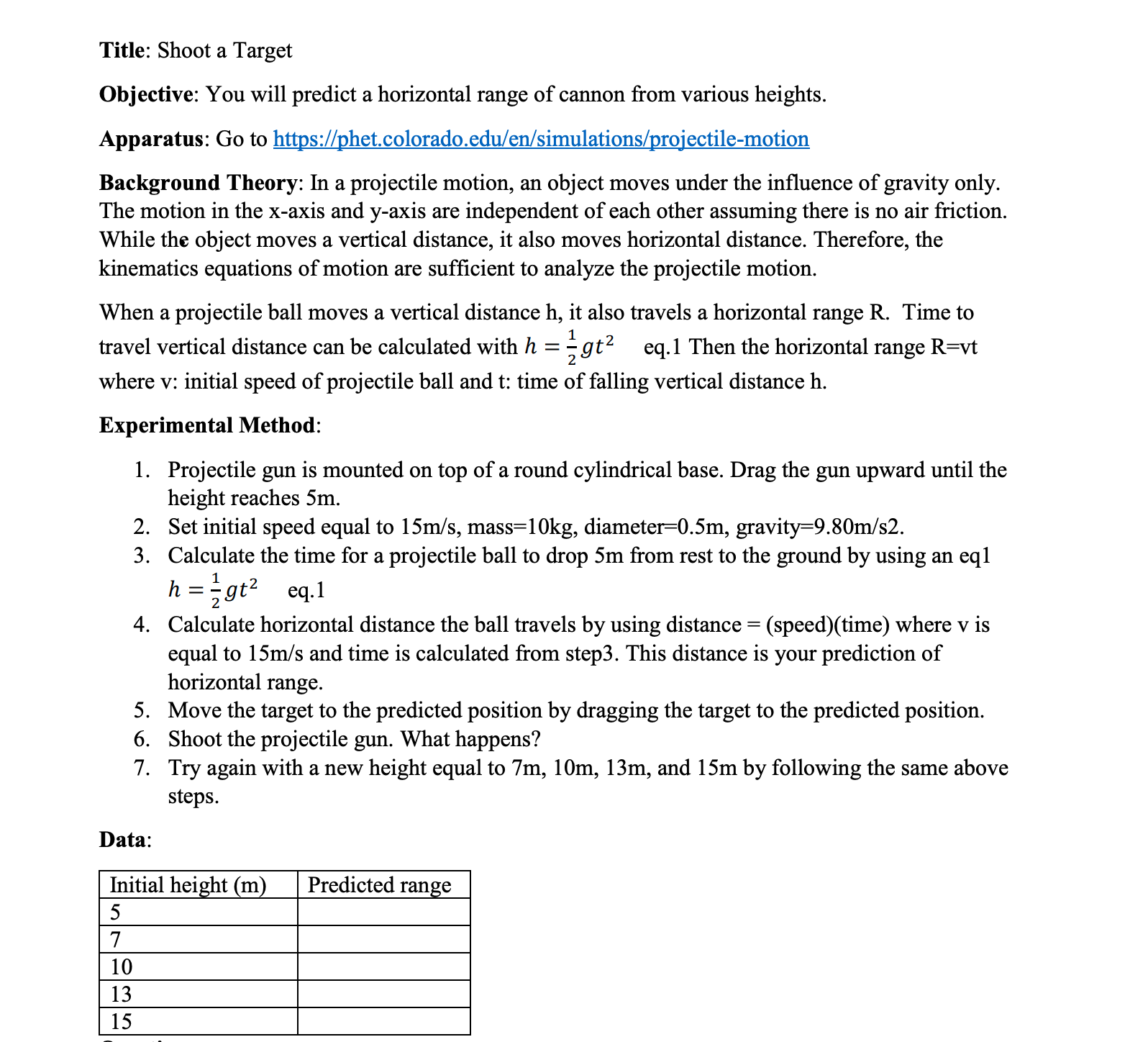
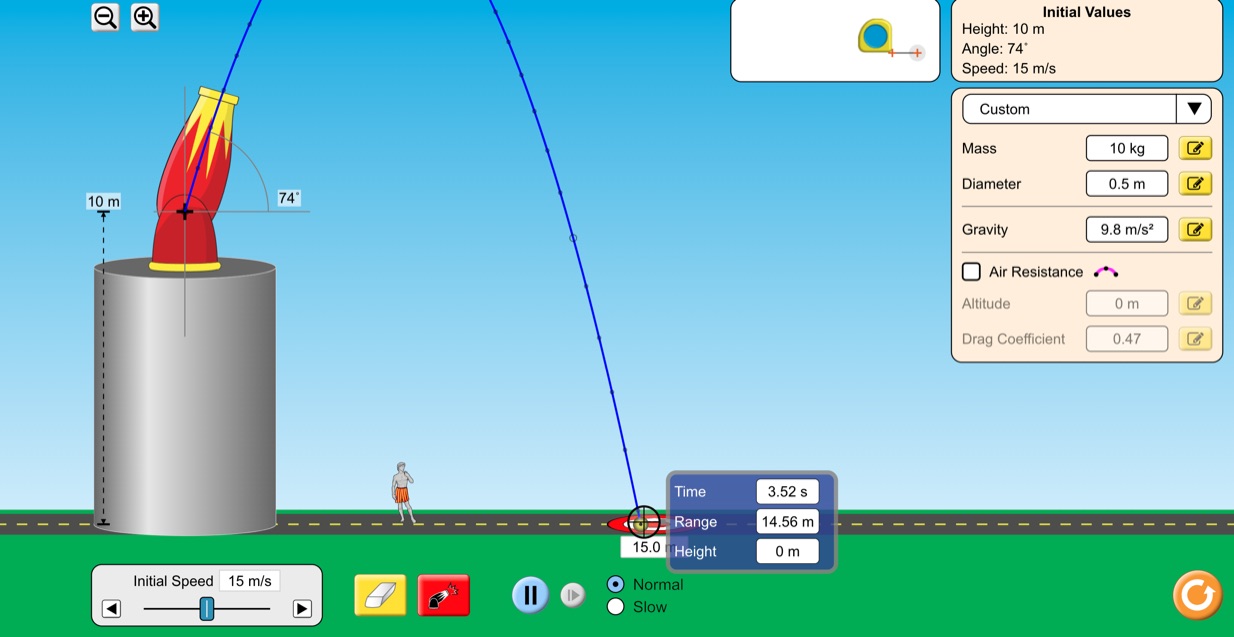
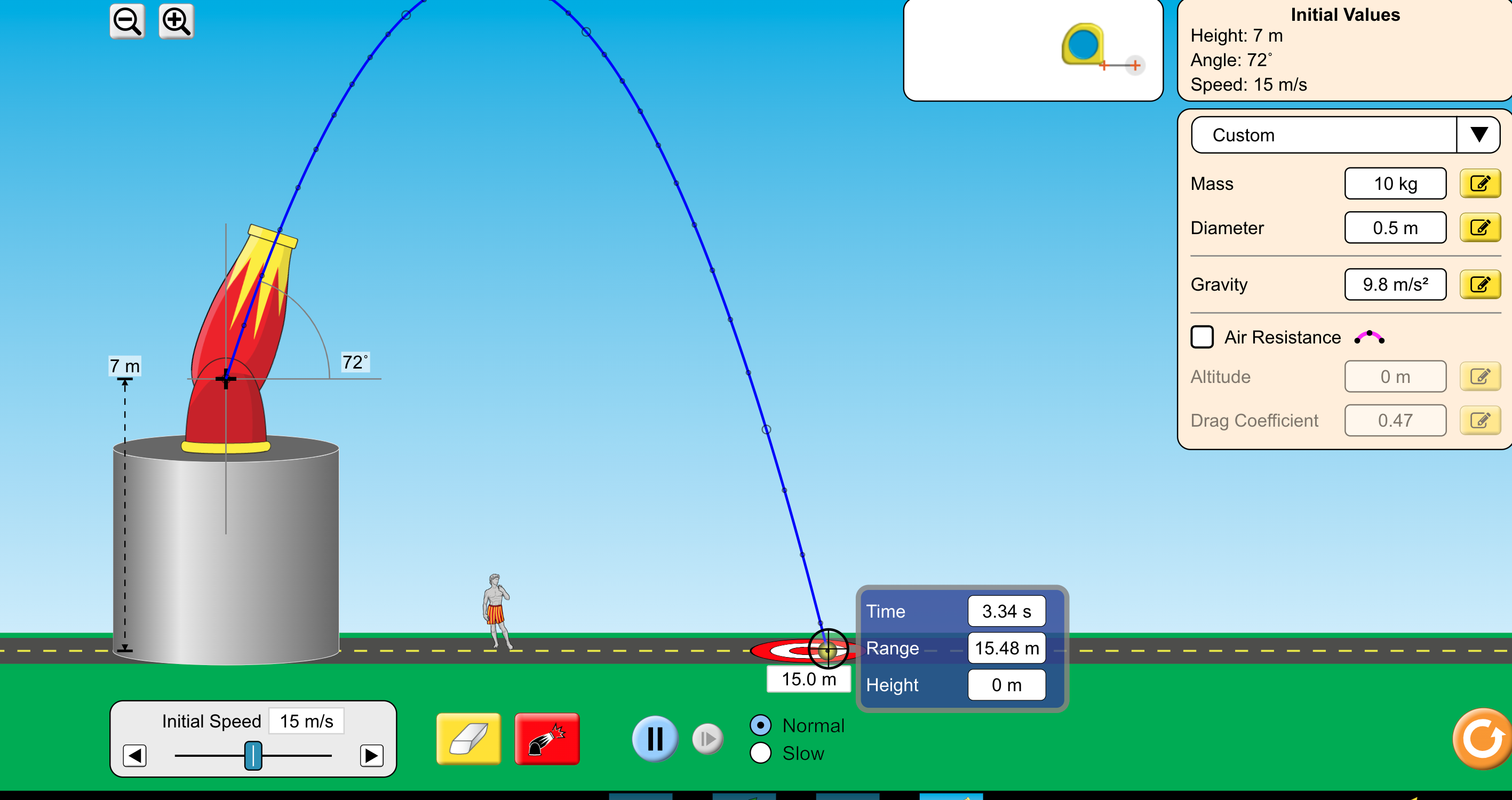
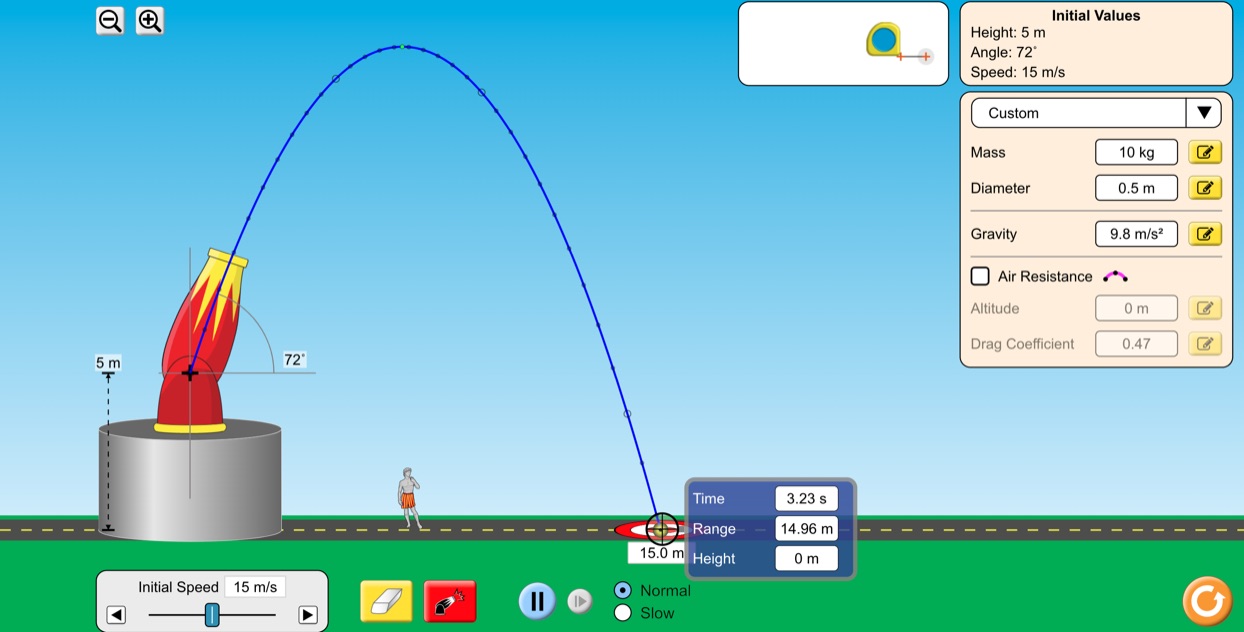
1. If gravity increases, what will happen to horizontal range of the projectile ball? 2. If gravity decreases, what will happen to horizontal range of the projectile ball? 3. If the mass of projectile ball increase, what happens to the horizontal range of the projectile ball? 4. If the mass of projectile ball decreases, what happens to the horizontal range of the projectile ball? Q Q 13 m 74 Time 3.67 s Range 15.16 m 15.0 m Height 0m Initial Speed 15 m/s Normal Slow Height: 13 m Initial Values Angle: 74 Speed: 15 m/s Custom Mass 10 kg Diameter 0.5 m Gravity 9.8 m/s Air Resistance Altitude 0m Drag Coefficient 0.47 Initial Values Q Q 15 m 75 Height: 15 m Angle: 75 Speed: 15 m/s Time 3.77 s Range 14.63 m 15.0 mHeight 0m Initial Speed 15 m/s Normal Slow Custom Mass 10 kg Diameter 0.5 m Gravity 9.8 m/s Air Resistance Altitude 0m Drag Coefficient 0.47 G Title: Shoot a Target Objective: You will predict a horizontal range of cannon from various heights. Apparatus: Go to https://phet.colorado.edu/en/simulations/projectile-motion Background Theory: In a projectile motion, an object moves under the influence of gravity only. The motion in the x-axis and y-axis are independent of each other assuming there is no air friction. While the object moves a vertical distance, it also moves horizontal distance. Therefore, the kinematics equations of motion are sufficient to analyze the projectile motion. When a projectile ball moves a vertical distance h, it also travels a horizontal range R. Time to travel vertical distance can be calculated with h = 1 gt eq.1 Then the horizontal range R=vt where v: initial speed of projectile ball and t: time of falling vertical distance h. Experimental Method: 1. Projectile gun is mounted on top of a round cylindrical base. Drag the gun upward until the height reaches 5m. 2. Set initial speed equal to 15m/s, mass=10kg, diameter=0.5m, gravity=9.80m/s2. 3. Calculate the time for a projectile ball to drop 5m from rest to the ground by using an eq1 h = gt eq.1 4. Calculate horizontal distance the ball travels by using distance = (speed) (time) where v is equal to 15m/s and time is calculated from step3. This distance is your prediction of horizontal range. 5. Move the target to the predicted position by dragging the target to the predicted position. 6. Shoot the projectile gun. What happens? 7. Try again with a new height equal to 7m, 10m, 13m, and 15m by following the same above steps. Data: Initial height (m) Predicted range 5 7 10 13 15 Qa 10 m 74 Time 3.52 s 14.56 m 0m Initial Speed 15 m/s Range 15.0 Height Normal Slow Initial Values Height: 10 m Angle: 74 Speed: 15 m/s Custom Mass 10 kg C Diameter 0.5 m C Gravity 9.8 m/s C Air Resistance Altitude 0m Drag Coefficient 0.47 Q Q 7 m 72 Initial Values Height: 7 m Angle: 72 Speed: 15 m/s Custom Mass 10 kg Diameter 0.5 m Gravity 9.8 m/s Air Resistance Altitude 0 m Drag Coefficient 0.47 Time 3.34 s Range 15.48 m 15.0 m Height 0m Initial Speed 15 m/s Normal Slow G 0 5 m 72 Time 3.23 s Range 14.96 m 15.0 m Height 0m Initial Speed 15 m/s Normal II Slow Initial Values Height: 5 m Angle: 72 Speed: 15 m/s Custom Mass 10 kg Diameter 0.5 m Gravity 9.8 m/s C Air Resistance Altitude 0m Drag Coefficient 0.47 G
Step by Step Solution
There are 3 Steps involved in it
It seems you have a set of questions about the projectile motion of a ball launched from a cannon and youre using a simulation tool to predict and tes... View full answer

Get step-by-step solutions from verified subject matter experts
 Study Help