



Question: 1. If you are asked to create a model and you think no model exists, say so, and explain why not. For this problem, we'll
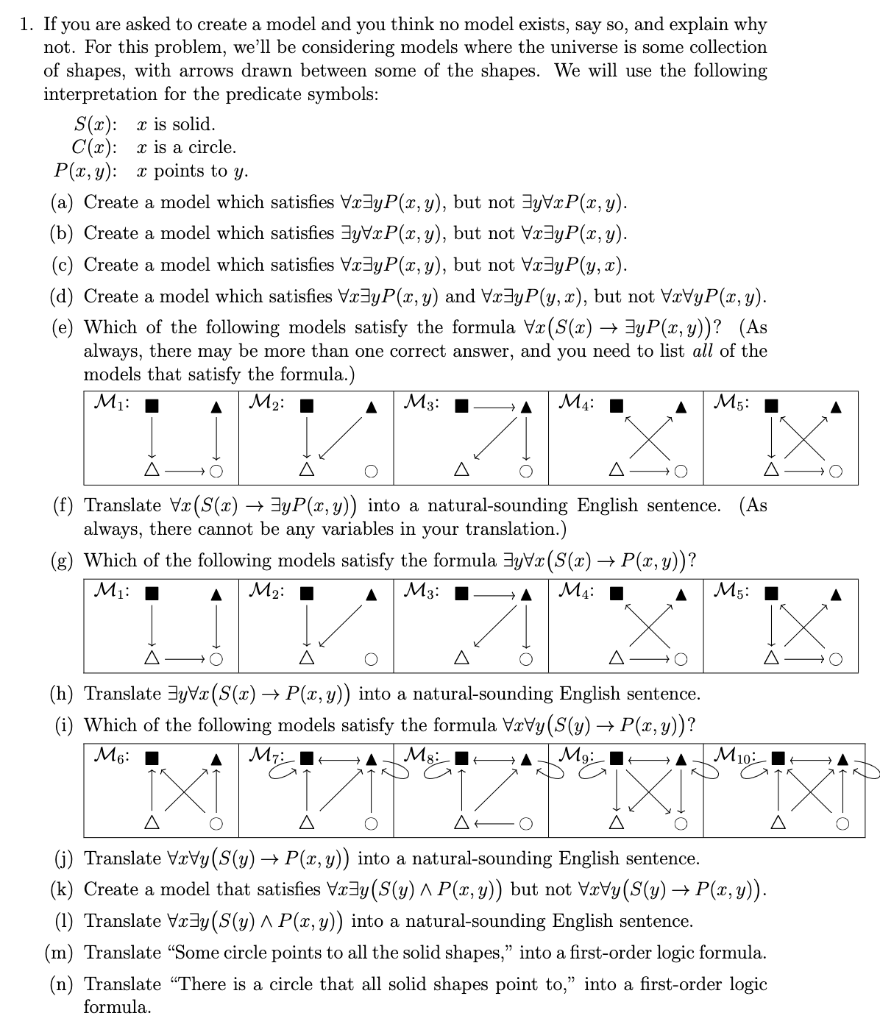
1. If you are asked to create a model and you think no model exists, say so, and explain why not. For this problem, we'll be considering models where the universe is some collection of shapes, with arrows drawn between some of the shapes. We will use the following interpretation for the predicate symbols: S(x):x is solid. C(x):x is a circle. P(x,y):x points to y. (a) Create a model which satisfies xyP(x,y), but not yxP(x,y). (b) Create a model which satisfies yxP(x,y), but not xyP(x,y). (c) Create a model which satisfies xyP(x,y), but not xyP(y,x). (d) Create a model which satisfies xyP(x,y) and xyP(y,x), but not xyP(x,y). (e) Which of the following models satisfy the formula x(S(x)yP(x,y)) ? (As always, there may be more than one correct answer, and you need to list all of the models that satisfy the formula.) (f) Translate x(S(x)yP(x,y)) into a natural-sounding English sentence. (As always, there cannot be any variables in your translation.) (g) Which of the following models satisfy the formula yx(S(x)P(x,y)) ? (h) Translate yx(S(x)P(x,y)) into a natural-sounding English sentence. (i) Which of the following models satisfy the formula xy(S(y)P(x,y)) ? (j) Translate xy(S(y)P(x,y)) into a natural-sounding English sentence. (k) Create a model that satisfies xy(S(y)P(x,y)) but not xy(S(y)P(x,y)). (1) Translate xy(S(y)P(x,y)) into a natural-sounding English sentence. (m) Translate "Some circle points to all the solid shapes," into a first-order logic formula. (n) Translate "There is a circle that all solid shapes point to," into a first-order logic formula
Step by Step Solution
There are 3 Steps involved in it

Get step-by-step solutions from verified subject matter experts