



Question: 1. Imagine a CSTR operating in which the following elementary exothermic reaction takes place. A+BC The reactor has a cooling jacket to control the reaction
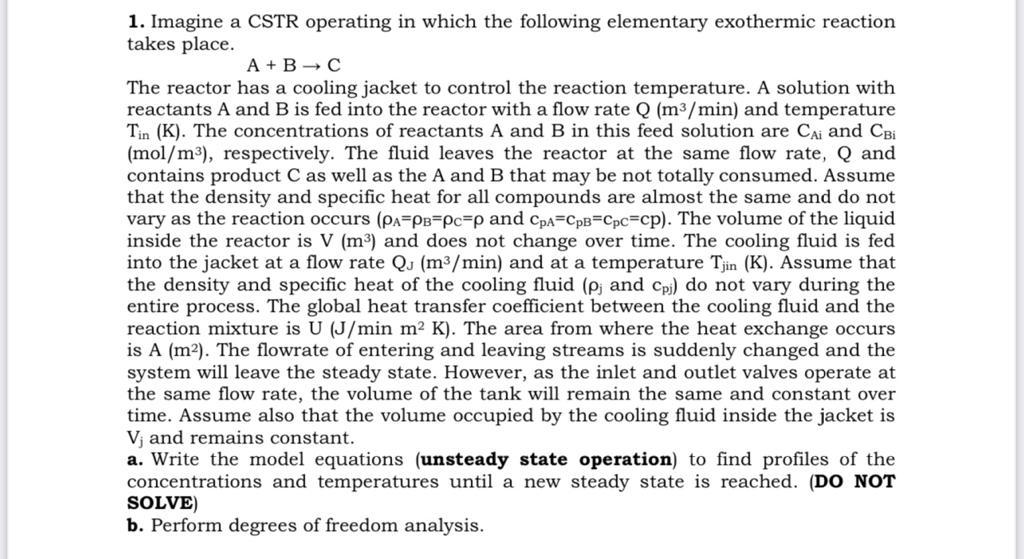
1. Imagine a CSTR operating in which the following elementary exothermic reaction takes place. A+BC The reactor has a cooling jacket to control the reaction temperature. A solution with reactants A and B is fed into the reactor with a flow rate Q(m3/min) and temperature Tin(K). The concentrations of reactants A and B in this feed solution are CAi and CBi (mol/m3), respectively. The fluid leaves the reactor at the same flow rate, Q and contains product C as well as the A and B that may be not totally consumed. Assume that the density and specific heat for all compounds are almost the same and do not vary as the reaction occurs (A=B=C= and cpA=cpB=cpC=cp). The volume of the liquid inside the reactor is V(m3) and does not change over time. The cooling fluid is fed into the jacket at a flow rate QJ(m3/min) and at a temperature Tjin(K). Assume that the density and specific heat of the cooling fluid (j and cpj ) do not vary during the entire process. The global heat transfer coefficient between the cooling fluid and the reaction mixture is U(J/minm2K). The area from where the heat exchange occurs is A(m2). The flowrate of entering and leaving streams is suddenly changed and the system will leave the steady state. However, as the inlet and outlet valves operate at the same flow rate, the volume of the tank will remain the same and constant over time. Assume also that the volume occupied by the cooling fluid inside the jacket is Vj and remains constant. a. Write the model equations (unsteady state operation) to find profiles of the concentrations and temperatures until a new steady state is reached. (DO NOT SOLVE) b. Perform degrees of freedom analysis
Step by Step Solution
There are 3 Steps involved in it

Get step-by-step solutions from verified subject matter experts