







Question: (1) In a second-price sealed-bid auction bidders simultaneously submit bids for an object, the highest bidder wins and pays a price that is equal to
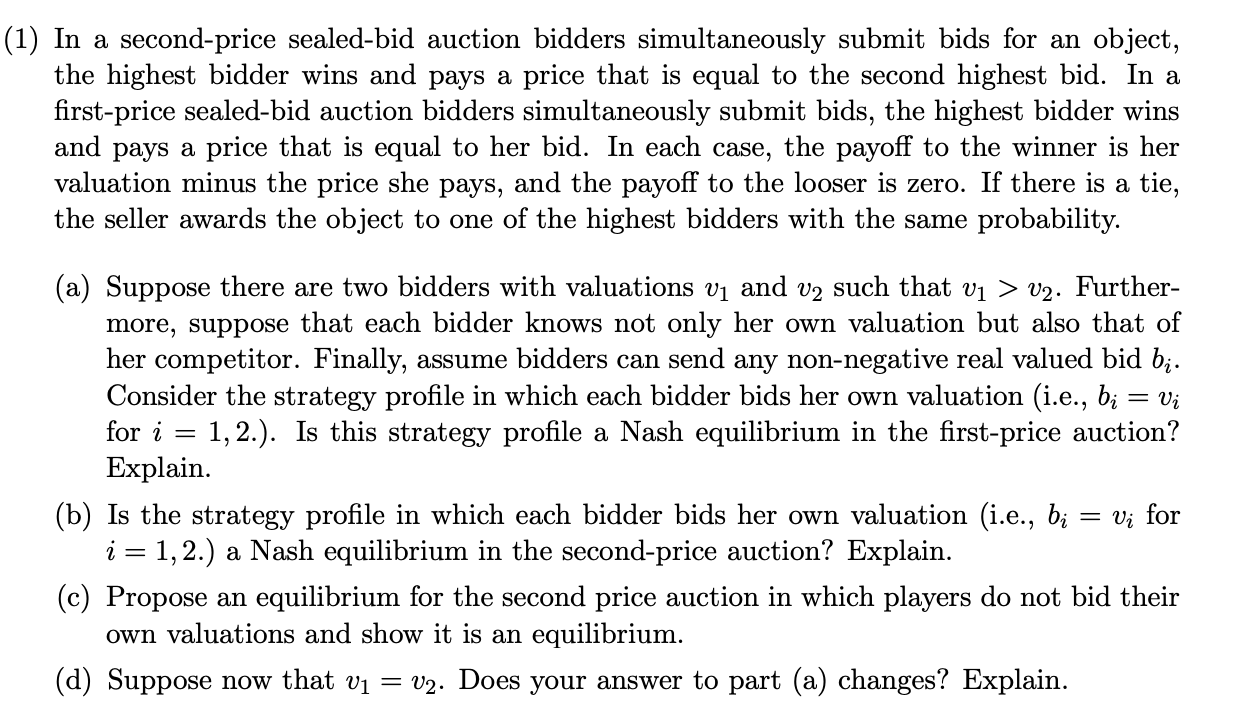
(1) In a second-price sealed-bid auction bidders simultaneously submit bids for an object, the highest bidder wins and pays a price that is equal to the second highest bid. In a rst-price sealed-bid auction bidders simultaneously submit bids, the highest bidder wins and pays a price that is equal to her bid. In each case, the payoff to the winner is her valuatiOn minus the price she pays, and the payoff to the looser is zero. If there is a tie, the seller awards the object to one of the highest bidders with the same probability. (a) Suppose there are two bidders with valuations v1 and '02 such that '01 > '02. Further- more, suppose that each bidder knows not only her own valuation but also that of her 60mpetitor. Finally, assume bidders can send any non-negative real valued bid bi. Consider the strategy prole in which each bidder bids her own valuation (Le, b, = v,- for 2' = 1, 2.). Is this strategy prole a Nash equilibrium in the rst-price auction? Explain. (b) Is the strategy prole in which each bidder bids her own valuation (i.e., b,- = m for z' = 1, 2.) a Nash equilibrium in the second-price auction? Explain. (c) Propose an equilibrium for the second price auction in which players do not bid their own valuations and show it is an equilibrium. (d) Suppose now that c1 = 112. Does your answer to part (a) changes? Explain
Step by Step Solution
There are 3 Steps involved in it

Get step-by-step solutions from verified subject matter experts
 Study Help