







Question: 1. In a simple but delicious world, Joey eats only sandwiches, s, and jam, j. He has a Cobb-Douglas utility function U(j,s) = Nj]-as, where
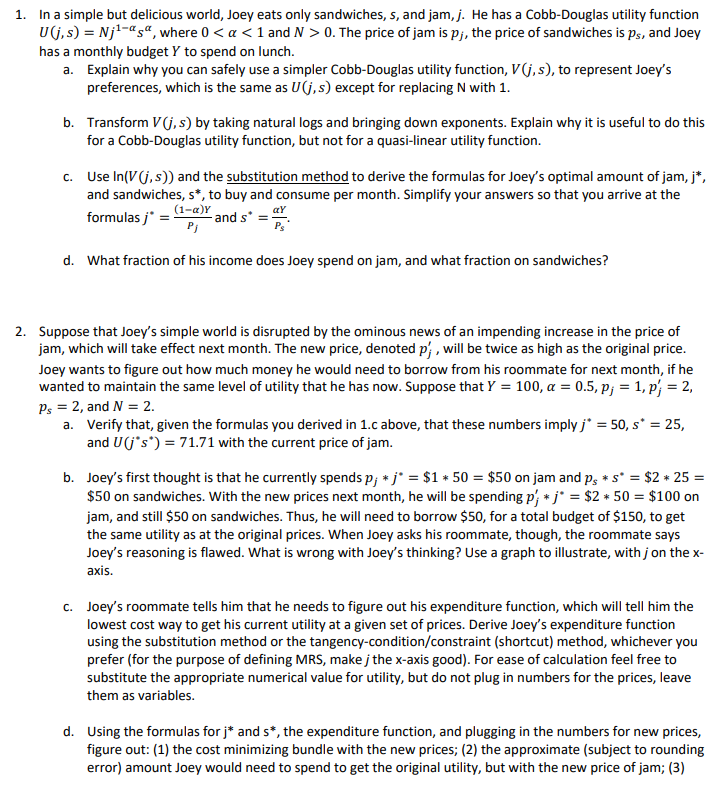
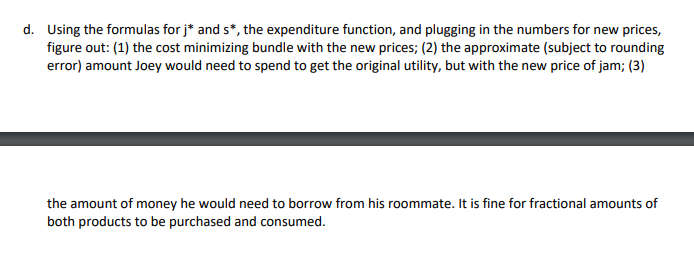
1. In a simple but delicious world, Joey eats only sandwiches, s, and jam, j. He has a Cobb-Douglas utility function U(j,s) = Nj]-as", where 0 0. The price of jam is py, the price of sandwiches is ps, and Joey has a monthly budget Y to spend on lunch. a. Explain why you can safely use a simpler Cobb-Douglas utility function, V(j, s), to represent Joey's preferences, which is the same as U(j, s) except for replacing N with 1. b. Transform V(j, s) by taking natural logs and bringing down exponents. Explain why it is useful to do this for a Cobb-Douglas utility function, but not for a quasi-linear utility function. c. Use In(V(j, s)) and the substitution method to derive the formulas for Joey's optimal amount of jam, j*, and sandwiches, s*, to buy and consume per month. Simplify your answers so that you arrive at the formulas j* =- (1-@)Y P J and s* = Ps' d. What fraction of his income does Joey spend on jam, and what fraction on sandwiches? 2. Suppose that Joey's simple world is disrupted by the ominous news of an impending increase in the price of jam, which will take effect next month. The new price, denoted p; , will be twice as high as the original price. Joey wants to figure out how much money he would need to borrow from his roommate for next month, if he wanted to maintain the same level of utility that he has now. Suppose that Y = 100, a = 0.5, p; = 1, p; = 2, Ps = 2, and N = 2. a. Verify that, given the formulas you derived in 1.c above, that these numbers imply /* = 50, s* = 25, and U(j's*) = 71.71 with the current price of jam. b. Joey's first thought is that he currently spends p; * j* = $1 * 50 = $50 on jam and p, * s* = $2 * 25 = $50 on sandwiches. With the new prices next month, he will be spending p; * j* = $2 *50 = $100 on jam, and still $50 on sandwiches. Thus, he will need to borrow $50, for a total budget of $150, to get the same utility as at the original prices. When Joey asks his roommate, though, the roommate says Joey's reasoning is flawed. What is wrong with Joey's thinking? Use a graph to illustrate, with / on the x- axis. c. Joey's roommate tells him that he needs to figure out his expenditure function, which will tell him the lowest cost way to get his current utility at a given set of prices. Derive Joey's expenditure function using the substitution method or the tangency-condition/constraint (shortcut) method, whichever you prefer (for the purpose of defining MRS, make j the x-axis good). For ease of calculation feel free to substitute the appropriate numerical value for utility, but do not plug in numbers for the prices, leave them as variables. d. Using the formulas for j* and s*, the expenditure function, and plugging in the numbers for new prices, figure out: (1) the cost minimizing bundle with the new prices; (2) the approximate (subject to rounding error) amount Joey would need to spend to get the original utility, but with the new price of jam; (3)d. Using the formulas for j* and s*, the expenditure function, and plugging in the numbers for new prices, figure out: (1) the cost minimizing bundle with the new prices; (2) the approximate (subject to rounding error) amount Joey would need to spend to get the original utility, but with the new price of jam; (3) the amount of money he would need to borrow from his roommate. It is fine for fractional amounts of both products to be purchased and consumed
Step by Step Solution
There are 3 Steps involved in it

Get step-by-step solutions from verified subject matter experts
 Study Help