







Question: 1. In an 8-bit binary number, which is the most significant bit (MSB)? 2. In the following code, the value in AL is intended to
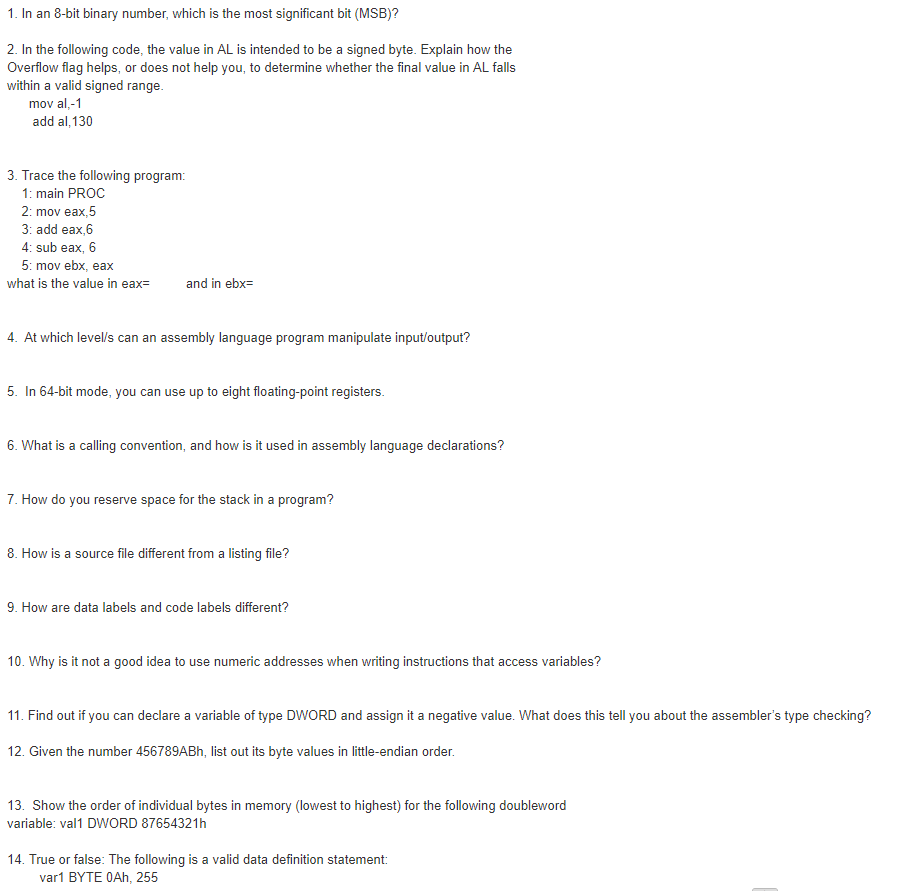

1. In an 8-bit binary number, which is the most significant bit (MSB)? 2. In the following code, the value in AL is intended to be a signed byte. Explain how the Overflow flag helps, or does not help you, to determine whether the final value in AL falls within a valid signed range mov al,-1 add al, 130 3. Trace the following program: 1: main PROC 2: mov eax,5 3: add eax,6 4: sub eax, 6 5: mov ebx, eax what is the value in eax and in ebx- 4. At which level/s can an assembly language program manipulate input/output? 5. In 64-bit mode, you can use up to eight floating-point registers 6. What is a calling convention, and how is it used in assembly language declarations? 7. How do you reserve space for the stack in a program? 8. How is a source file different from a listing file? 9. How are data labels and code labels different? 10. Why is it not a good idea to use numeric addresses when writing instructions that access variables? 11. Find out if you can declare a variable of type DWORD and assign it a negative value. What does this tell you about the assembler's type checking? 12. Given the number 456789ABh, list out its byte values in little-endian order 13. Show the order of individual bytes in memory (lowest to highest) for the following doubleword variable: val1 DWORD 87654321h 14. True or false: The following is a valid data definition statement: var1 BYTE 0Ah, 255
Step by Step Solution
There are 3 Steps involved in it

Get step-by-step solutions from verified subject matter experts
 Study Help