



Question: 1. In an implantable device (see schematic below) envisioned for use in the treatment of diabetes, therapeutic cells (e.g., insulin producing cells found in the
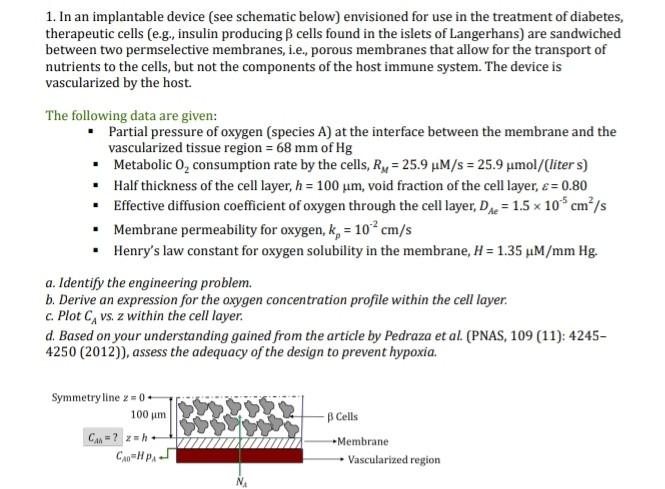
1. In an implantable device (see schematic below) envisioned for use in the treatment of diabetes, therapeutic cells (e.g., insulin producing cells found in the islets of Langerhans) are sandwiched between two permselective membranes, i.e., porous membranes that allow for the transport of nutrients to the cells, but not the components of the host immune system. The device is vascularized by the host. The following data are given: - Partial pressure of oxygen (species A) at the interface between the membrane and the vascularized tissue region =68mm of Hg - Metabolic 02 consumption rate by the cells, RM=25.9M/s=25.9mol/ (liter s) - Half thickness of the cell layer, h=100m, void fraction of the cell layer, =0.80 - Effective diffusion coefficient of oxygen through the cell layer, DAe=1.5105cm2/s - Membrane permeability for oxygen, kp=102cm/s - Henry's law constant for oxygen solubility in the membrane, H=1.35M/mmHg. a. Identify the engineering problem. b. Derive an expression for the oxygen concentration profile within the cell layer. c. Plot CA vs. z within the cell layer. d. Based on your understanding gained from the article by Pedraza et al. (PNAS, 109 (11): 42454250 (2012)), assess the adequacy of the design to prevent hypoxia
Step by Step Solution
There are 3 Steps involved in it

Get step-by-step solutions from verified subject matter experts