







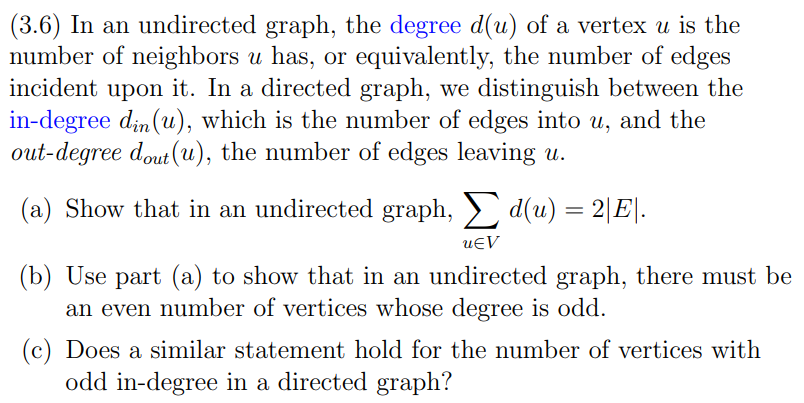
Question: 1 . In an undirected graph, the degree d ( u ) of a vertex u is the number of neighbors u has, or equivalently,
In an undirected graph, the degree of a vertex is the
number of neighbors has, or equivalently, the number of edges
incident upon it In a directed graph, we distinguish between the
indegree which is the number of edges into and the
outdegree the number of edges leaving
a Show that in an undirected graph,
b Use part a to show that in an undirected graph, there must be
an even number of vertices whose degree is odd.
c Does a similar statement hold for the number of vertices with
odd indegree in a directed graph?
Give a lineartime algorithm to determine whether an
undirected graph is bipartite.
An Eulerian tour in an undirected graph is a cycle that is
allowed to pass through each vertex multiple times, but must use each
edge exactly once. This simple concept was used by Euler in to
solve the famous Konigsberg bridge problem, which launched the field
of graph theory.
a Show that an undirected graph has an Eulerian tour if and only
if all its vertices have even degree.
b An Eulerian path is a path which uses each edge exactly once.
Can you give a similar ifandonlyif characterization of which
undirected graphs have Eulerian paths?
c Can you give an analog of part a for directed graphs?
Step by Step Solution
There are 3 Steps involved in it
1 Expert Approved Answer
Step: 1 Unlock

Question Has Been Solved by an Expert!
Get step-by-step solutions from verified subject matter experts
Step: 2 Unlock
Step: 3 Unlock
 Study Help