





Question: 1. In Chapter 4 , Meyer argues that although most people say they would prefer an egalitarian work approach, different cultures fall on a broad
1. In Chapter 4 , Meyer argues that although most
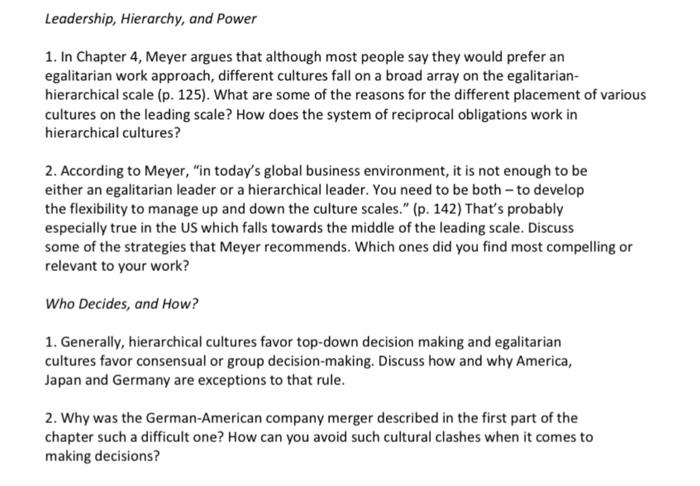
1. In Chapter 4 , Meyer argues that although most people say they would prefer an egalitarian work approach, different cultures fall on a broad array on the egalitarianhierarchical scale (p. 125). What are some of the reasons for the different placement of various cultures on the leading scale? How does the system of reciprocal obligations work in hierarchical cultures? 2. According to Meyer, "in today's global business environment, it is not enough to be either an egalitarian leader or a hierarchical leader. You need to be both - to develop the flexibility to manage up and down the culture scales." (p. 142) That's probably especially true in the US which falls towards the middle of the leading scale. Discuss some of the strategies that Meyer recommends. Which ones did you find most compelling or relevant to your work? Who Decides, and How? 1. Generally, hierarchical cultures favor top-down decision making and egalitarian cultures favor consensual or group decision-making. Discuss how and why America, Japan and Germany are exceptions to that rule. 2. Why was the German-American company merger described in the first part of the chapter such a difficult one? How can you avoid such cultural clashes when it comes to making decisions

Step by Step Solution

There are 3 Steps involved in it

1 Expert Approved Answer
Step: 1 Unlock blur-text-image

Question Has Been Solved by an Expert!

Get step-by-step solutions from verified subject matter experts

Step: 2 Unlock
Step: 3 Unlock

Students Have Also Explored These Related General Management Questions!