



Question: 1. In Fig. 1, all four particles are fixed in the xy plane, and q1 = -3.20 x 10⁻¹⁹ C, q2 = +3.20 x 10⁻¹⁹
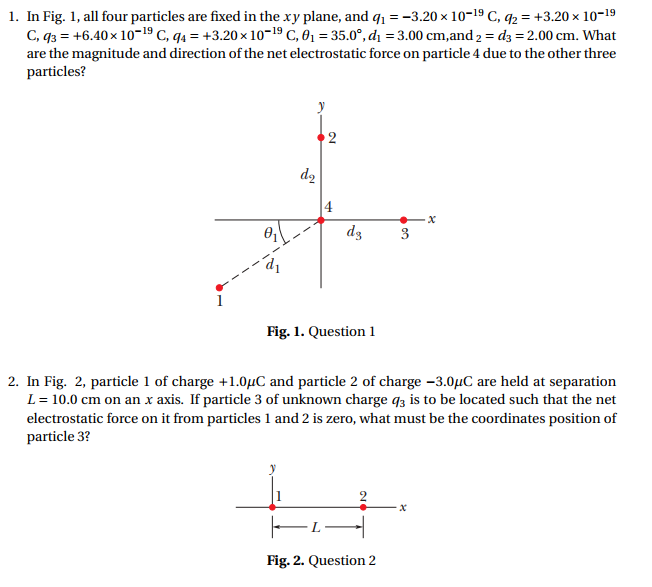
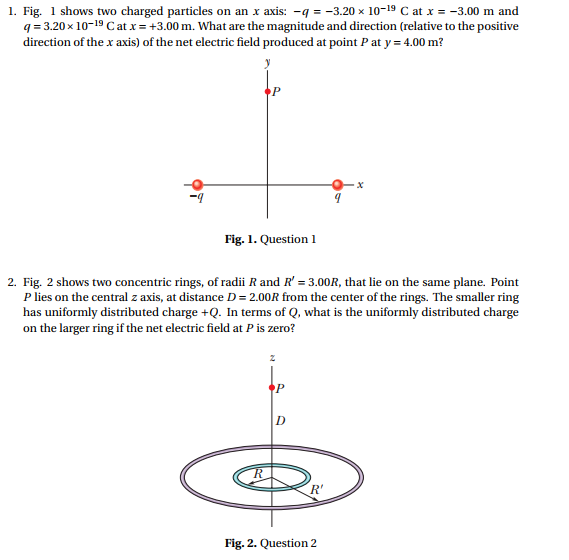
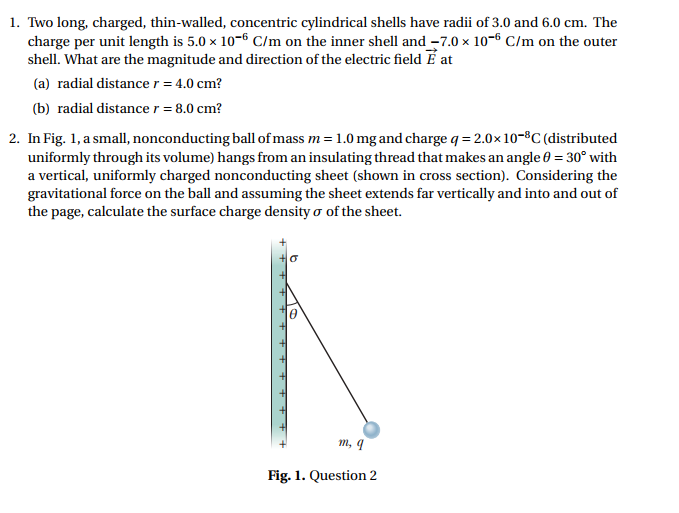
1. In Fig. 1, all four particles are fixed in the xy plane, and q1 = -3.20 x 10⁻¹⁹ C, q2 = +3.20 x 10⁻¹⁹ C, 43 = +6.40x 10 " C, q4 = +3.20 x 10-" C, 61 =35.0', dj =3.00 cm,and 2 = d3 =2.00 cm. What are the magnitude and direction of the net electrostatic force on particle 4 due to the other three particles? 9 X ds Fig. 1. Question 1 2. In Fig. 2, particle 1 of charge +1.OC and particle 2 of charge -3.0C are held at separation L = 10.0 cm on an x axis. If particle 3 of unknown charge q; is to be located such that the net electrostatic force on it from particles 1 and 2 is zero, what must be the coordinates position of particle 3? Fig. 2. Question 21. Fig. 1 shows two charged particles on an x axis: -q = -3.20 x 10⁻¹⁹ Cat x = -3.00 m and q =3.20 * 10-19 Cat x = +3.00 m. What are the magnitude and direction (relative to the positive direction of the x axis) of the net electric field produced at point P at y = 4.00 m? P O -X Fig. 1. Question 1 2. Fig. 2 shows two concentric rings, of radii R and R' = 3.00R, that lie on the same plane. Point P lies on the central z axis, at distance D = 2.00R from the center of the rings. The smaller ring has uniformly distributed charge +Q. In terms of Q, what is the uniformly distributed charge on the larger ring if the net electric field at P is zero? D R Fig. 2. Question 21. Two long, charged, thin-walled, concentric cylindrical shells have radii of 3.0 and 6.0 cm. The charge per unit length is 5.0 x 10" C/m on the inner shell and -7.0 x 10" C/m on the outer shell. What are the magnitude and direction of the electric field E at (a) radial distance r = 4.0 cm? (b) radial distance r = 8.0 cm? 2. In Fig. 1, a small, nonconducting ball of mass m = 1.0 mg and charge q = 2.0x 10-C (distributed uniformly through its volume) hangs from an insulating thread that makes an angle 0 = 30* with a vertical, uniformly charged nonconducting sheet (shown in cross section). Considering the gravitational force on the ball and assuming the sheet extends far vertically and into and out of the page, calculate the surface charge density o of the sheet. Fig. 1. Question 2
Step by Step Solution
There are 3 Steps involved in it

Get step-by-step solutions from verified subject matter experts