



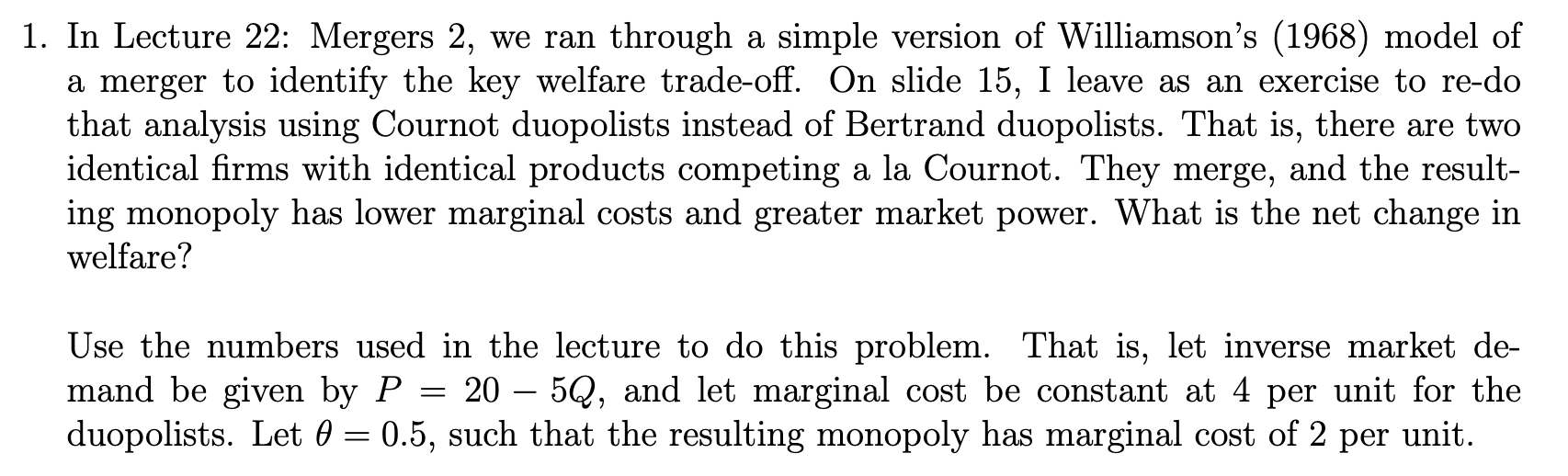
Question: 1. In Lecture 22: Mergers 2, we ran through a simple version of Williamson's (1968) model of a merger to identify the key welfare trade-off.
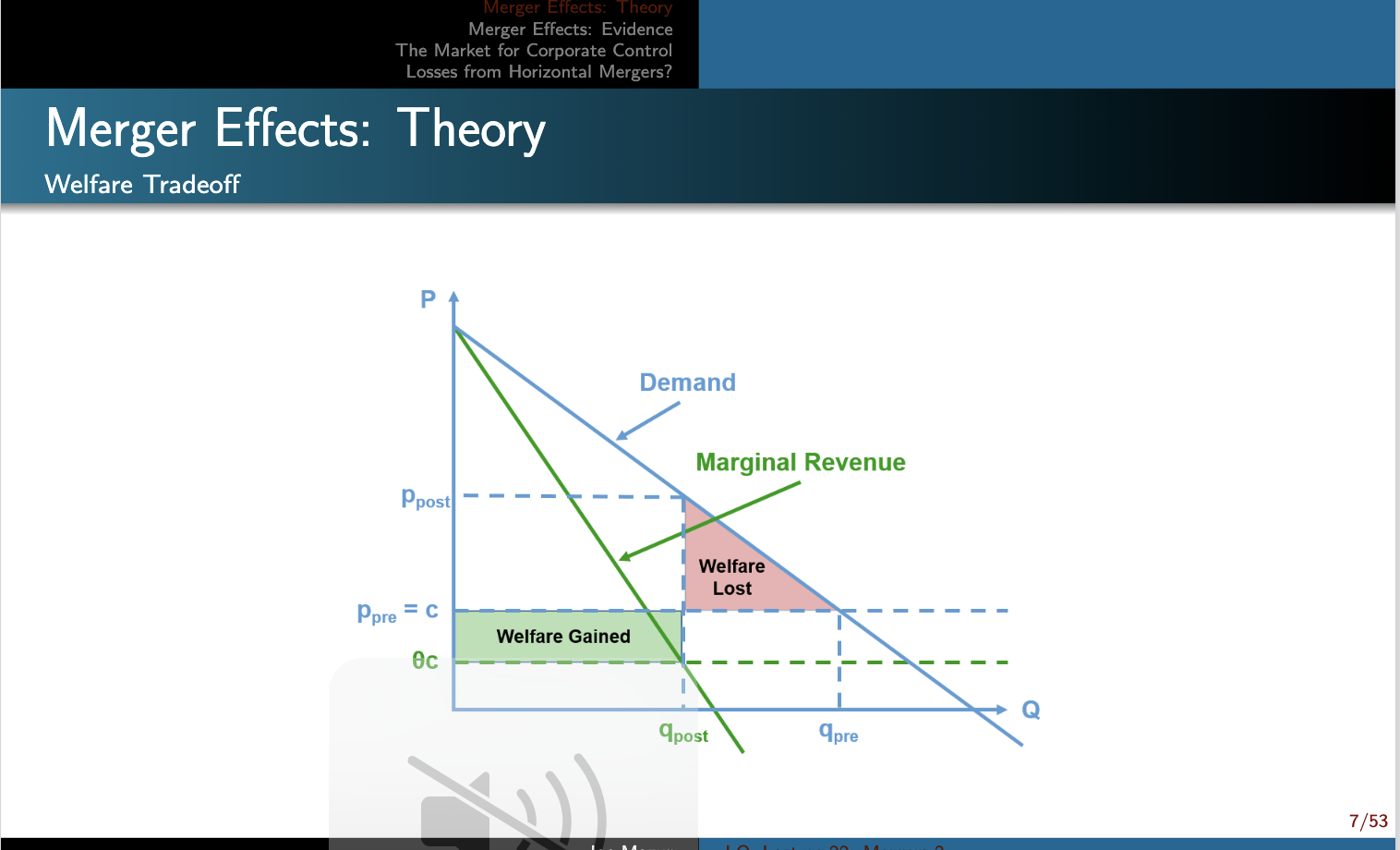
![[0, 1]. o The diagram on the following slide illustrates these changes.](https://s3.amazonaws.com/si.experts.images/answers/2024/06/6669b9b418e03_8516669b9b3ee6d7.jpg)
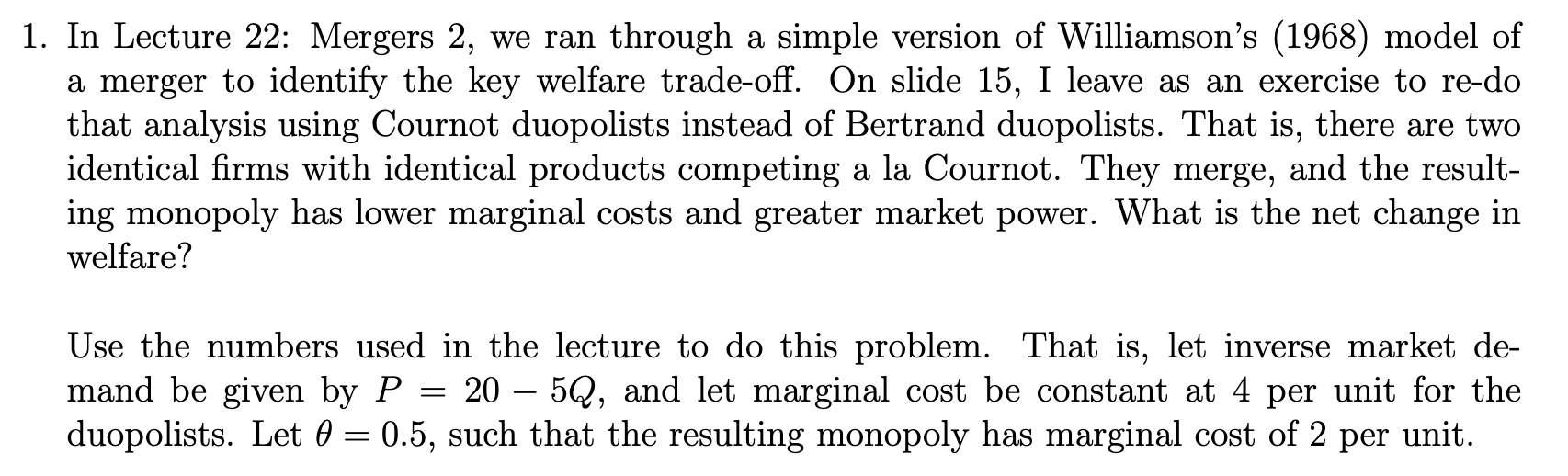
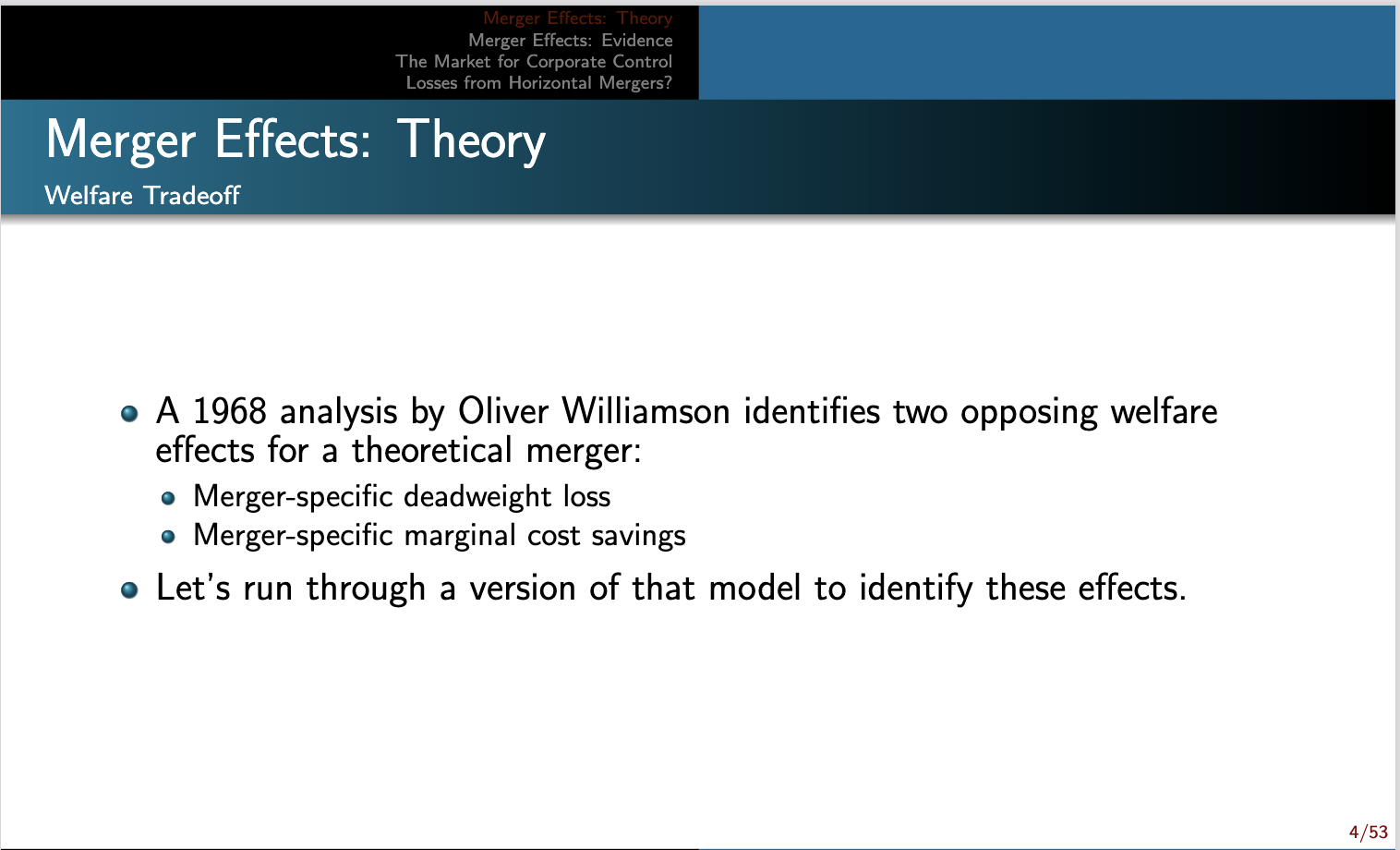
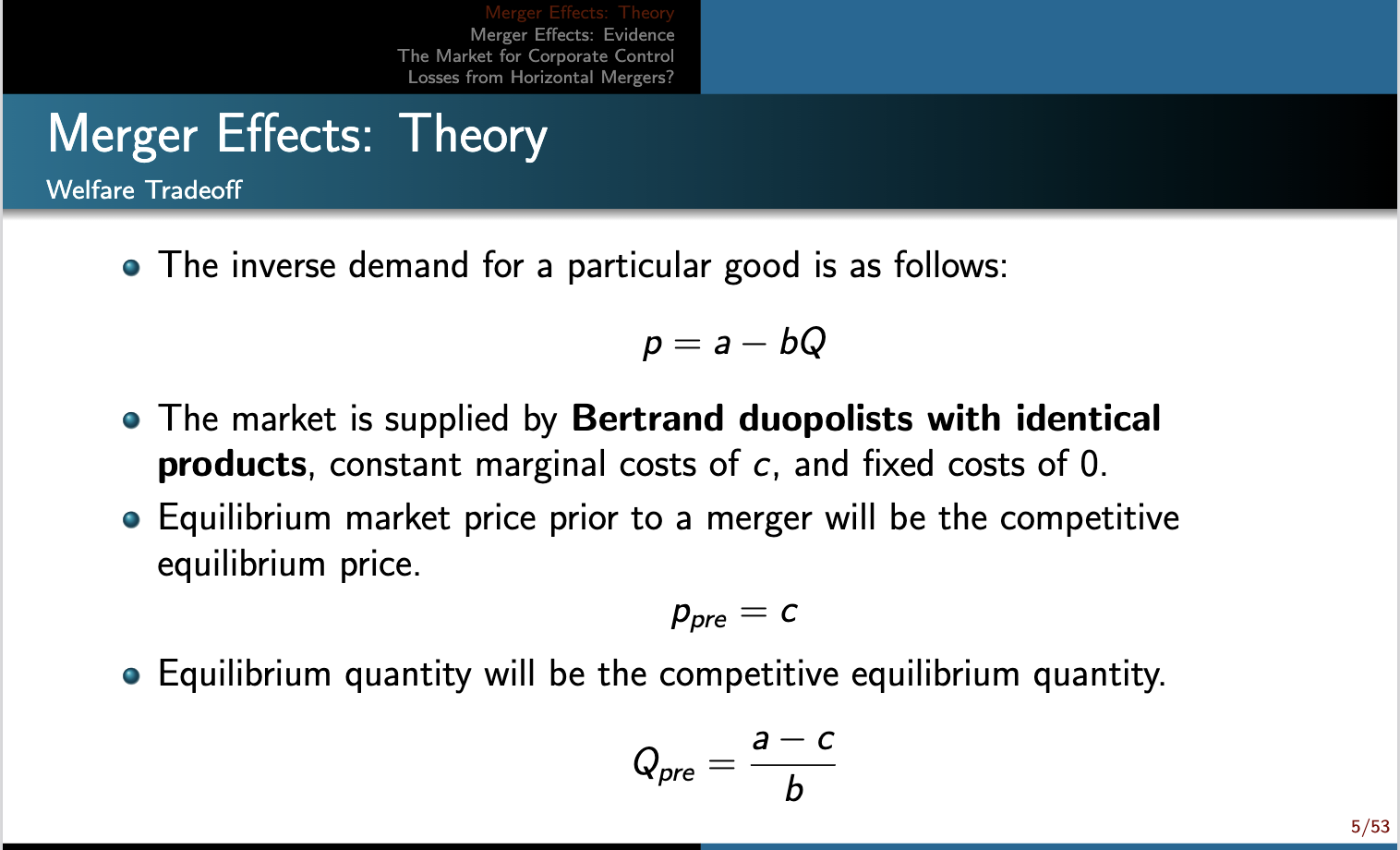
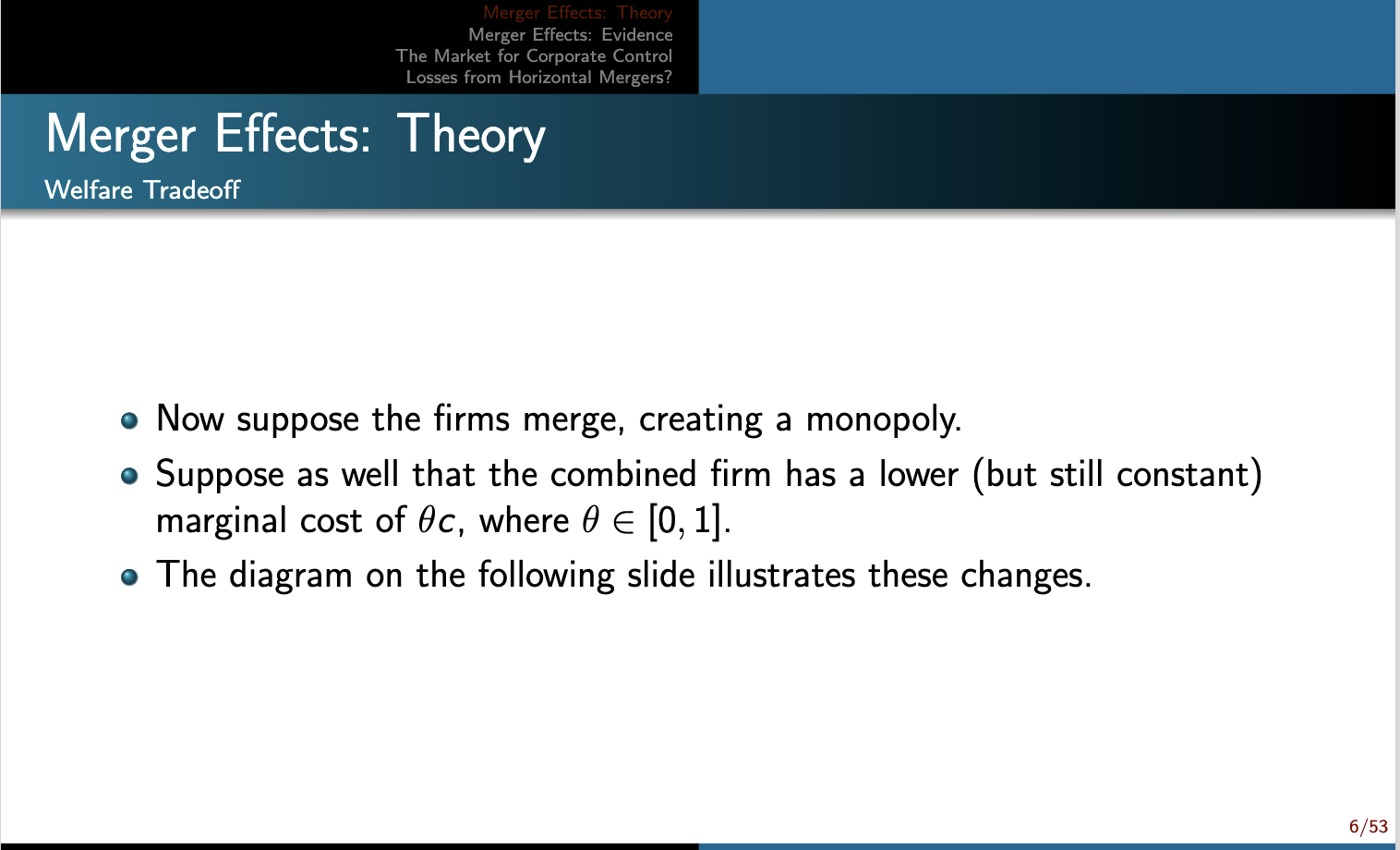
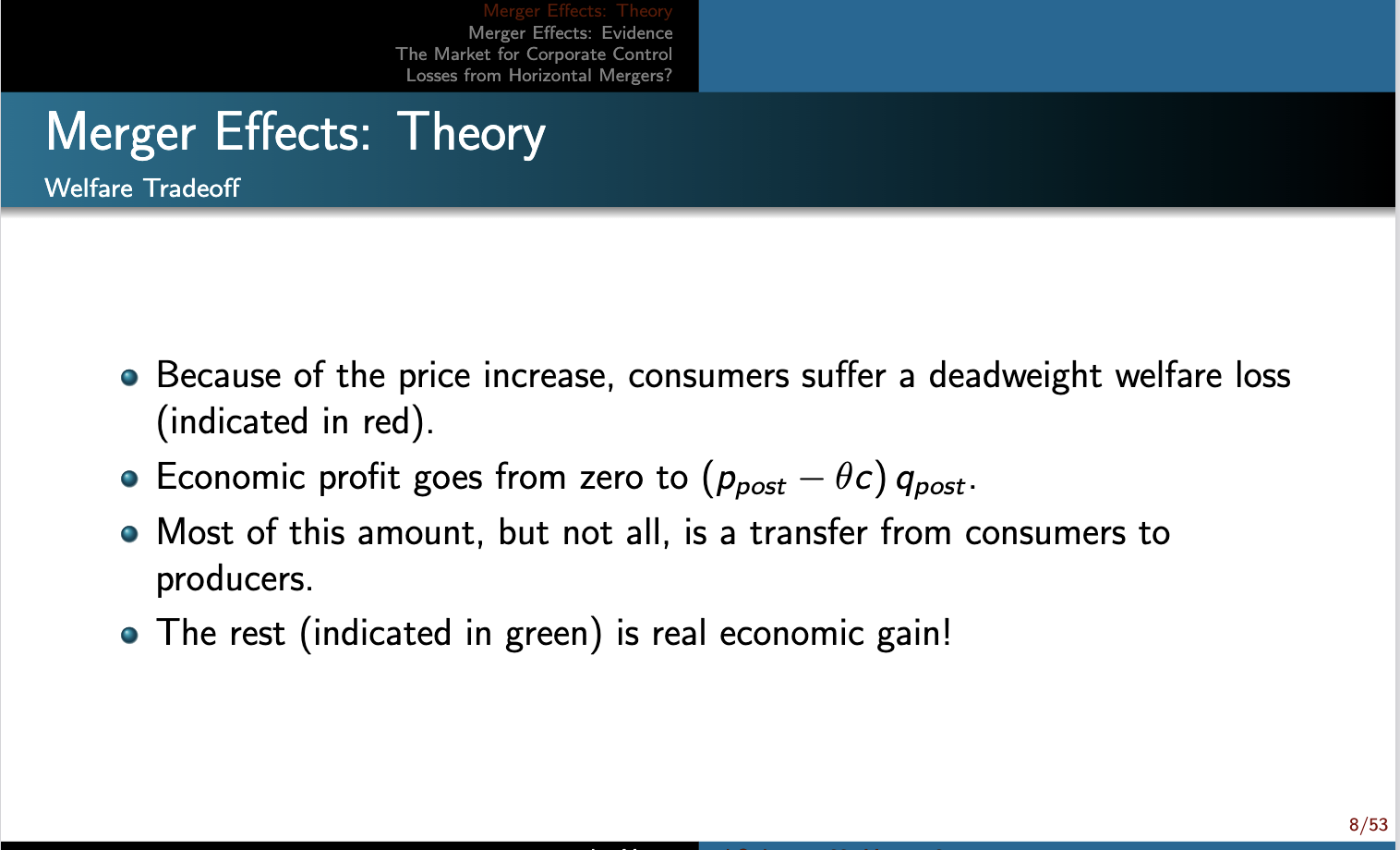
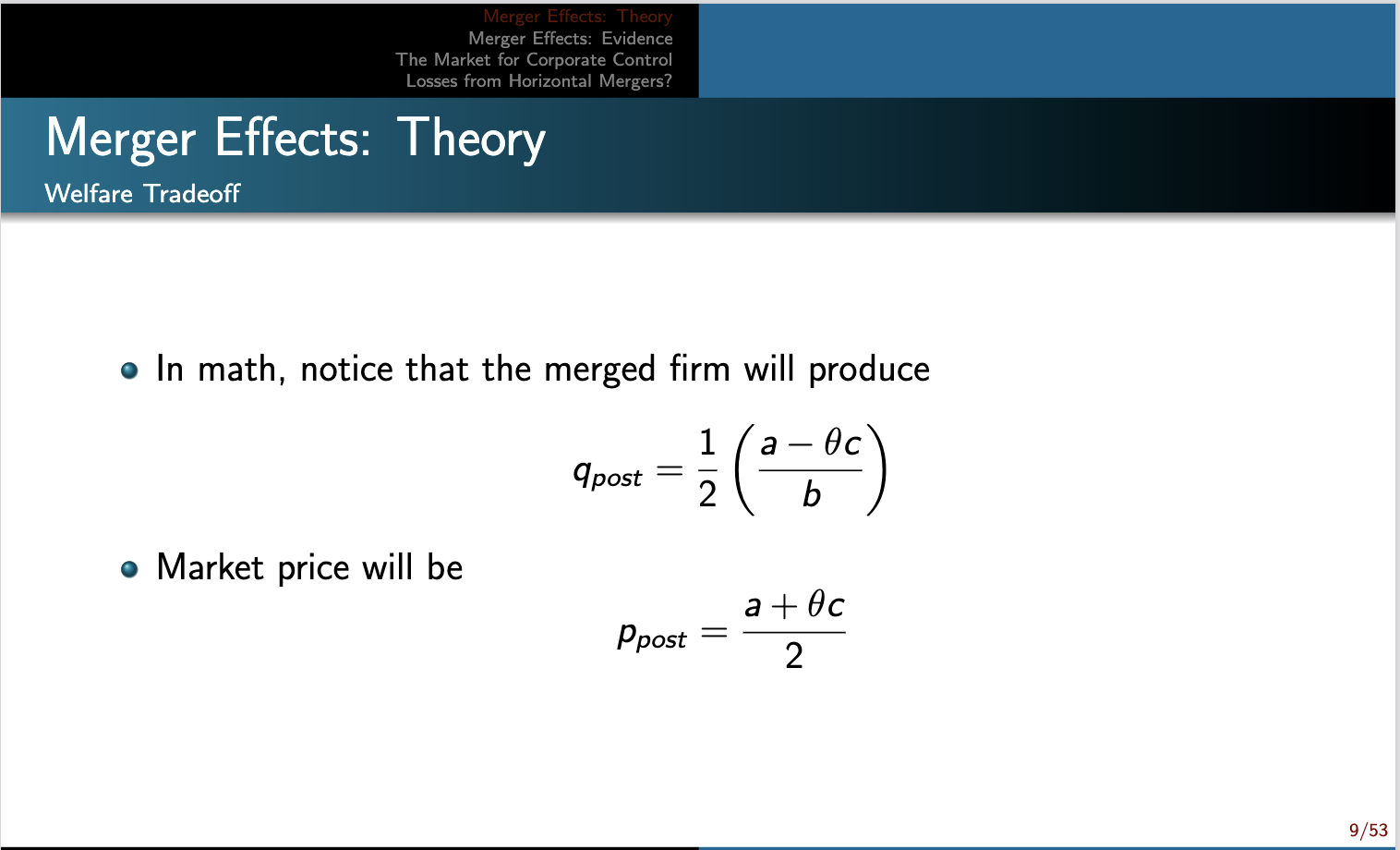
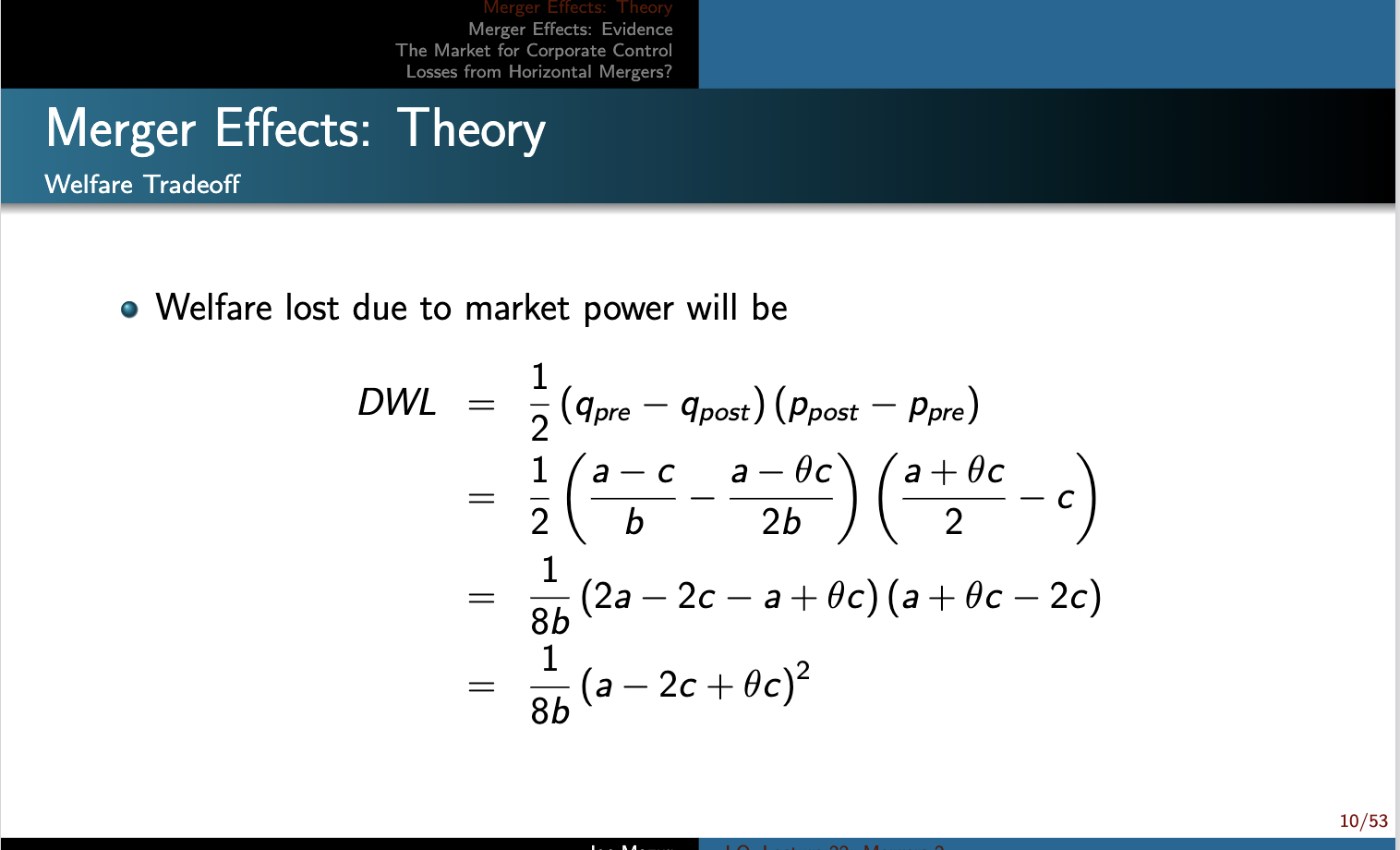
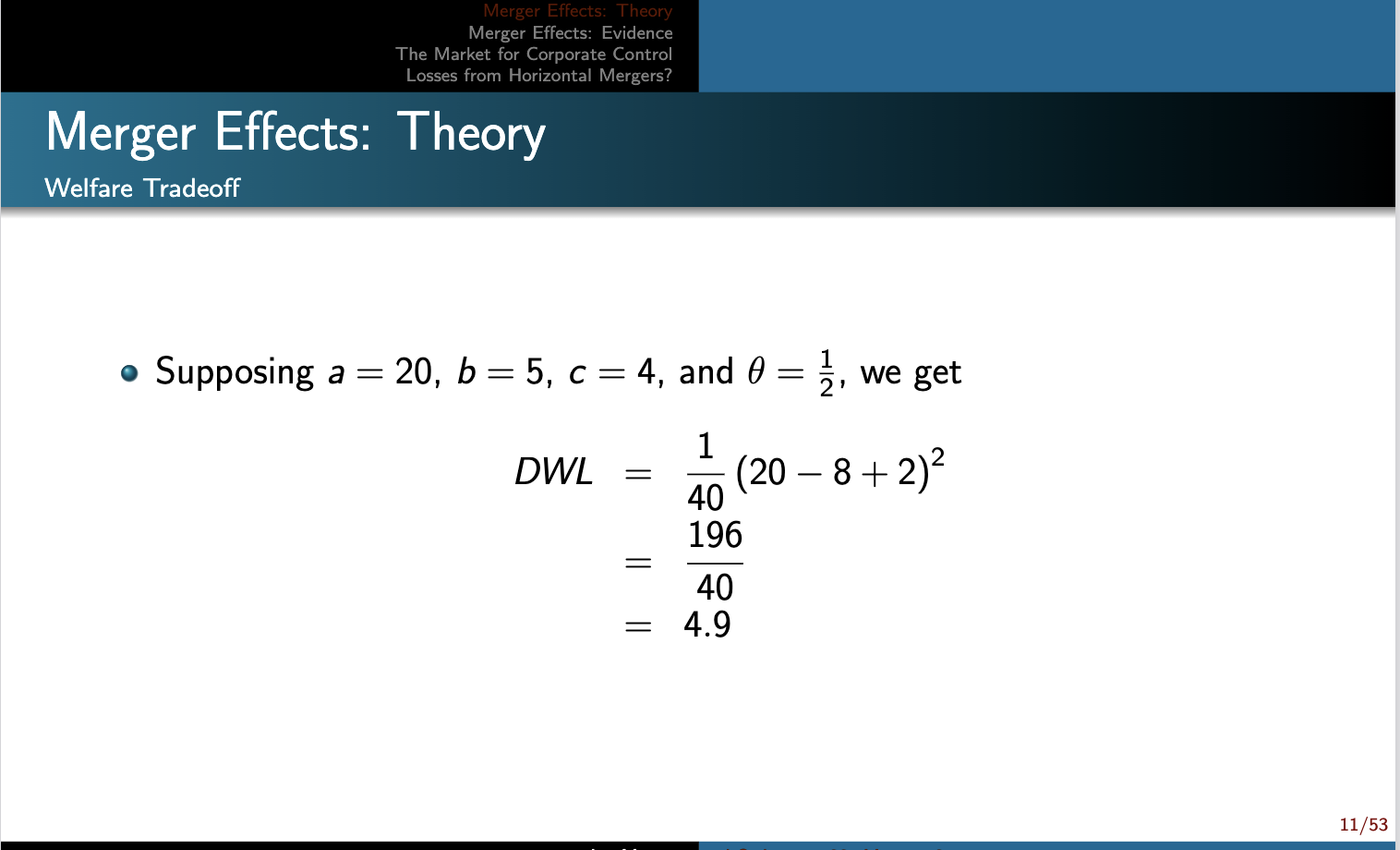
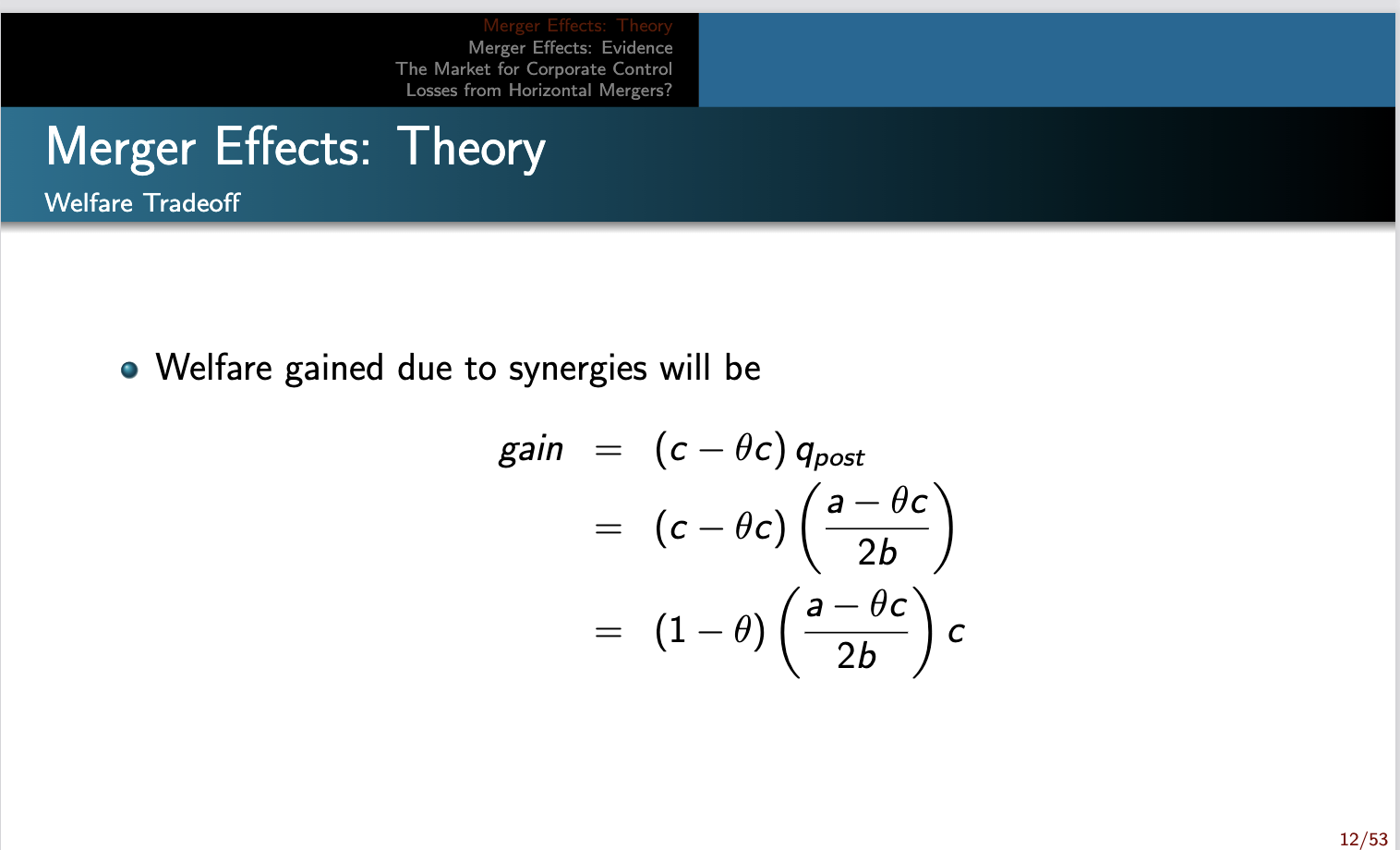
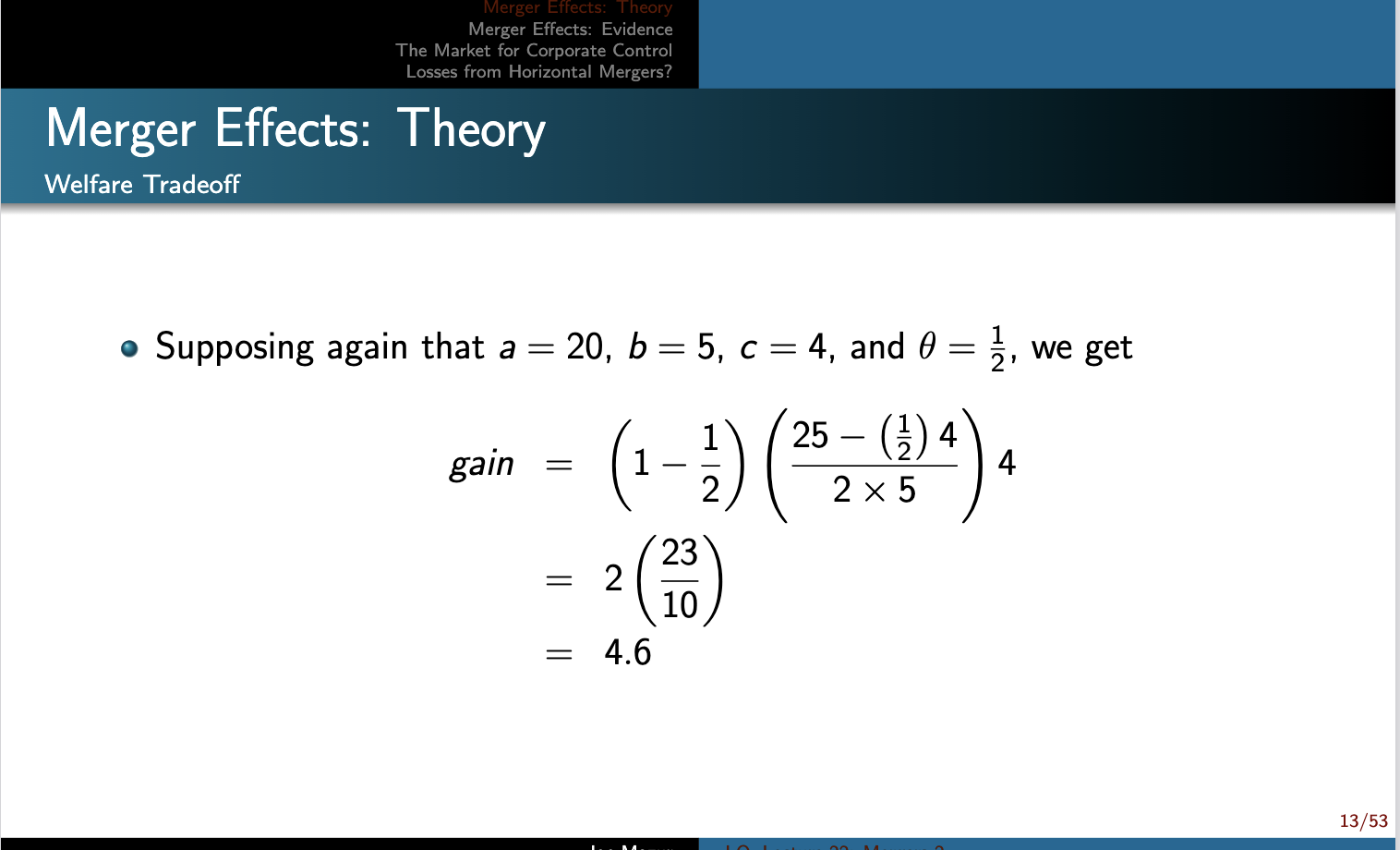
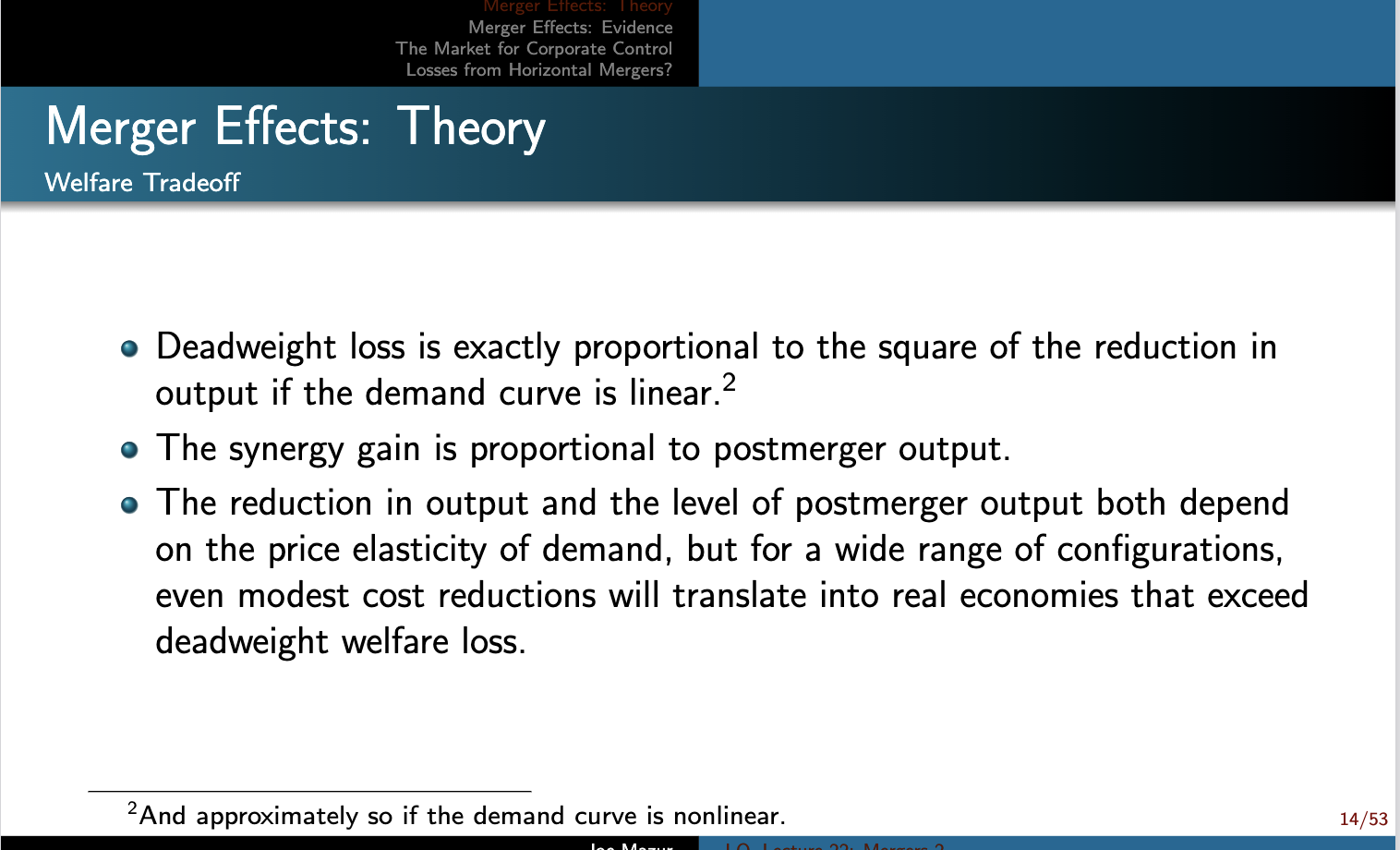
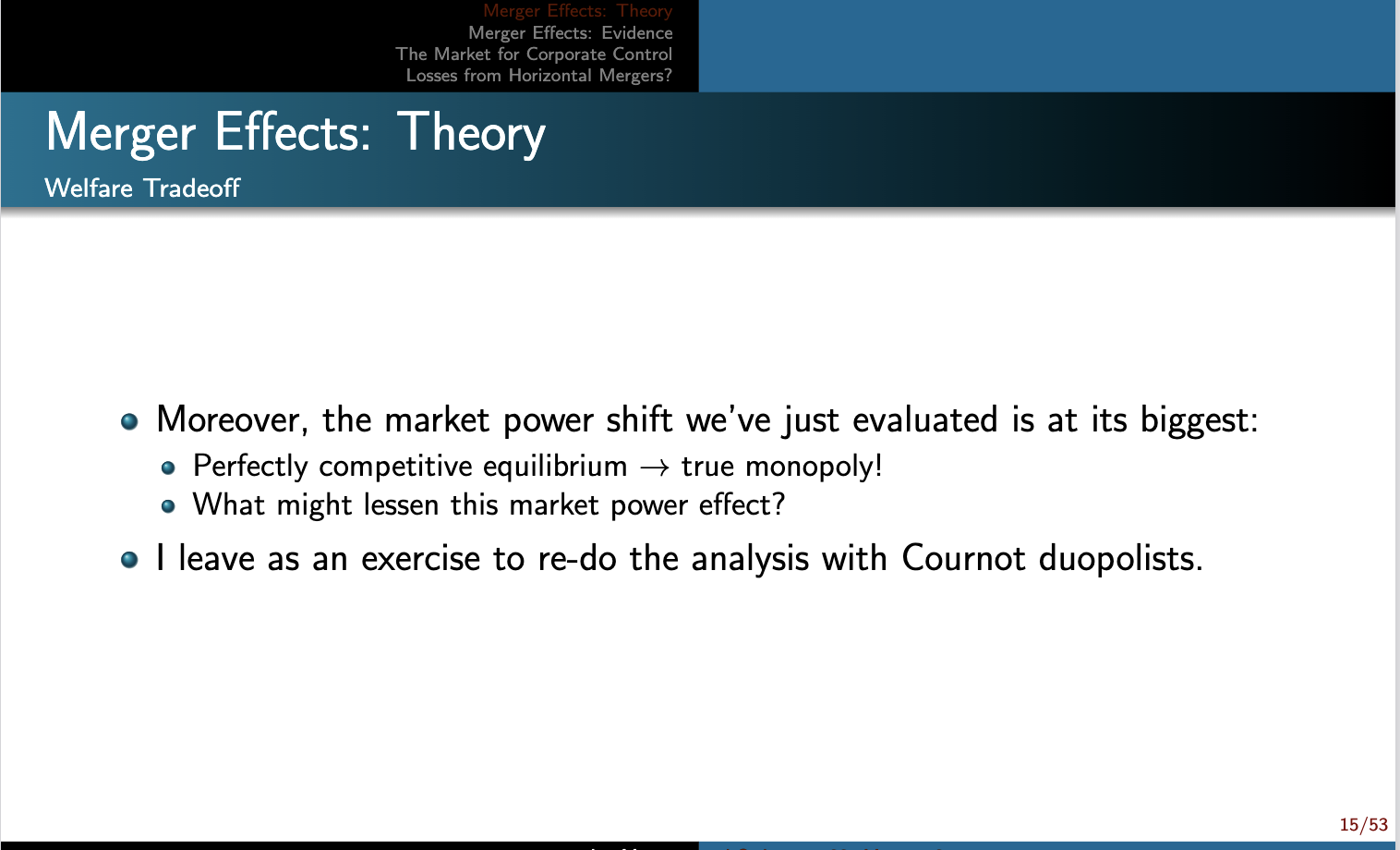
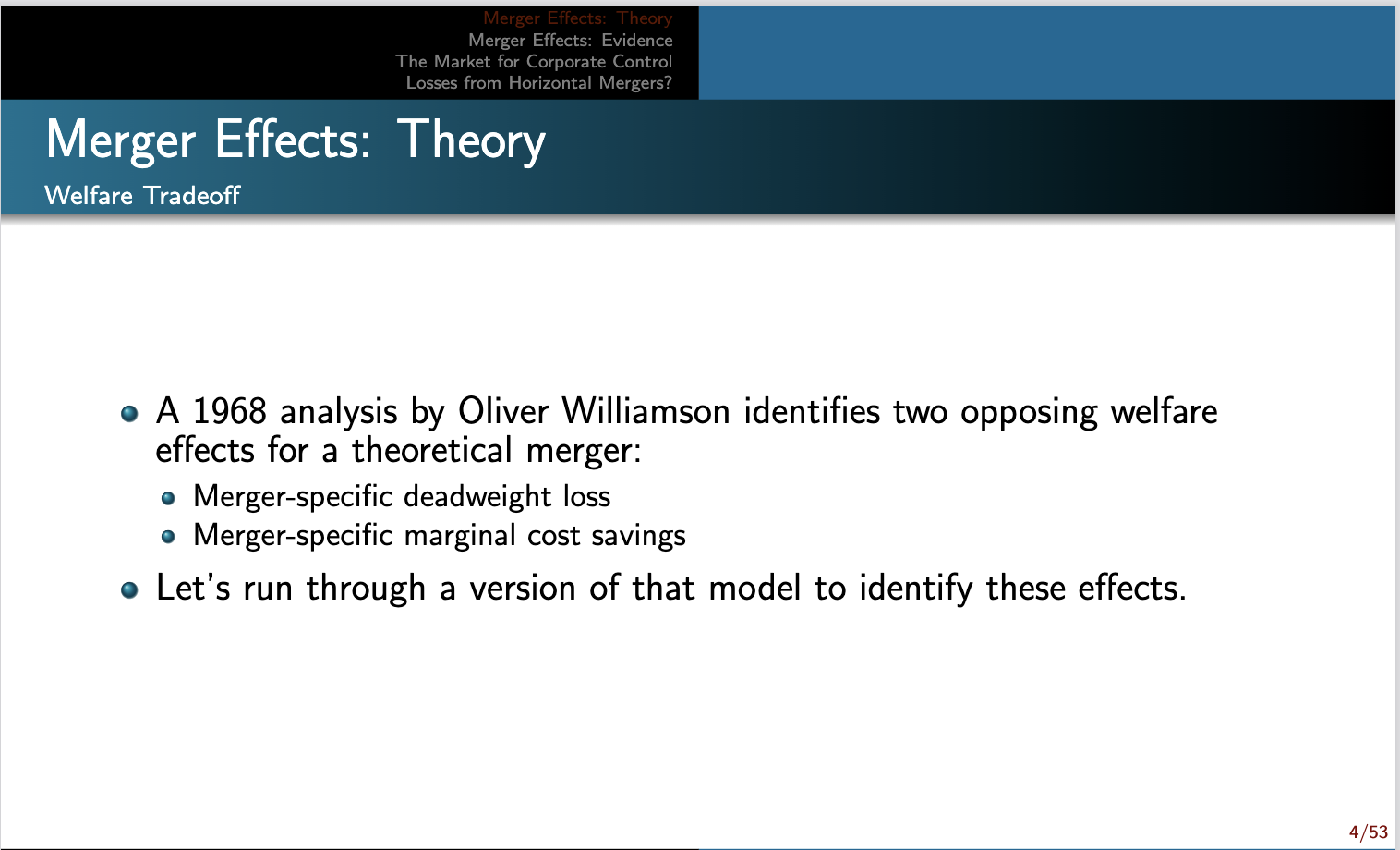
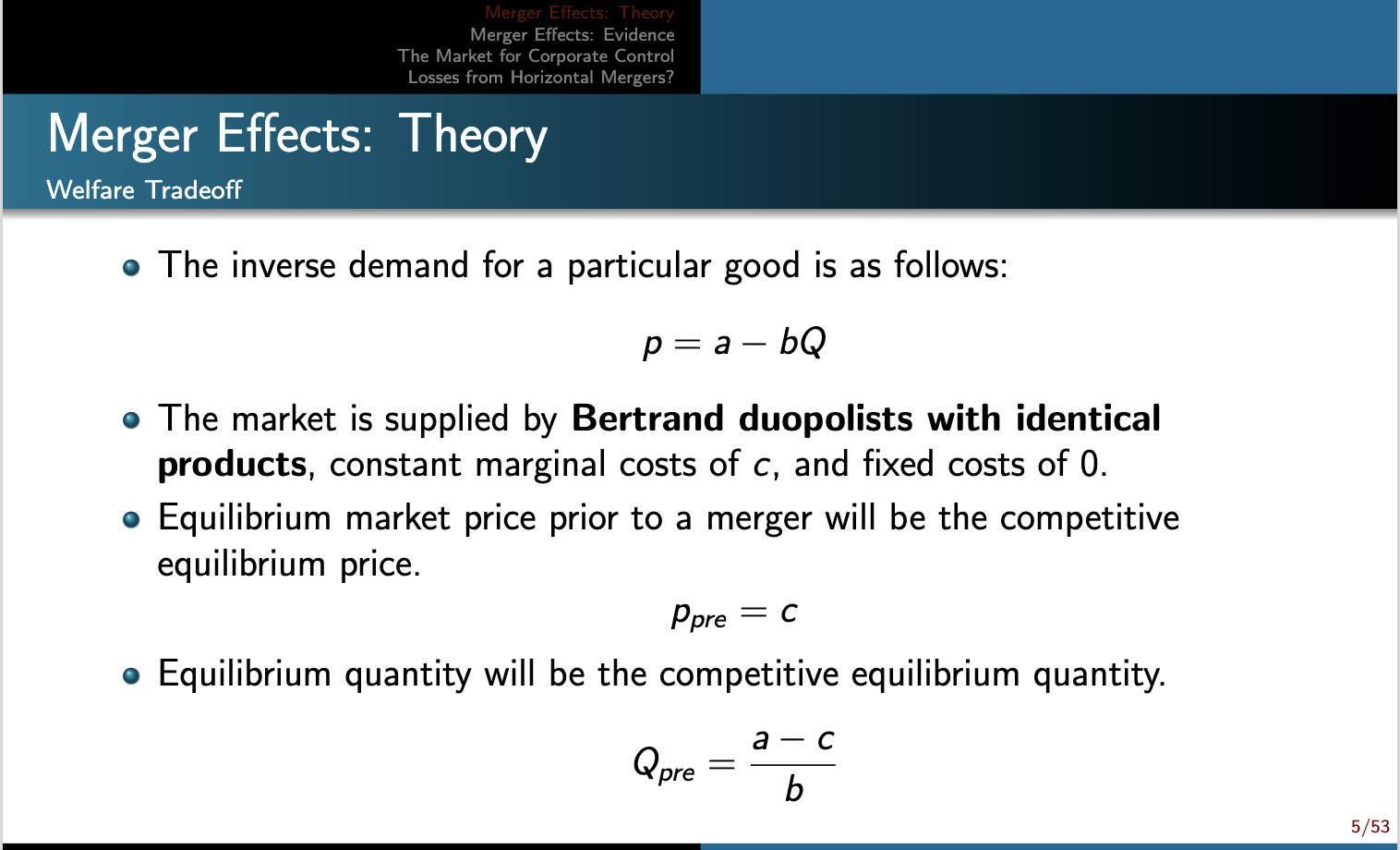
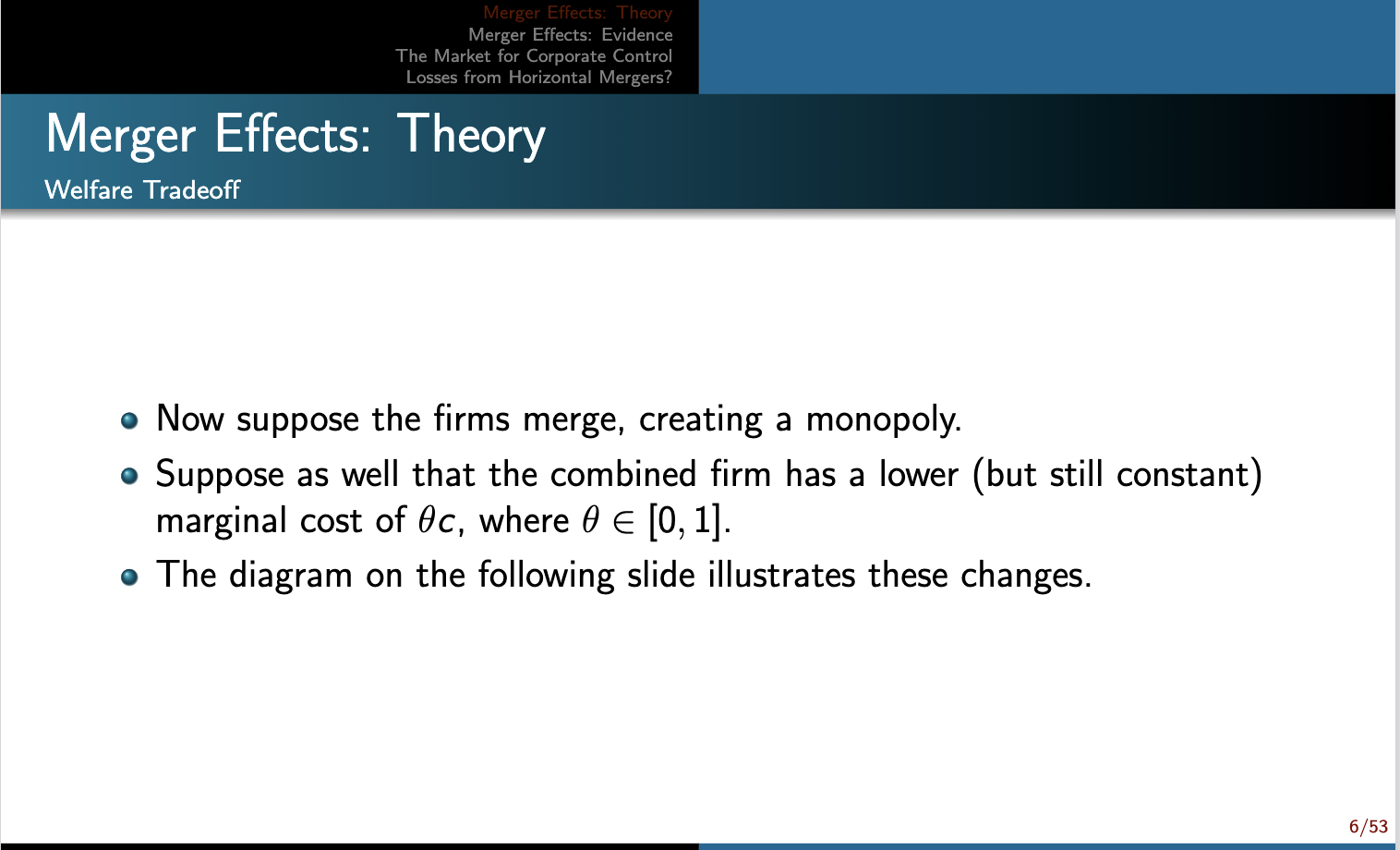
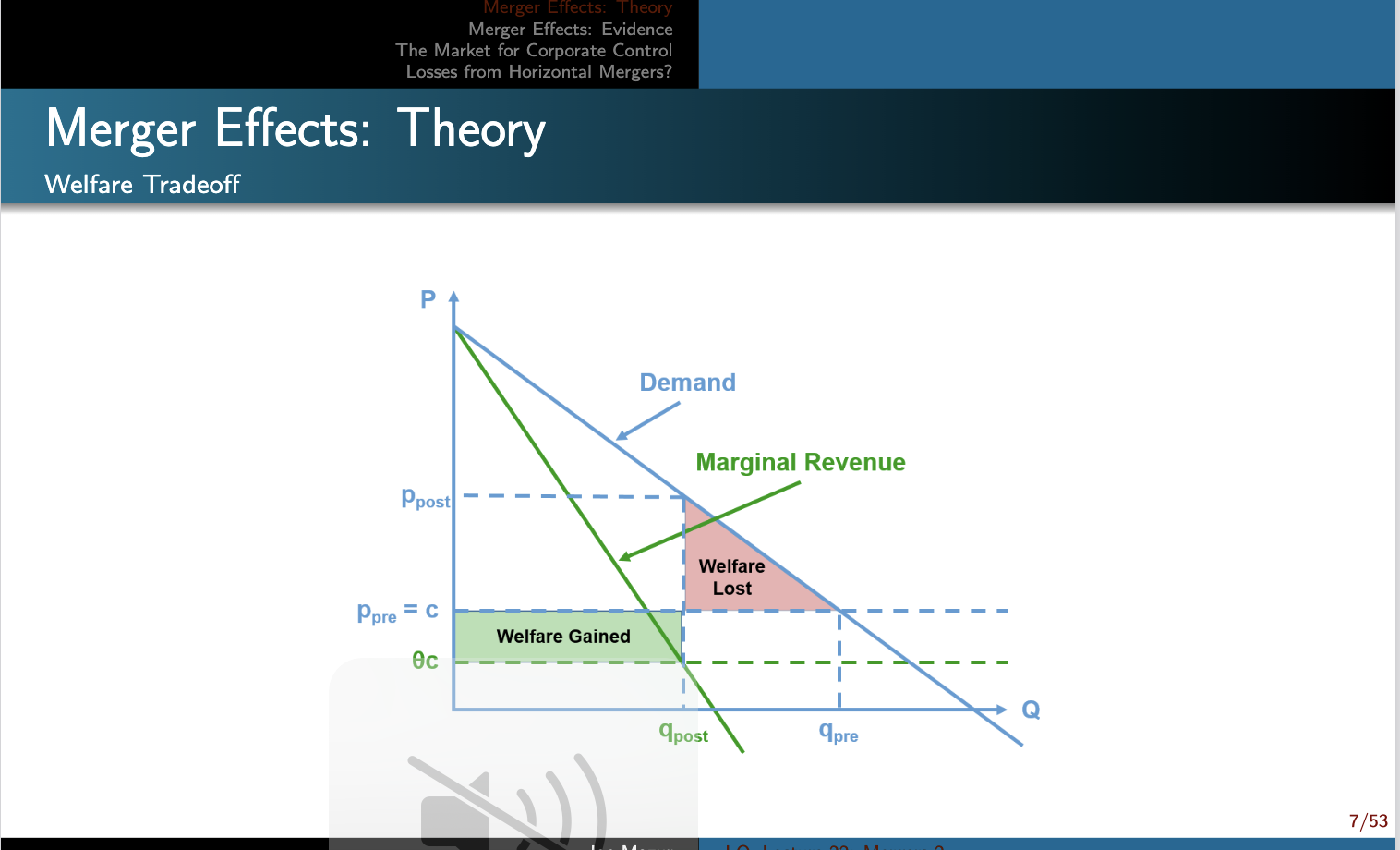
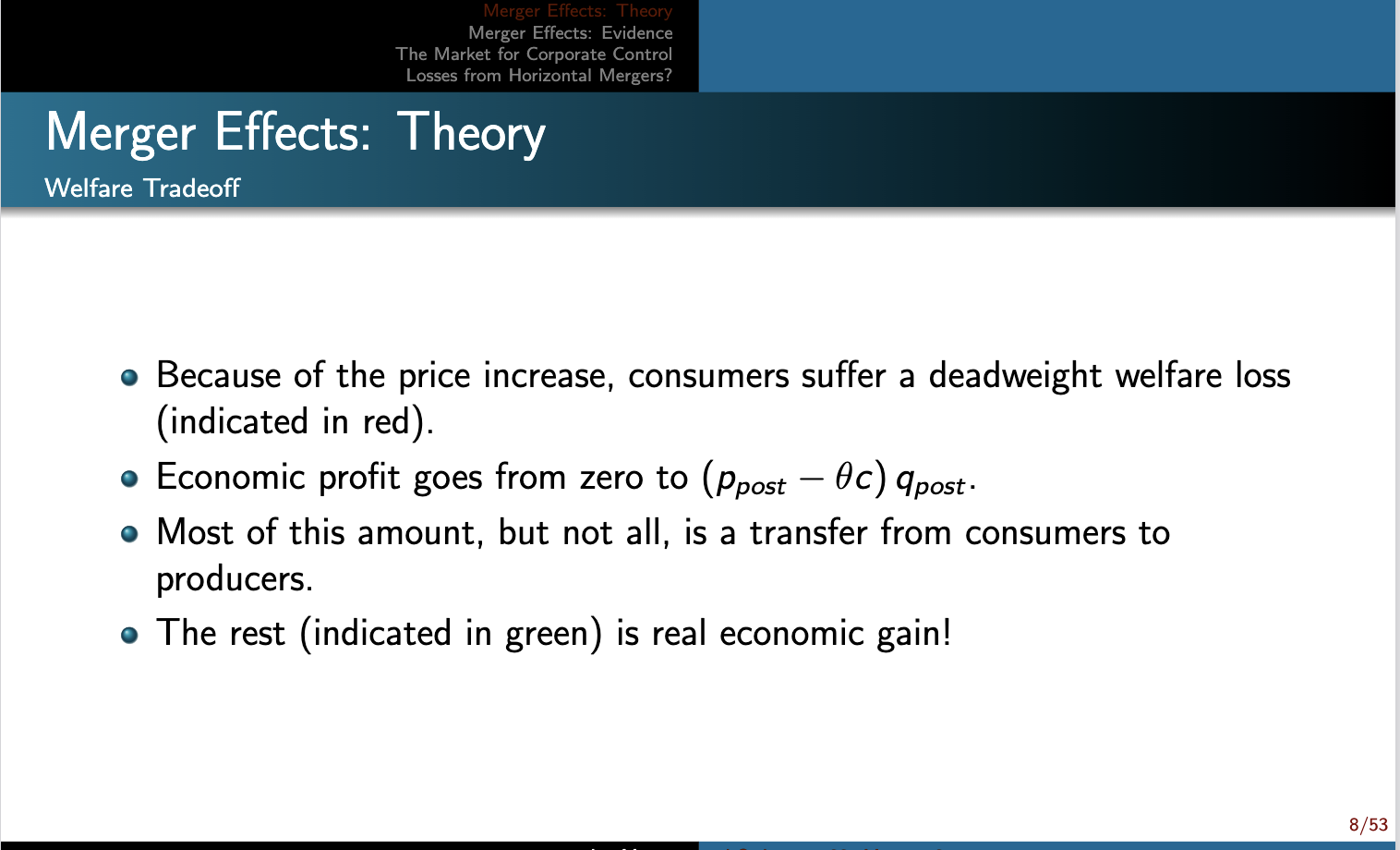
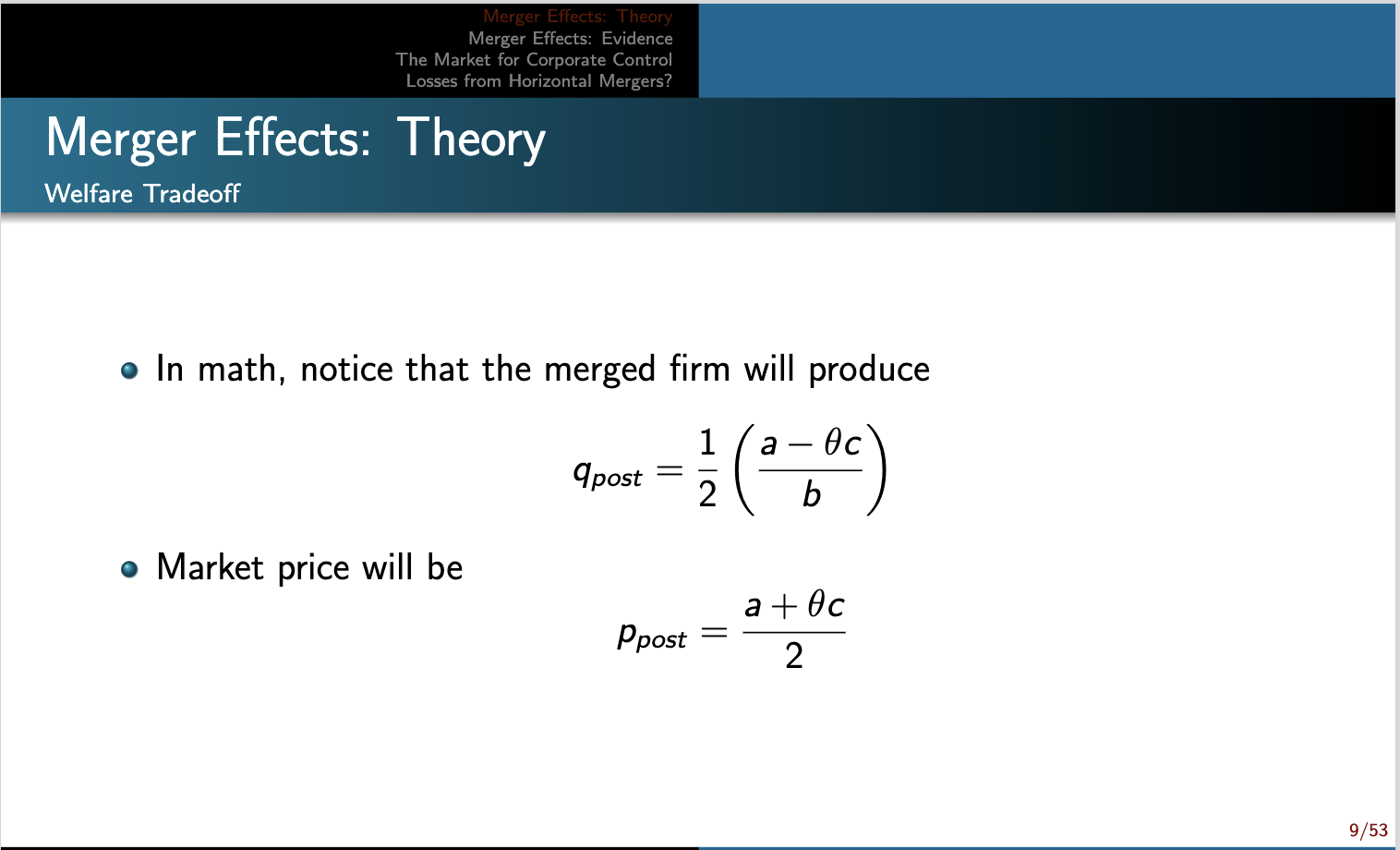
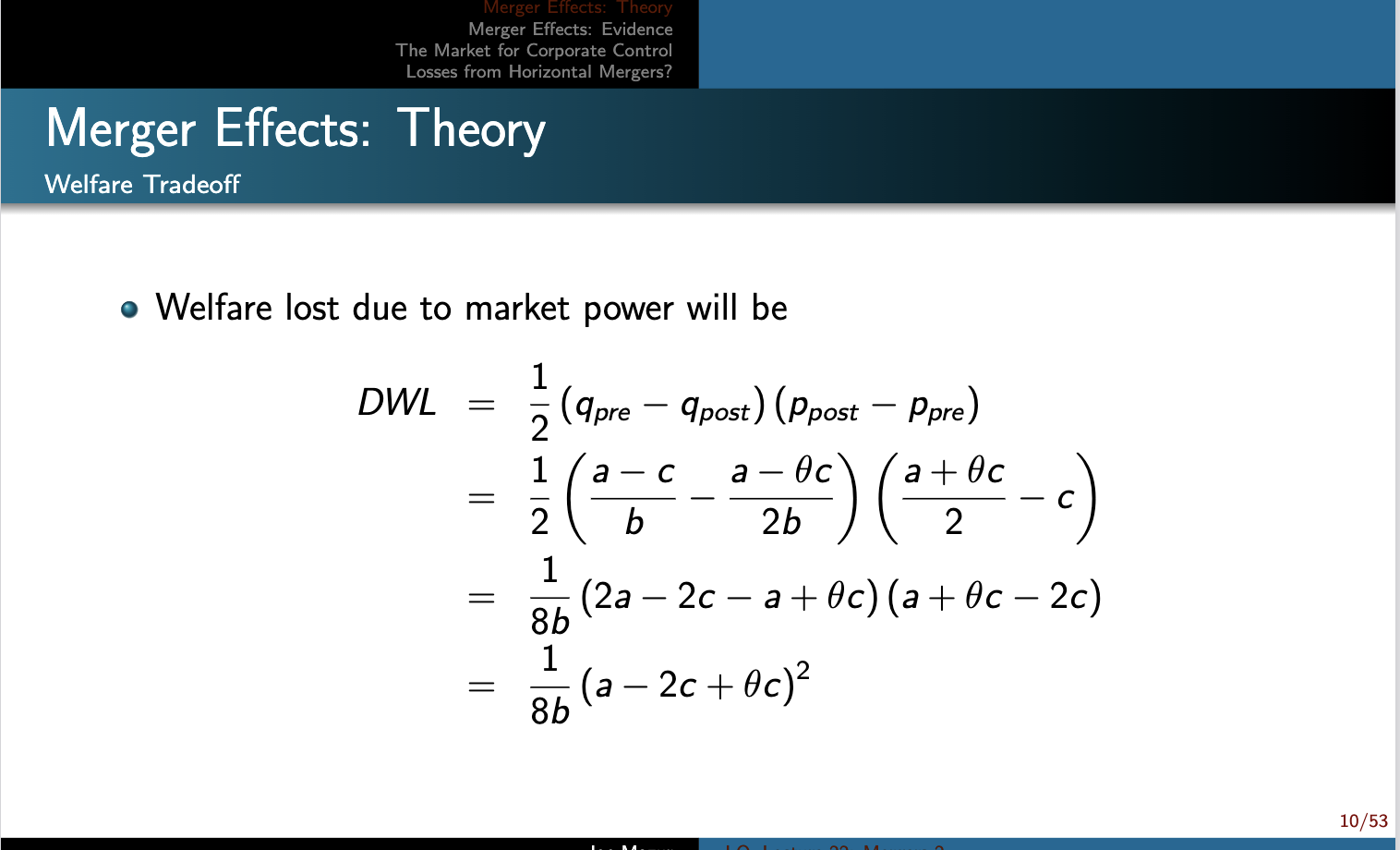
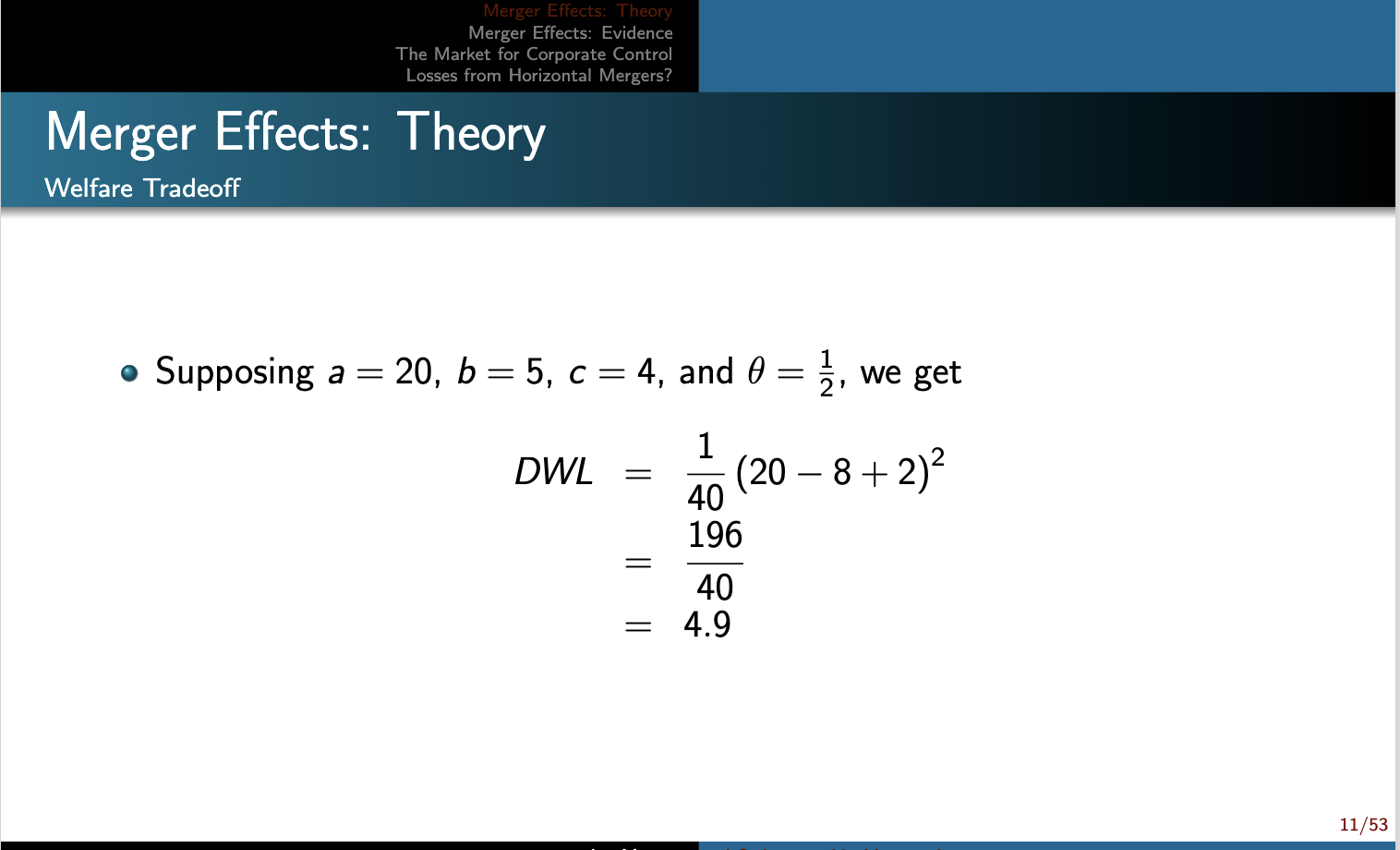
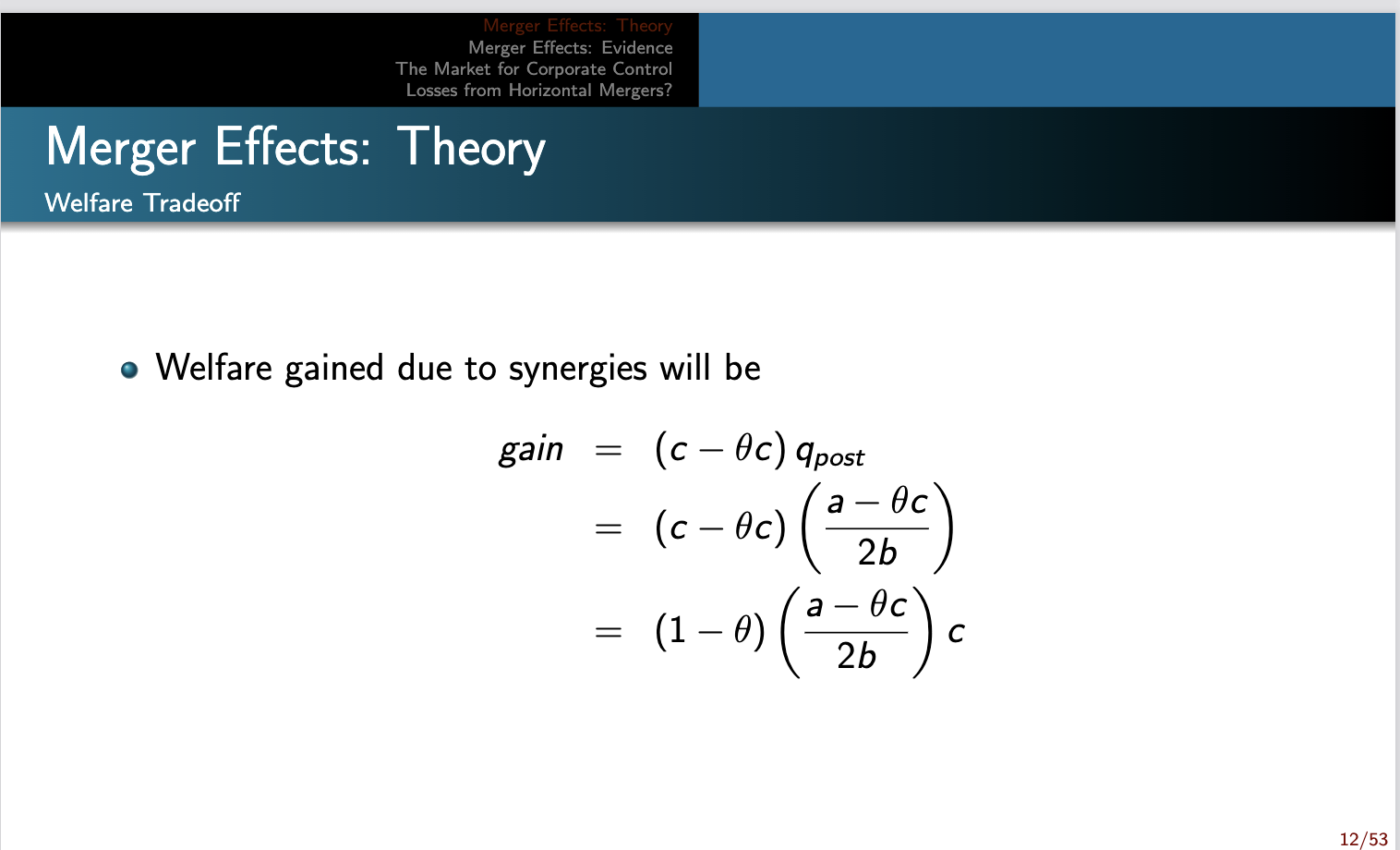
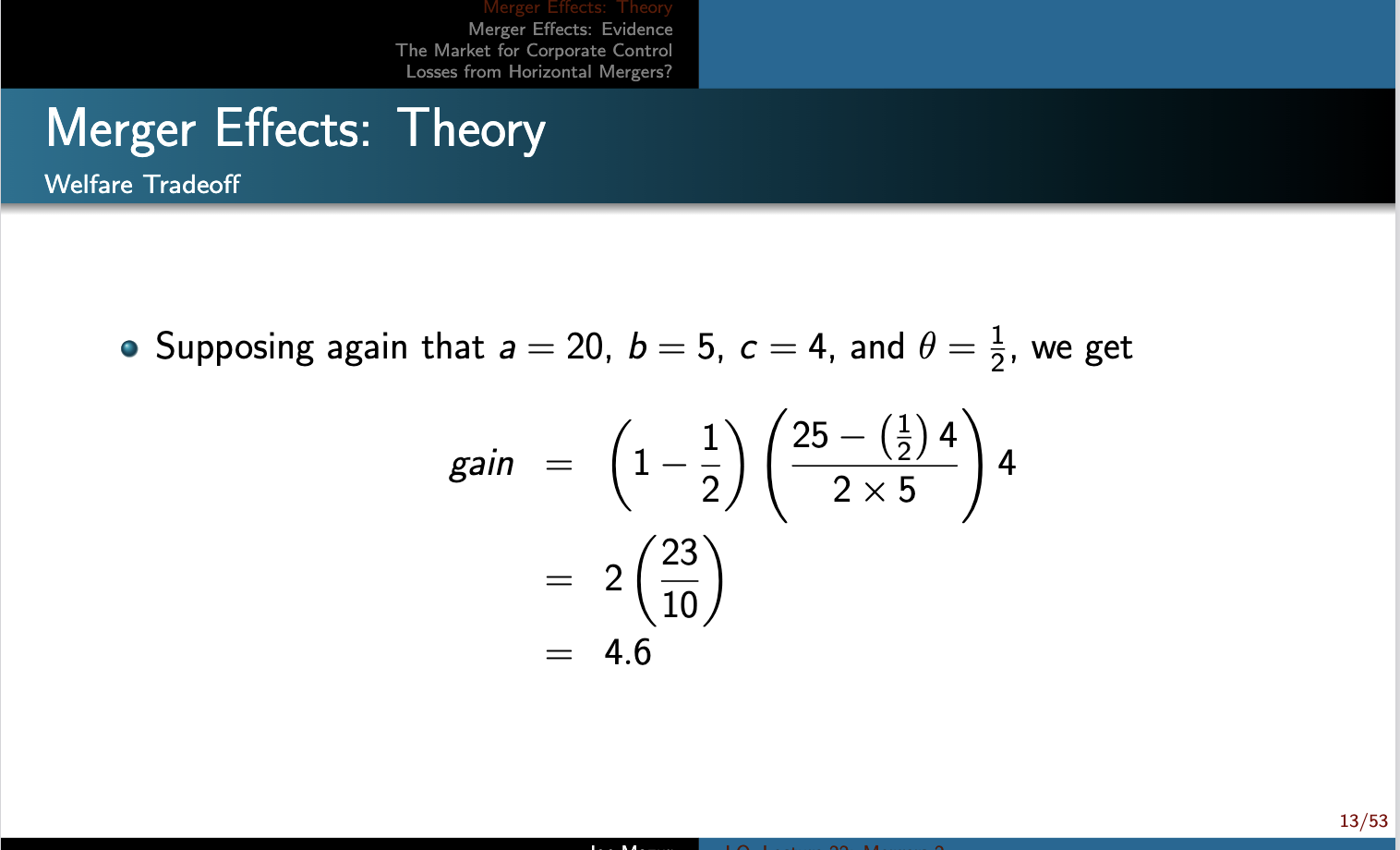
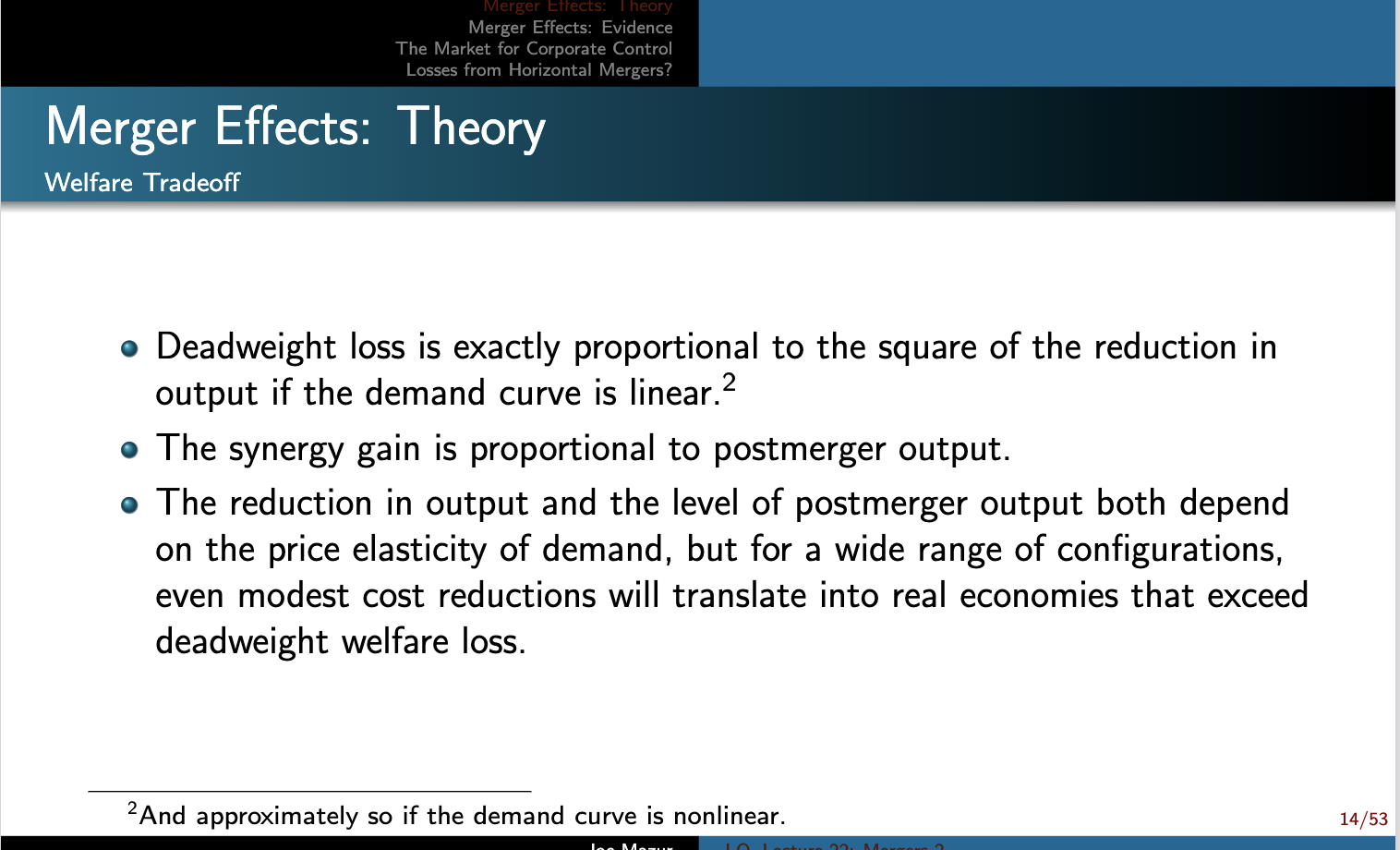
1. In Lecture 22: Mergers 2, we ran through a simple version of Williamson's (1968) model of a merger to identify the key welfare trade-off. On slide 15, I leave as an exercise to redo that analysis using Cournot duopolists instead of Bertrand duopolists. That is, there are two identical rms with identical products competing a la Cournot. They merge, and the result- ing monopoly has lower marginal costs and greater market power. What is the net change in welfare? Use the numbers used in the lecture to do this problem. That is, let inverse market de- mand be given by P = 20 562, and let marginal cost be constant at 4 per unit for the duopolists. Let 0 = 0.5, such that the resulting monopoly has marginal cost of 2 per unit. Merger Effects: Theory Merger Effects: Evidence The Market for Corporate Control Losses from Horizontal Mergers? Merger Effects: Theory Welfare Tradeoff . A 1968 analysis by Oliver Williamson identifies two opposing welfare effects for a theoretical merger: . Merger-specific deadweight loss . Merger-specific marginal cost savings . Let's run through a version of that model to identify these effects. 4/53Merger Effects: Theory Welfare Tradeoff o The inverse demand for a particular good is as follows: p = a b0 0 The market is supplied by Bertrand duopolists with identical products, constant marginal costs of c. and fixed costs of 0. o Equilibrium market price prior to a merger will be the competitive equilibrium price. Ppre = C o Equilibrium quantity will be the competitive equilibrium quantity. ac Qpre = b 5/53 Merger Effects: Theory Welfare Tradeoff 0 Now suppose the firms merge. creating a monOpoly. 0 Suppose as well that the combined firm has a lower (but still constant) marginal cost of 6c. where 6 E [0, 1]. o The diagram on the following slide illustrates these changes. 6/53 Merger Effects: Theory Merger Effects: Evidence The Market for Corporate Control Losses from Horizontal Mergers? Merger Effects: Theory Welfare Tradeoff P Demand Marginal Revenue Ppost -- Welfare Lost Ppre = C Welfare Gained Oc Q qpost qpre 7/53Merger Effects: Theory Welfare Tradeoff 0 Because of the price increase, consumers suffer a deadweight welfare loss (indicated in red). 0 Economic profit goes from zero to (ppm 6c) qpost. 0 Most of this amount, but not all, is a transfer from consumers to producers. o The rest (indicated in green) is real economic gain! 8/53 Merger Effects: Theory Merger Effects: Evidence The Market for Corporate Control Losses from Horizontal Mergers? Merger Effects: Theory Welfare Tradeoff . In math, notice that the merged firm will produce a - 0c 9post b . Market price will be a + 0c Ppost = 2 9/53Merger Effects: Theory Merger Effects: Evidence The Market for Corporate Control Losses from Horizontal Mergers? Merger Effects: Theory Welfare Tradeoff . Welfare lost due to market power will be DWL = (qpre - 9post) (Ppost - Ppre) a - c a - 0c a + 0c = C b 2b 2 = 8b (2a - 2c - a + 0c) (a + 0c -2c) 1 = 8b (a - 2c + 0c)2 10/53Merger Effects: Theory Merger Effects: Evidence The Market for Corporate Control Losses from Horizontal Mergers? Merger Effects: Theory Welfare Tradeoff . Supposing a = 20, b = 5, c = 4, and 0 = , we get DWL = (20 - 8+ 2)2 40 196 = 40 = 4.9 11/53Merger Effects: Theory Merger Effects: Evidence The Market for Corporate Control Losses from Horizontal Mergers? Merger Effects: Theory Welfare Tradeoff . Welfare gained due to synergies will be gain = (c - 0c) qpost a - 0c = (c - 0c) 2b a - Oc = (1-0) C 2b 12/53Merger Effects: Theory Merger Effects: Evidence The Market for Corporate Control Losses from Horizontal Mergers? Merger Effects: Theory Welfare Tradeoff . Supposing again that a = 20, b = 5, c = 4, and 0 = , we get 25 - () 4 gain = 1 4 2x 5 23 = 2 10 = 4.6 13/53Merger Effects: Theory Welfare Tradeoff o Deadweight loss is exactly pr0portional to the square of the reduction in output if the demand curve is linear.2 o The synergy gain is proportional to postmerger output. 0 The reduction in output and the level of postmerger output both depend on the price elasticity of demand, but for a wide range of configurations, even modest cost reductions will translate into real economies that exceed deadweight welfare loss. 2And approximately so if the demand curve is nonlinear. 14/53 Merger Effects: Theory Welfare Tradeoff 0 Moreover, the market power shift we've just evaluated is at its biggest: c Perfectly competitive equilibrium > true monopoly! o What might lessen this market power effect? c I leave as an exercise to redo the analysis with Cournot duopolists. 15/53
Step by Step Solution
There are 3 Steps involved in it

Get step-by-step solutions from verified subject matter experts