







Question: 1. In the figure shown below, Host A is connected to Host B by a path of 3 links with data rates R, R2,
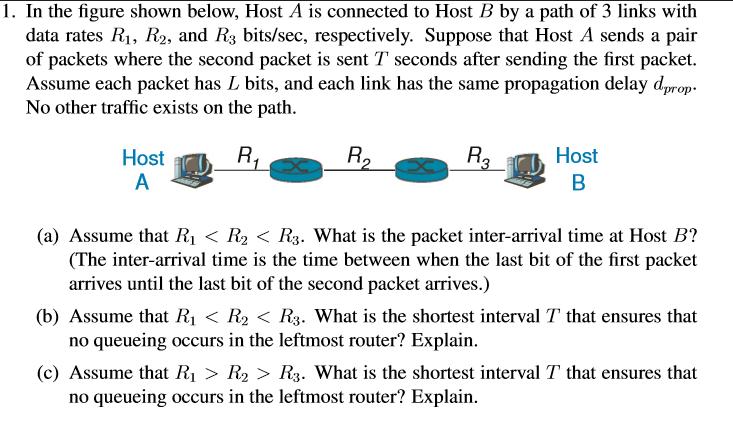
1. In the figure shown below, Host A is connected to Host B by a path of 3 links with data rates R, R2, and R3 bits/sec, respectively. Suppose that Host A sends a pair of packets where the second packet is sent T seconds after sending the first packet. Assume each packet has L bits, and each link has the same propagation delay dprop. No other traffic exists on the path. R Host A R R3 Host B (a) Assume that R R < R3. What is the packet inter-arrival time at Host B? (The inter-arrival time is the time between when the last bit of the first packet arrives until the last bit of the second packet arrives.) (b) Assume that R R2 R3. What is the shortest interval T that ensures that no queueing occurs in the leftmost router? Explain. (c) Assume that R > R R3. What is the shortest interval T that ensures that no queueing occurs in the leftmost router? Explain.
Step by Step Solution
There are 3 Steps involved in it

Get step-by-step solutions from verified subject matter experts
 Study Help