







Question: 1. In the first problem from the activity we found that the rate of change of energy with respect to time is power. The rate
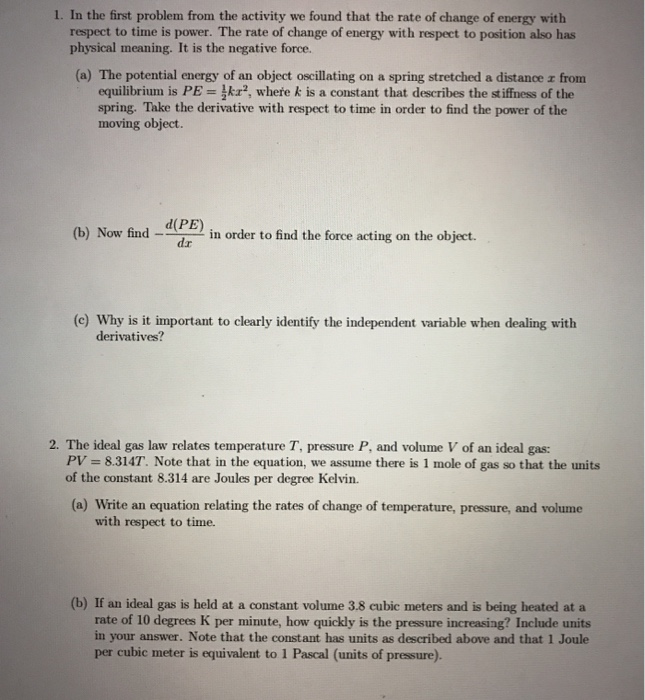
1. In the first problem from the activity we found that the rate of change of energy with respect to time is power. The rate of change of energy with respect to position also has physical meaning. It is the negative force. (a) The potential energy of an object oscillating on a spring stretched a distance from equilibrium is PE = kx, where k is a constant that describes the stiffness of the spring. Take the derivative with respect to time in order to find the power of the moving object. d(PE) (b) Now find - in order to find the force acting on the object. (C) Why is it important to clearly identify the independent variable when dealing with derivatives? 2. The ideal gas law relates temperature T, pressure P, and volume V of an ideal gas: PV = 8.314T. Note that in the equation, we assume there is 1 mole of gas so that the units of the constant 8.314 are Joules per degree Kelvin (a) Write an equation relating the rates of change of temperature, pressure, and volume with respect to time (b) If an ideal gas is held at a constant volume 3.8 cubic meters and is being heated at a rate of 10 degrees K per minute, how quickly is the pressure increasing? Include units in your answer. Note that the constant has units as described above and that 1 Joule per cubic meter is equivalent to 1 Pascal (units of pressure)
Step by Step Solution
There are 3 Steps involved in it

Get step-by-step solutions from verified subject matter experts
 Study Help