







Question: 1. In the updated color scheme test, the bounce rate indicates that _____. a. the new color scheme for the homepage is more successful than
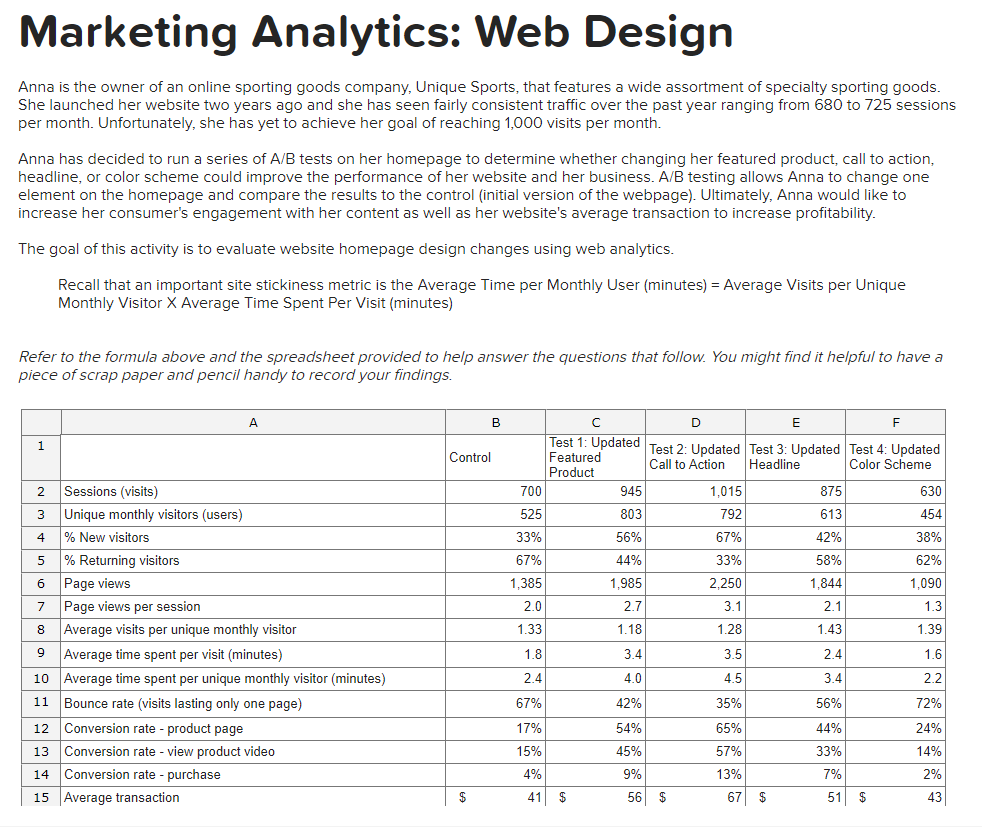
1. In the updated color scheme test, the bounce rate indicates that _____. a. the new color scheme for the homepage is more successful than the existing color scheme b. customers are more likely to make a purchase after seeing the new homepage color scheme as compared to the homepage with the existing color scheme. c. page views per session for the new color scheme should be higher than the control d. the updated color scheme test has the fewest number of consumers leaving the website after viewing only one page e. more than 7/10 visitors leave Unique Sport's homepage without viewing additional pages, reducing the likelihood of a purchase and resulting in a 2% purchase conversion rate.
2. Comparing the four test conditions against the control, which of the homepages was the most successful? a. Updated call to action b. Updated heading c. The control d. Updated color scheme e. Updated featured product
3. Anna feels that she needs to increase the average time spent per unique monthly visitor to help her reach her transaction (purchase goals). What should Anna do to increase this metric the most? a. Increase the number of visits per unique monthly visitor and increase the average time spent per visit b. Decrease the number of visits per unique monthly visitor and increase the average time spent per visit c. Decrease the number of visits per unique monthly visitor and decrease the average time spent per visit d. Increase the number of sessions e. Increase the number of unique monthly visitors
4. Anna notices that the average time spent per unique monthly visitor in minutes is quite a bit higher in the updated featured product condition as compared to the control. How can this result be explained? a. In the updated feature product condition, fewer unique visitors visit the website, and when they do visit the website they spend less time. b. In the updated feature product condition, consumers visit the website less frequently, and when they do visit they spend less time. c. In the updated feature product condition, consumers do not visit the website as frequently, but when they do visit they stay longer d. In the updated feature product condition, consumers visit the website more frequently, but when they do visit they spend less time e. In the updated feature product condition, consumers visit the website more frequently, and when they do visit they stay longer
5. In the updated call to action test, how does consumer behavior differ from the control? a. While consumers in the updated call to action test have a higher average transaction, they spend less time on the website. b. Consumers are not attracted to the updated call to action, resulting in less profitable consumer behavior. c. Visiting the product page and viewing the product video negatively impacts the purchase conversion rate in the updated call to action test. d. Consumers make fewer visits to the website per month with the updated call to action, but they visit more pages and spend more time on the website e. Consumers make fewer transactions with the updated call to action resulting in a reduced purchase probability and profitability
Anna is the owner of an online sporting goods company, Unique Sports, that features a wide assortment of specialty sporting goods. She launched her website two years ago and she has seen fairly consistent traffic over the past year ranging from 680 to 725 sessions per month. Unfortunately, she has yet to achieve her goal of reaching 1,000 visits per month. Anna has decided to run a series of A/B tests on her homepage to determine whether changing her featured product, call to action, headline, or color scheme could improve the performance of her website and her business. A/B testing allows Anna to change one element on the homepage and compare the results to the control (initial version of the webpage). Ultimately, Anna would like to increase her consumer's engagement with her content as well as her website's average transaction to increase profitability. The goal of this activity is to evaluate website homepage design changes using web analytics. Recall that an important site stickiness metric is the Average Time per Monthly User (minutes) = Average Visits per Unique Monthly Visitor X Average Time Spent Per Visit (minutes) Refer to the formula above and the spreadsheet provided to help answer the questions that follow. You might find it helpful to have a piece of scrap paper and pencil handy to record your findings
Step by Step Solution
There are 3 Steps involved in it

Get step-by-step solutions from verified subject matter experts
 Study Help