



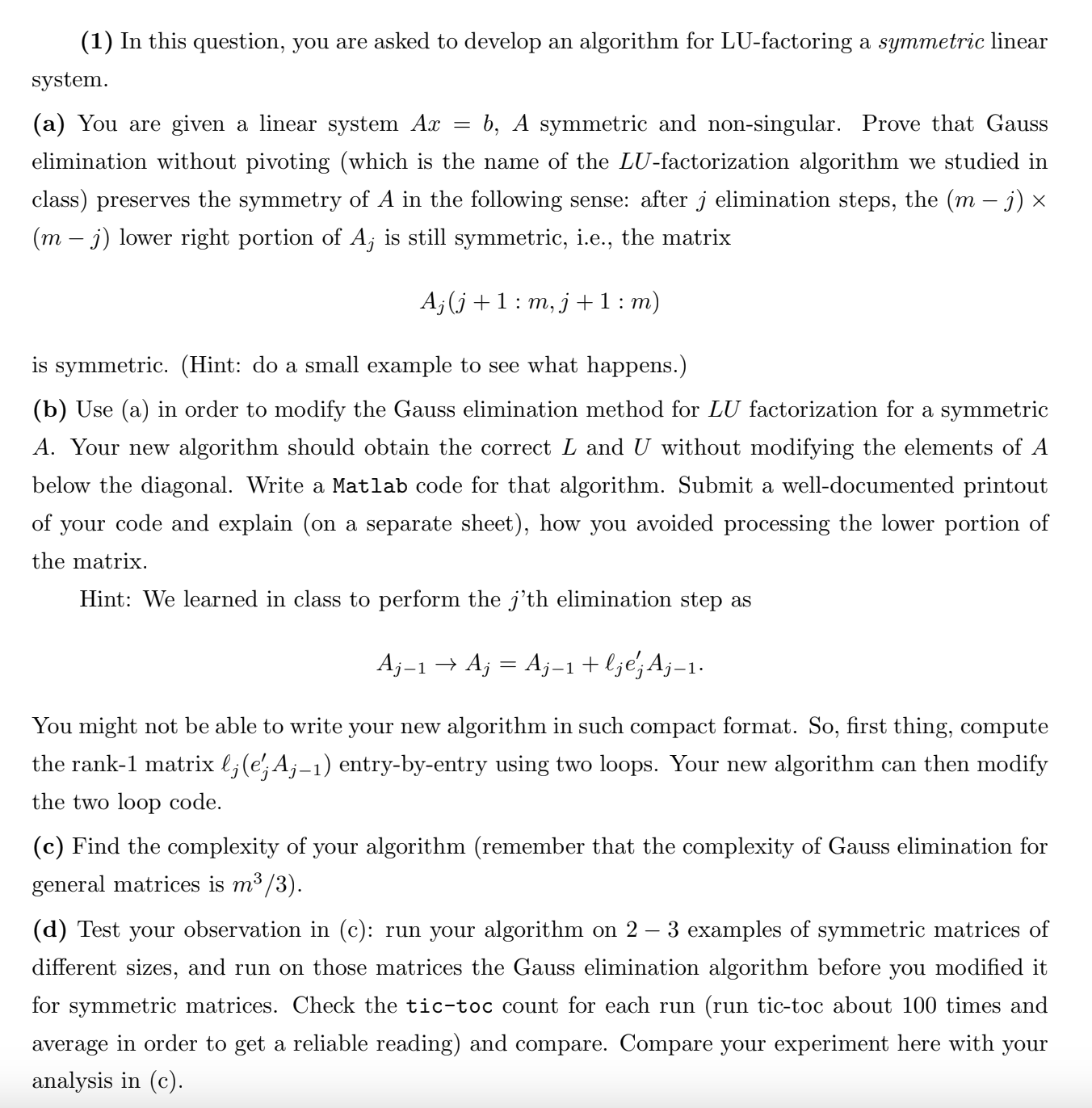
Question: ( 1 ) In this question, you are asked to develop an algorithm for LU - factoring a symmetric linear system. ( a ) You
In this question, you are asked to develop an algorithm for LUfactoring a symmetric linear
system.
a You are given a linear system A symmetric and nonsingular. Prove that Gauss
elimination without pivoting which is the name of the factorization algorithm we studied in
class preserves the symmetry of in the following sense: after elimination steps, the
lower right portion of is still symmetric, ie the matrix
::
is symmetric. Hint: do a small example to see what happens.
b Use a in order to modify the Gauss elimination method for factorization for a symmetric
Your new algorithm should obtain the correct and without modifying the elements of
below the diagonal. Write a Matlab code for that algorithm. Submit a welldocumented printout
of your code and explain on a separate sheet how you avoided processing the lower portion of
the matrix.
Hint: We learned in class to perform the th elimination step as
You might not be able to write your new algorithm in such compact format. So first thing, compute
the rank matrix entrybyentry using two loops. Your new algorithm can then modify
the two loop code.
c Find the complexity of your algorithm remember that the complexity of Gauss elimination for
general matrices is :
d Test your observation in c: run your algorithm on examples of symmetric matrices of
different sizes, and run on those matrices the Gauss elimination algorithm before you modified it
for symmetric matrices. Check the tictoc count for each run run tictoc about times and
average in order to get a reliable reading and compare. Compare your experiment here with your
analysis in c
Step by Step Solution
There are 3 Steps involved in it
1 Expert Approved Answer
Step: 1 Unlock

Question Has Been Solved by an Expert!
Get step-by-step solutions from verified subject matter experts
Step: 2 Unlock
Step: 3 Unlock