







Question: 1. In this question you will implement a system that receives as input 3 variables A, B, C, each variable consisting of k bits, and
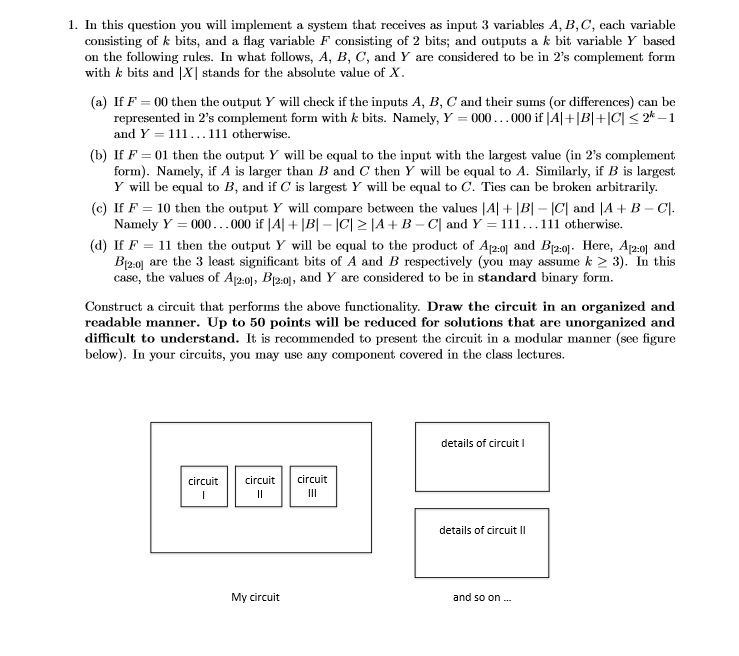
1. In this question you will implement a system that receives as input 3 variables A, B, C, each variable consisting of k bits, and a flag variable F consisting of 2 bits; and outputs a k bit variable Y based on the following rules. In what follows, A, B, C, and Y are considered to be in 2's complement form with bits and IXI stands for the absolute value of X (a) If F-00 then the output Y will check if the inputs A, B, C and their sums (or differences) can be represented in 2's complement form with k bits. Namely, Y 000..000 if IAl+BI+IC2-1 and Y 111...111 otherwise. (b) If F 01 then the output Y will be equal to the input with the largest value (in 2's complement form). Namely, if A is larger than B and C then Y will be equal to A. Similarly, if B is largest Y wil be equal to B, and if C is largest Y will be equal to C. Ties can be broken arbitrarily (c) If F 10 then the output Y will compare between the values |A] + IBI-ICl and |A + B-Cl Namely Y-000 000 if IAI + IBI-1Cl [A + B-Cl and Y-111 . . . 111 otherwise. (d) If F-11 then the output Y will be equal to the product of A12?and Bi2?. Here, A12:0] and B2-0 are the 3 least significant bits of A and B respectively (you may assume k 3). In this case, the values of A12:01, B2:?, and Y are considered to be in standard binary form Construct a circuit that performs the above functionality. Draw the circuit in an organized and readable manner. Up to 50 points wil be reduced for solutions that are unorganized and difficult to understand. It is recommended to present the circuit in a modular manner (see figure below). In your circuits, you may use any component covered in the class lectures. details of circuit I circuitccuit circuit details of circuit II My circuit and so on 1. In this question you will implement a system that receives as input 3 variables A, B, C, each variable consisting of k bits, and a flag variable F consisting of 2 bits; and outputs a k bit variable Y based on the following rules. In what follows, A, B, C, and Y are considered to be in 2's complement form with bits and IXI stands for the absolute value of X (a) If F-00 then the output Y will check if the inputs A, B, C and their sums (or differences) can be represented in 2's complement form with k bits. Namely, Y 000..000 if IAl+BI+IC2-1 and Y 111...111 otherwise. (b) If F 01 then the output Y will be equal to the input with the largest value (in 2's complement form). Namely, if A is larger than B and C then Y will be equal to A. Similarly, if B is largest Y wil be equal to B, and if C is largest Y will be equal to C. Ties can be broken arbitrarily (c) If F 10 then the output Y will compare between the values |A] + IBI-ICl and |A + B-Cl Namely Y-000 000 if IAI + IBI-1Cl [A + B-Cl and Y-111 . . . 111 otherwise. (d) If F-11 then the output Y will be equal to the product of A12?and Bi2?. Here, A12:0] and B2-0 are the 3 least significant bits of A and B respectively (you may assume k 3). In this case, the values of A12:01, B2:?, and Y are considered to be in standard binary form Construct a circuit that performs the above functionality. Draw the circuit in an organized and readable manner. Up to 50 points wil be reduced for solutions that are unorganized and difficult to understand. It is recommended to present the circuit in a modular manner (see figure below). In your circuits, you may use any component covered in the class lectures. details of circuit I circuitccuit circuit details of circuit II My circuit and so on
Step by Step Solution
There are 3 Steps involved in it

Get step-by-step solutions from verified subject matter experts
 Study Help