







Question: 1) Indicate the sites that are Phylogenetically Informative. 2) Construct the most parsimonious unrooted tree of groups 1, 2, 3, and 4 3) Map substitutions
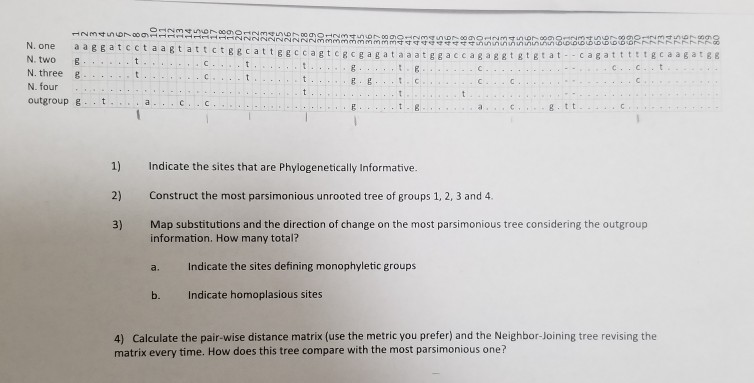
1) Indicate the sites that are Phylogenetically Informative.
2) Construct the most parsimonious unrooted tree of groups 1, 2, 3, and 4
3) Map substitutions and the direction of change on the most parsimonious tree considering the outgroup information. How many total? a) Indicate the sites defining monophyletic groups, b) Indicate homoplasious sites
4) Calculate the pair-wise distance matrix (use the metric you prefer) and the Neighbor-Joining tree revising the matrix every time. How does this tree compare with the most parsimonious one?
N. one aag g atcct N. two B N. three e N.four outgroup g.t taagtattcteg catte g c cagtcg cgag at a a at gga cc ag aggtgtgt at cagatttttgc aagat88 gg cattggccagtcecgag c..ct a.c.gtt 1) Indicate the sites that are Phylogenetically Informative. 2) Construct the most parsimonious unrooted tree of groups 1, 2, 3 and 4 3) Map substitutions and the direction of change on the most parsimonious tree considering the outgroup information. How many total? a. Indicate the sites defining monophyletic groups b. Indicate homoplasious sites 4) Calculate the pair-wise distance matrix (use the metric you prefer) and the Neighbor-Joining tree revising the matrix every time. How does this tree compare with the most parsimonious one? N. one aag g atcct N. two B N. three e N.four outgroup g.t taagtattcteg catte g c cagtcg cgag at a a at gga cc ag aggtgtgt at cagatttttgc aagat88 gg cattggccagtcecgag c..ct a.c.gtt 1) Indicate the sites that are Phylogenetically Informative. 2) Construct the most parsimonious unrooted tree of groups 1, 2, 3 and 4 3) Map substitutions and the direction of change on the most parsimonious tree considering the outgroup information. How many total? a. Indicate the sites defining monophyletic groups b. Indicate homoplasious sites 4) Calculate the pair-wise distance matrix (use the metric you prefer) and the Neighbor-Joining tree revising the matrix every time. How does this tree compare with the most parsimonious one
Step by Step Solution
There are 3 Steps involved in it

Get step-by-step solutions from verified subject matter experts
 Study Help