



Question: 1. Introduce a summary of the case study 2. How does Spirit Airlines create value for their travelers? How does it meet the wants and
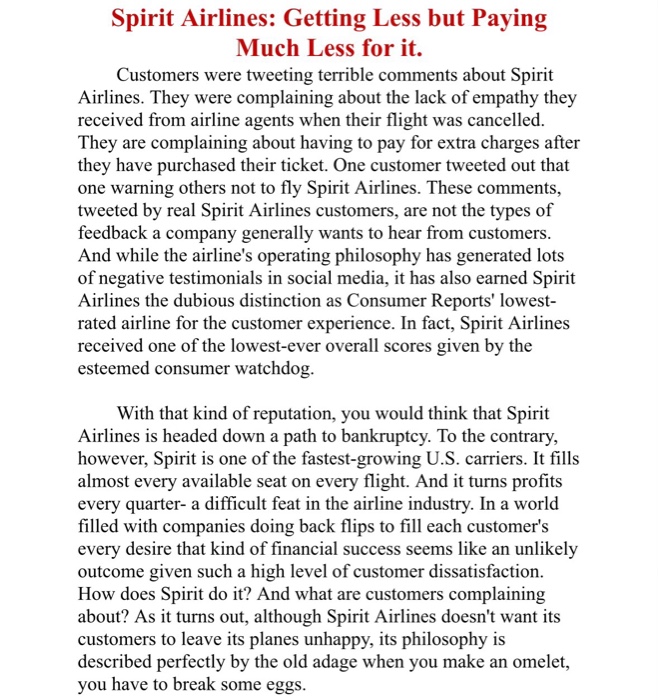
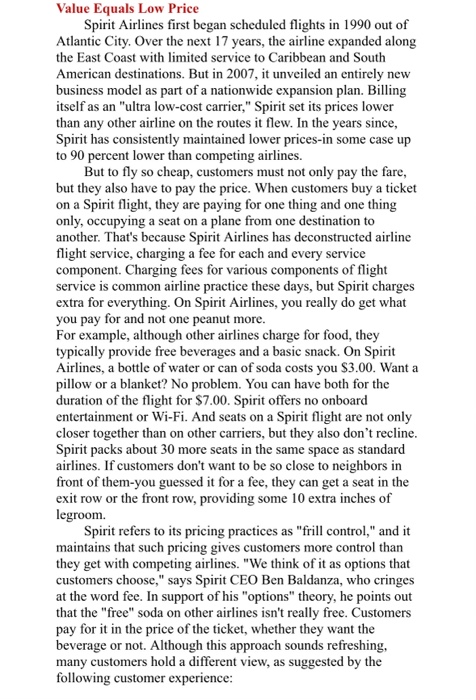
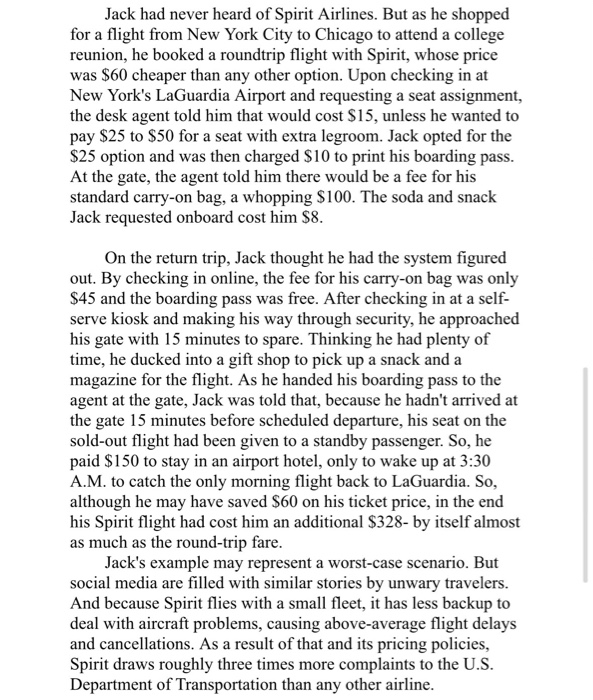
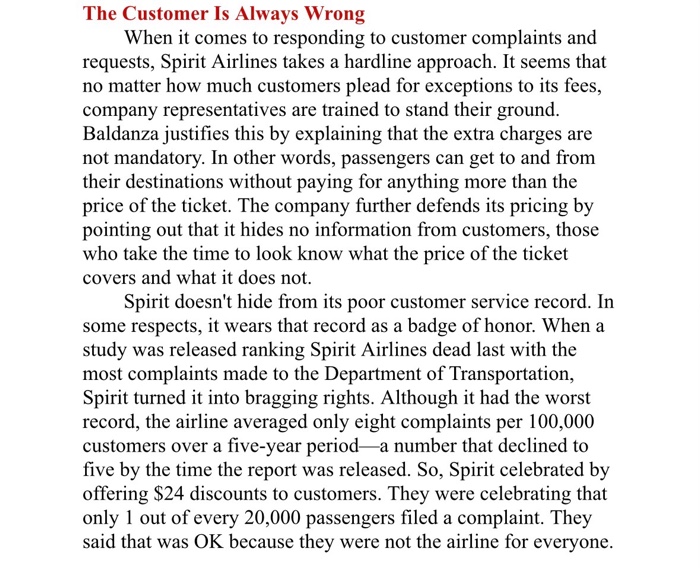
Value Equals Low Price Spirit Airlines first began scheduled flights in 1990 out of Atlantic City. Over the next 17 years, the airline expanded along the East Coast with limited service to Caribbean and South American destinations. But in 2007, it unveiled an entirely new business model as part of a nationwide expansion plan. Billing itself as an "ultra low-cost carrier," Spirit set its prices lower than any other airline on the routes it flew. In the years since, Spirit has consistently maintained lower prices-in some case up to 90 percent lower than competing airlines. But to fly so cheap, customers must not only pay the fare, but they also have to pay the price. When customers buy a ticket on a Spirit flight, they are paying for one thing and one thing only, occupying a seat on a plane from one destination to another. That's because Spirit Airlines has deconstructed airline flight service, charging a fee for each and every service component. Charging fees for various components of flight service is common airline practice these days, but Spirit charges extra for everything. On Spirit Airlines, you really do get what you pay for and not one peanut more. For example, although other airlines charge for food, they typically provide free beverages and a basic snack. On Spirit Airlines, a bottle of water or can of soda costs you \$3.00. Want a pillow or a blanket? No problem. You can have both for the duration of the flight for $7.00. Spirit offers no onboard entertainment or Wi-Fi. And seats on a Spirit flight are not only closer together than on other carriers, but they also don't recline. Spirit packs about 30 more seats in the same space as standard airlines. If customers don't want to be so close to neighbors in front of them-you guessed it for a fee, they can get a seat in the exit row or the front row, providing some 10 extra inches of legroom. Spirit refers to its pricing practices as "frill control," and it maintains that such pricing gives customers more control than they get with competing airlines. "We think of it as options that customers choose," says Spirit CEO Ben Baldanza, who cringes at the word fee. In support of his "options" theory, he points out that the "free" soda on other airlines isn't really free. Customers pay for it in the price of the ticket, whether they want the beverage or not. Although this approach sounds refreshing, many customers hold a different view, as suggested by the following customer experience: Jack had never heard of Spirit Airlines. But as he shopped for a flight from New York City to Chicago to attend a college reunion, he booked a roundtrip flight with Spirit, whose price was $60 cheaper than any other option. Upon checking in at New York's LaGuardia Airport and requesting a seat assignment, the desk agent told him that would cost $15, unless he wanted to pay $25 to $50 for a seat with extra legroom. Jack opted for the $25 option and was then charged $10 to print his boarding pass. At the gate, the agent told him there would be a fee for his standard carry-on bag, a whopping $100. The soda and snack Jack requested onboard cost him $8. On the return trip, Jack thought he had the system figured out. By checking in online, the fee for his carry-on bag was only $45 and the boarding pass was free. After checking in at a selfserve kiosk and making his way through security, he approached his gate with 15 minutes to spare. Thinking he had plenty of time, he ducked into a gift shop to pick up a snack and a magazine for the flight. As he handed his boarding pass to the agent at the gate, Jack was told that, because he hadn't arrived at the gate 15 minutes before scheduled departure, his seat on the sold-out flight had been given to a standby passenger. So, he paid $150 to stay in an airport hotel, only to wake up at 3:30 A.M. to catch the only morning flight back to LaGuardia. So, although he may have saved $60 on his ticket price, in the end his Spirit flight had cost him an additional \$328- by itself almost as much as the round-trip fare. Jack's example may represent a worst-case scenario. But social media are filled with similar stories by unwary travelers. And because Spirit flies with a small fleet, it has less backup to deal with aircraft problems, causing above-average flight delays and cancellations. As a result of that and its pricing policies, Spirit draws roughly three times more complaints to the U.S. The Customer Is Always Wrong When it comes to responding to customer complaints and requests, Spirit Airlines takes a hardline approach. It seems that no matter how much customers plead for exceptions to its fees, company representatives are trained to stand their ground. Baldanza justifies this by explaining that the extra charges are not mandatory. In other words, passengers can get to and from their destinations without paying for anything more than the price of the ticket. The company further defends its pricing by pointing out that it hides no information from customers, those who take the time to look know what the price of the ticket covers and what it does not. Spirit doesn't hide from its poor customer service record. In some respects, it wears that record as a badge of honor. When a study was released ranking Spirit Airlines dead last with the most complaints made to the Department of Transportation, Spirit turned it into bragging rights. Although it had the worst record, the airline averaged only eight complaints per 100,000 customers over a five-year period- a number that declined to five by the time the report was released. So, Spirit celebrated by offering \$24 discounts to customers. They were celebrating that only 1 out of every 20,000 passengers filed a complaint. They said that was OK because they were not the airline for everyone. Spirit Airlines is on a tear, and it doesn't plan to slow things down. It currently accounts for only 1.4 percent of the weekly U.S. seat inventory. But if things go as planned, that figure will rise to 5 percent by 2022 . And as Baldanza sees it, that growth is good for the industry. He sees Spirit as expanding the demand for air transportation by providing flights at prices that enable people to fly on Spirit that could not afford to fly on the other airlines. What about all those complaints? Although Spirit isn't saying that it will never improve with respect to the customer experience, it is making one thing very clear: "[We won't] add costs for things that most customers don't value as much as our low fares just to reduce the complaints of a few customers. Doing that would raise prices for everyone, compromising our commitment to what our customers have continuously told us they truly value-the lowest possible price
Step by Step Solution
There are 3 Steps involved in it

Get step-by-step solutions from verified subject matter experts