Question: 1. INTRODUCTION Modern corporate supply chains are com- plex. The process of transforming raw ma- This case study focuses on the mining com- Environmental sustainability
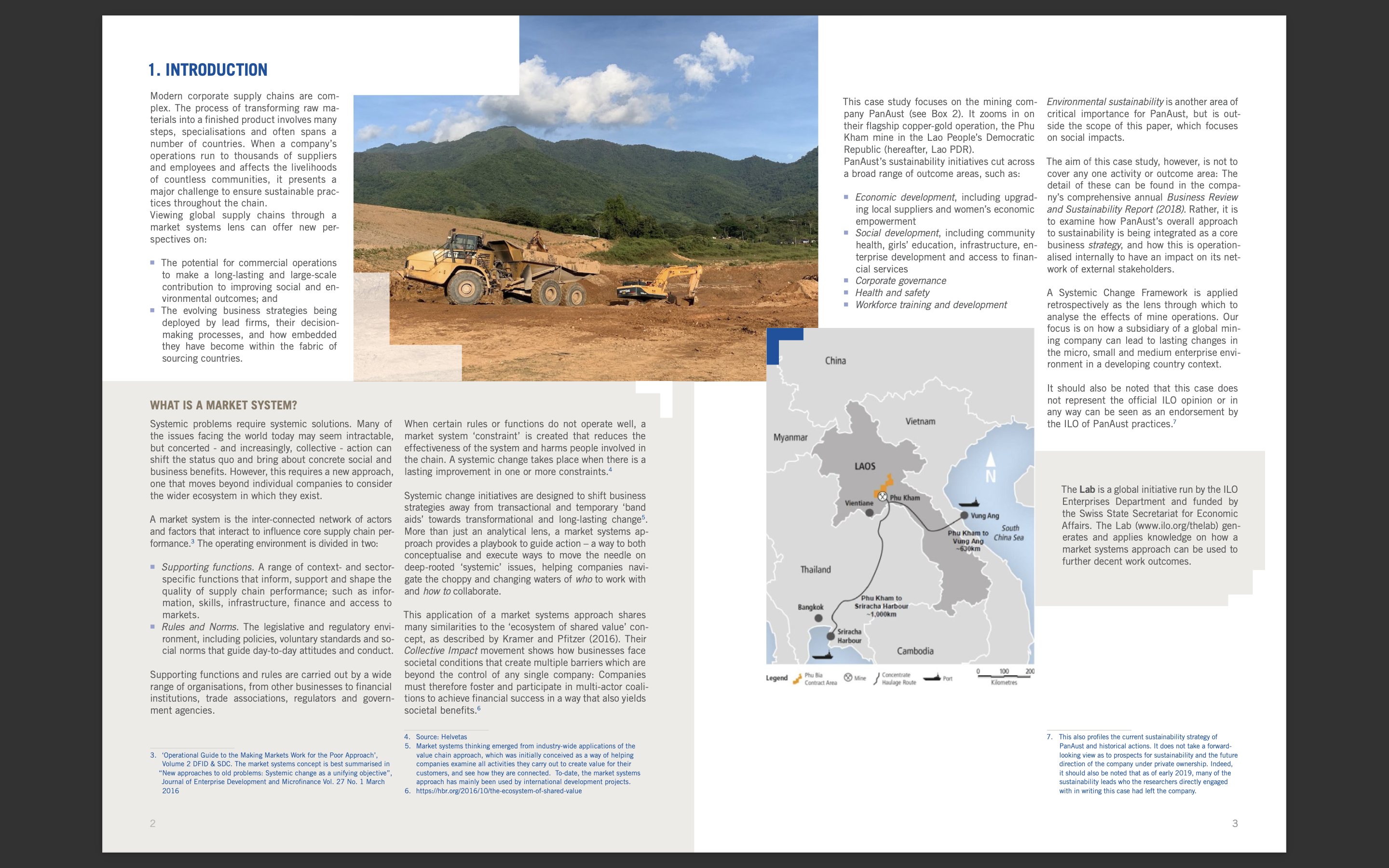
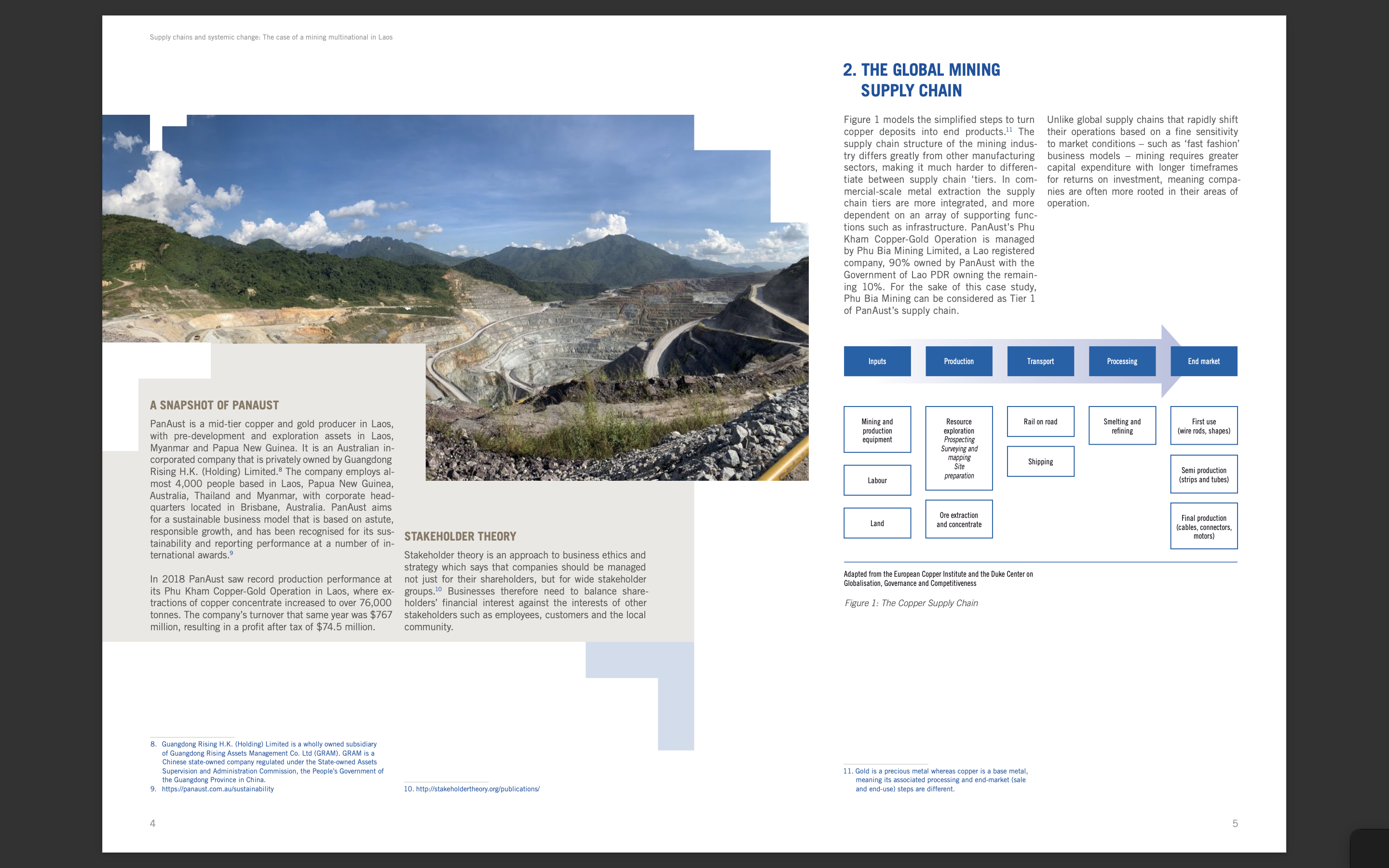
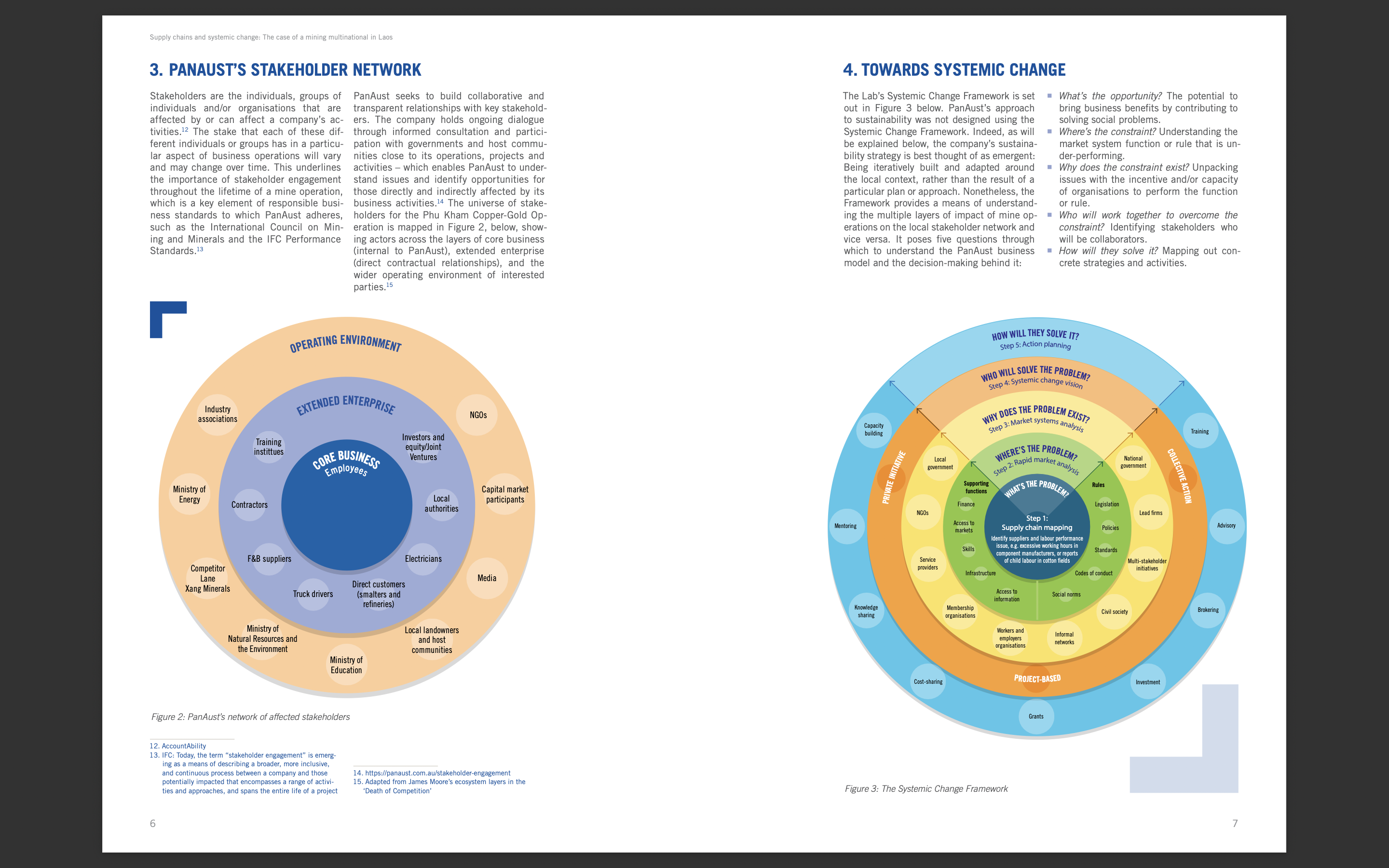
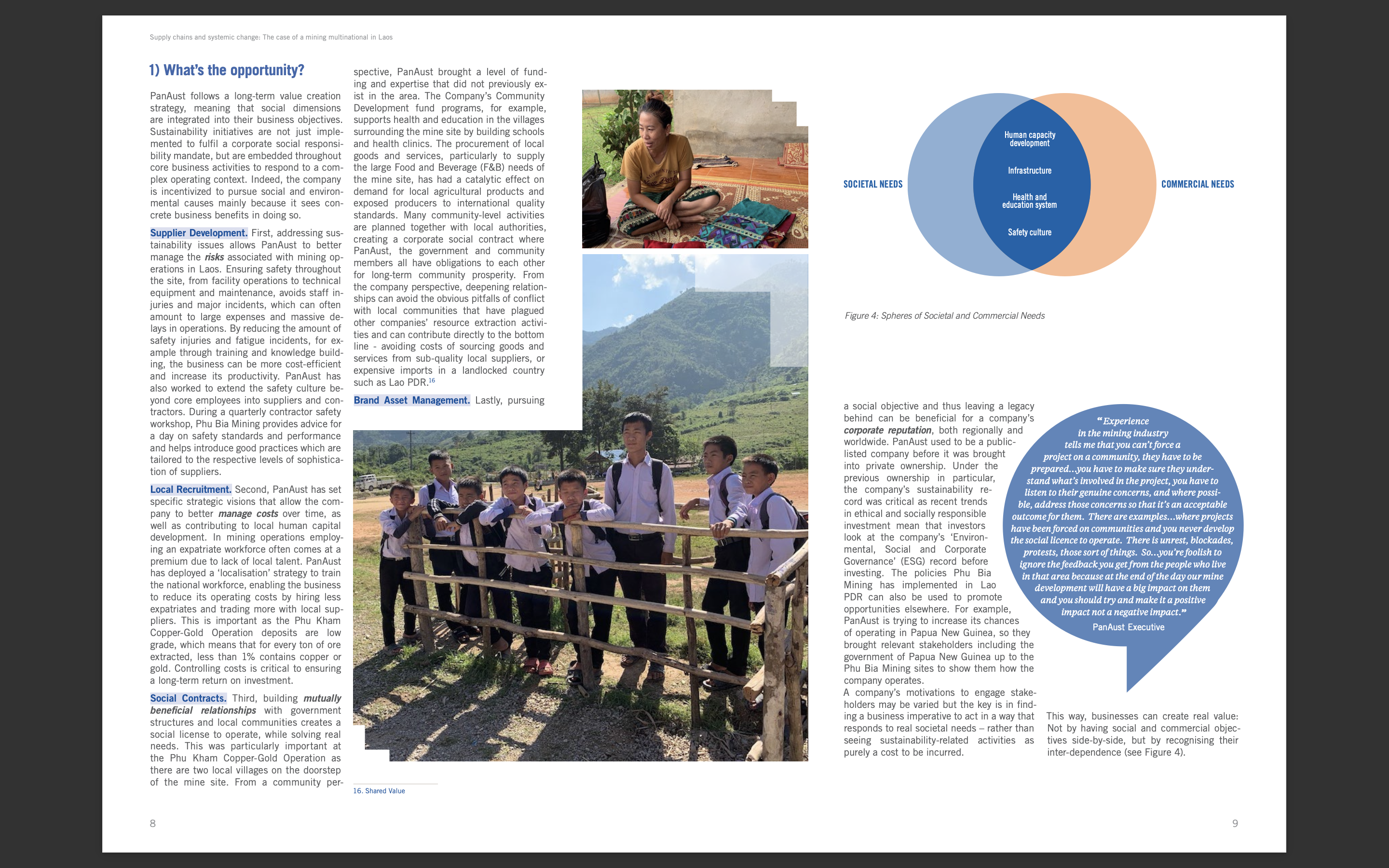
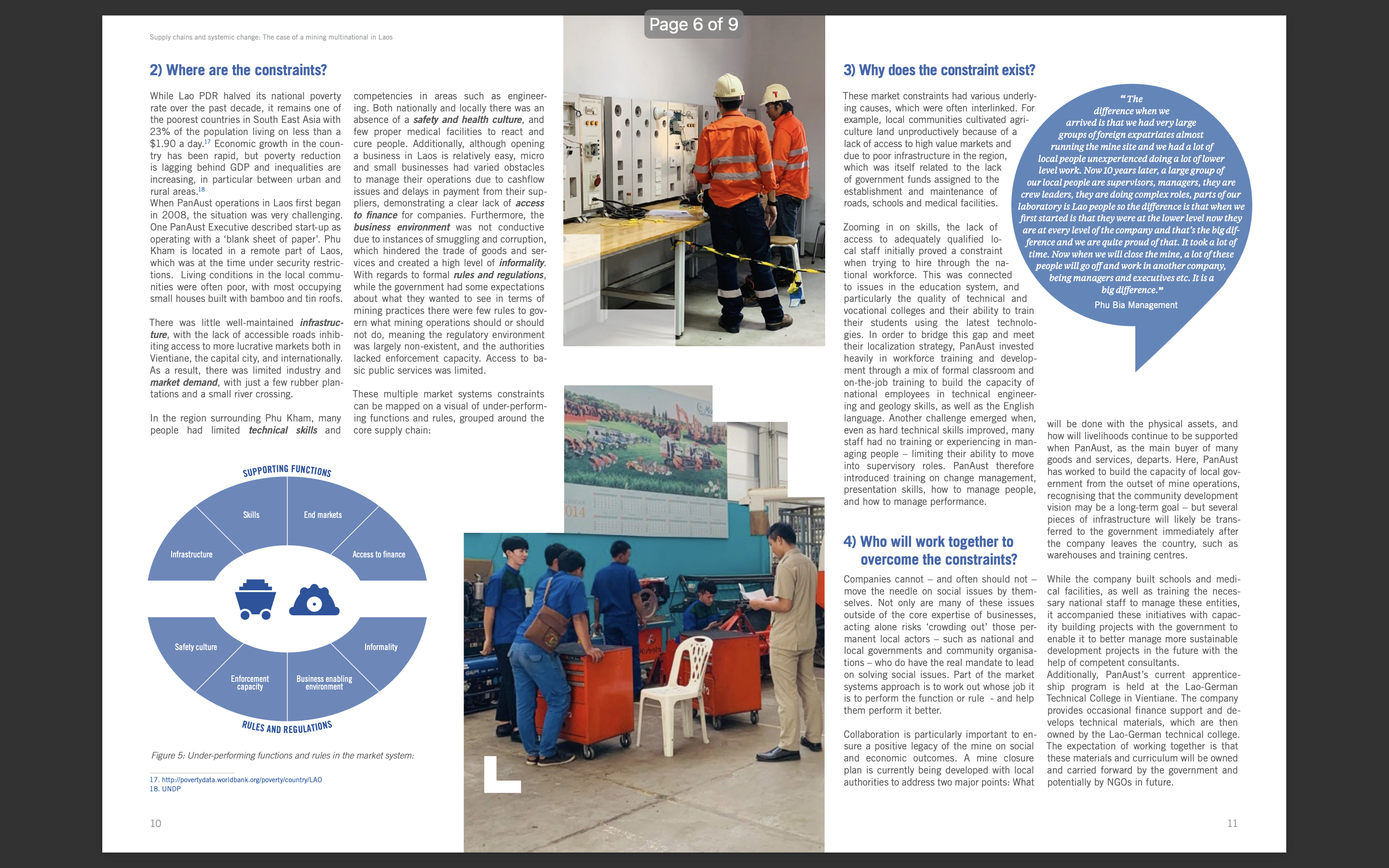
1. INTRODUCTION Modern corporate supply chains are com- plex. The process of transforming raw ma- This case study focuses on the mining com- Environmental sustainability is another area of erials into a finished product involves many pany PanAust (see Box 2). It zooms in on critical importance for PanAust, but is out- steps, specialisations and often spans a their flagship copper-gold operation, the Phu side the scope of this paper, which focuses number of countries. When a company's Kham mine in the Lao People's Democratic on social impacts. operations run to thousands of suppliers Republic (hereafter, Lao PDR). and employees and affects the livelihoods PanAust's sustainability initiatives cut across The aim of this case study, however, is not to of countless communities, it presents a a broad range of outcome areas, such as: cover any one activity or outcome area: The major challenge to ensure sustainable prac- detail of these can be found in the compa- tices throughout the chain. " Economic development, including upgrad- ny's comprehensive annual Business Review Viewing global supply chains through a ing local suppliers and women's economic and Sustainability Report (2018). Rather, it is market systems lens can offer new per- empowerment to examine how PanAust's overall approach spectives on: Social development, including community to sustainability is being integrated as a core health, girls' education, infrastructure, en- business strategy, and how this is operation The potential for commercial operations terprise development and access to finan- alised internally to have an impact on its net- to make a long-lasting and large-scale cial services work of external stakeholders. contribution to improving social and en- Corporate governance vironmental outcomes; and Health and safety A Systemic Change Framework is applied The evolving business strategies being Workforce training and development retrospectively as the lens through which to deployed by lead firms, their decision- analyse the effects of mine operations. Our making processes, and how embedded focus is on how a subsidiary of a global min- they have become within the fabric of ing company can lead to lasting changes in sourcing countries. the micro, small and medium enterprise envi- China ronment in a developing country context. It should also be noted that this case does WHAT IS A MARKET SYSTEM? not represent the official ILO opinion or in any way can be seen as an endorsement by Systemic problems require systemic solutions. Many of When certain rules or functions do not operate well, a Vietnam the ILO of PanAust practices.? the issues facing the world today may seem intractable, market system 'constraint' is created that reduces the Myanmar but concerted - and increasingly, collective - action can effectiveness of the system and harms people involved in shift the status quo and bring about concrete social and the chain. A systemic change takes place when there is a business benefits. However, this requires a new approach, lasting improvement in one or more constraints. LAOS N one that moves beyond individual companies to consider the wider ecosystem in which they exist. Systemic change initiatives are designed to shift business Vientiane Phu Kham The Lab is a global initiative run by the ILO strategies away from transactional and temporary 'band Enterprises Department and funded by A market system is the inter-connected network of actors aids' towards transformational and long-lasting changes Vung Ang the Swiss State Secretariat for Economic and factors that interact to influence core supply chain per- More than just an analytical lens, a market systems ap South Affairs. The Lab (www.ilo.org/thelab) gen- Phu Kham to China Sea formance. The operating environment is divided in two: proach provides a playbook to guide action - a way to both Vung Ang erates and applies knowledge on how a conceptualise and execute ways to move the needle on -630km market systems approach can be used to Supporting functions. A range of context- and sector- deep-rooted 'systemic' issues, helping companies navi- further decent work outcomes. Thailand specific functions that inform, support and shape the gate the choppy and changing waters of who to work with quality of supply chain performance; such as infor- and how to collaborate. mation, skills, infrastructure, finance and access to Phu Kham to Bangkok riracha Harbour markets. This application of a market systems approach shares ~1,000km Rules and Norms. The legislative and regulatory envi- many similarities to the 'ecosystem of shared value' con- Sriracha ronment, including policies, voluntary standards and so- cept, as described by Kramer and Pfitzer (2016). Their Harbour cial norms that guide day-to-day attitudes and conduct. Collective Impact movement shows how businesses face Cambodia societal conditions that create multiple barriers which are Supporting functions and rules are carried out by a wide beyond the control of any single company: Companies Legend Contract Area Mine / Haulage Route Port 100 range of organisations, from other businesses to financial must therefore foster and participate in multi-actor coali- institutions, trade associations, regulators and govern- tions to achieve financial success in a way that also yields ment agencies. societal benefits.6 Source: Helvetas This also profiles the current sustainability strategy of Market systems thinking emerged from industry-wide applications of the PanAust and historical actions. It does not take a forward- 3. 'Operational Guide to the Making Markets Work for the Poor Approach', value chain approach, which was i which was initially conceived as a way of helping looking view as to prospects for sustainability and the future Volume 2 DFID & SDC. The market systems concept is best summarised in companies examine all activities they carry out to create value for their direction of the company under private ownership. Indeed, "New approaches to old problems: Systemic change as a unifying objective" tomers, and see how they are connected. To-date, the market systems it should also be noted that as of early 2019, Journal of Enterprise Development and Microfinance Vol. 27 No. 1 March approach has mainly been used by international development projects. sustainability leads who the researchers directly engaged 2016 https:/hbr.org/2016/10/the-ecosystem-of-shared-value with in writing this case had left the company. 3Supply chains and systemic change: The case of a mining multinational in Laos 2. THE GLOBAL MINING SUPPLY CHAIN Figure 1 models the simplified steps to turn Unlike global supply chains that rapidly shift copper deposits into end products. The their operations based on a fine sensitivity supply chain structure of the mining indus- to market conditions - such as 'fast fashion' try differs greatly from other manufacturing business models - mining requires greater sectors, making it much harder to differen- capital expenditure with longer timeframes tiate between supply chain 'tiers. In com- for returns on investment, meaning compa- mercial-scale metal extraction the supply nies are often more rooted in their areas of chain tiers are more integrated, and more operation. dependent on an array of supporting func- tions such as infrastructure. PanAust's Phu Kham Copper-Gold Operation is managed by Phu Bia Mining Limited, a Lao registered company, 90% owned by PanAust with the Government of Lao PDR owning the remain- ing 10%. For the sake of this case study, Phu Bia Mining can be considered as Tier 1 of PanAust's supply chain Inputs Production Transport Processing End market A SNAPSHOT OF PANAUST PanAust is a mid-tier copper and gold producer in Laos, Mining and Resource Rail on road Smelting and First use with pre-development and exploration assets in Laos, production xploration refining (wire rods, shapes) equipment Prospecting Myanmar and Papua New Guinea. It is an Australian in- Surveying and corporated company that is privately owned by Guangdong mapping Shipping Rising H.K. (Holding) Limited. The company employs al- preparation Semi production most 4,000 people based in Laos, Papua New Guinea, Labour (strips and tubes) Australia, Thailand and Myanmar, with corporate head- quarters located in Brisbane, Australia. PanAust aims for a sustainable business model that is based on astute, Ore extraction Land and concentrate Final production responsible growth, and has been recognised for its sus- cables, connectors tainability and reporting performance at a number of in- STAKEHOLDER THEORY motors) ternational awards.9 Stakeholder theory is an approach to business ethics and strategy which says that companies should be managed In 2018 PanAust saw record production performance at not just for their shareholders, but for wide stakeholder Adapted from the European Copper Institute and the Duke Center on Globalisation, Governance and Competitiveness its Phu Kham Copper-Gold Operation in Laos, where ex- groups.10 Businesses therefore need to balance share tractions of copper concentrate increased to over 76,000 holders' financial interest against the interests of other Figure 1: The Copper Supply Chain tonnes. The company's turnover that same year was $767 stakeholders such as employees, customers and the local million, resulting in a profit after tax of $74.5 million. community. 8. Guangdong Rising H.K. (Holding) Limited is a wholly owned subsidiary of Guangdong Rising Assets Management Co. Lid (GR Chinese state-owned company regulated under the State-ow Supervision and Administration Commission, the People's Government of 1 1. Gold is a precious metal whereas copper is a base metal, the Guangdong Province in China. meaning its associated processing and end-market (sale 9. https://panaust.com.au/sustainability 10. http:/stakeholdertheory.org/publications/ and end-use) steps are different. 5Supply chains and systemic change: The case of a mining multinational in Laos 3. PANAUST'S STAKEHOLDER NETWORK 4. TOWARDS SYSTEMIC CHANGE Stakeholders are the individuals, groups of PanAust seeks to build collaborative and The Lab's Systemic Change Framework is set . What's the opportunity? The potential to individuals and/or organisations that are transparent relationships with key stakehold- out in Figure 3 below. PanAust's approach bring business benefits by contributing to affected by or can affect a company's ac- ers. The company holds ongoing dialogue to sustainability was not designed using the solving social problems. tivities.12 The stake that each of these dif- through informed consultation and partici- Systemic Change Framework. Indeed, as will . Where's the constraint? Understanding the ferent individuals or groups has in a particu- pation with governments and host commu- be explained below, the company's sustaina- market system function or rule that is un- lar aspect of business operations will vary nities close to its operations, projects and bility strategy is best thought of as emergent: der-performing and may change over time. This underlines activities - which enables PanAust to under- Being iteratively built and adapted around . Why does the constraint exist? Unpacking the importance of stakeholder engagement stand issues and identify opportunities for the local context, rather than the result of a issues with the incentive and/or capacity throughout the lifetime of a mine operation, those directly and indirectly affected by its particular plan or approach. Nonetheless, the of organisations to perform the function which is a key element of responsible busi- business activities.14 The universe of stake- Framework provides a means of understand- or rule. ness standards to which PanAust adheres, holders for the Phu Kham Copper-Gold Op- ing the multiple layers of impact of mine op- . Who will work together to overcome the such as the International Council on Min- eration is mapped in Figure 2, below, show- erations on the local stakeholder network and constraint? Identifying stakeholders who ng and Minerals and the IFC Performance ing actors across the layers of core business vice versa. It poses five questions through will be collaborators. Standards.13 (internal to PanAust), extended enterprise which to understand the PanAust business . How will they solve it? Mapping out con- (direct contractual relationships), and the model and the decision-making behind it: crete strategies and activities. wider operating environment of interested parties. 15 OPERATING ENVIRONMENT HOW WILL THEY SOLVE IT? Step 5: Action planning WHO WILL SOLVE THE PROBLEM? Step 4: Systemic change vision Industry EXTENDED ENTERPRISE associations NGOS WHY DOES THE PROBLEM EXIST? building Step 3: Market systems analysis Training Training Investors and instittues equity/Joint CORE BUSINESS WHERE'S THE PROBLEM? Nationa Employees vernmen Step 2: Rapid market analysis overnme PRIVATE INITIATIVE COLLECTIVE ACTION Ministry of Capital market functions WHAT'S THE PROBLEM Rules Energy Contractors Local participants luthorities Finance Legislation NGO Step 1: Lead firms Mentoring markets Supply chain mapping Policies Advisor dentify suppliers and labour performance Skills issue, e.g. excess manure working hours in Standards F&B suppliers Electricians Service of child labour in cotton fields Multi-stakehold Competitor providers Infrastructure Codes of conduct initiatives Lane Media Xang Minerals Direct customers Truck drivers (smalters and Access to refineries) formation Social norms Knowledge Members rganisation Civil society brokering Ministry of Local landowners Workers and Natural Resources and and host employers Informal networks the Environment communities organisations Ministry of Education Cost -sharing PROJECT-BASED Investment Figure 2: PanAust's network of affected stakeholders Grants 12. AccountAbility 13. IFC: Today, the term "stakeholder engagement" is emerg- describing a broader, more inclusive, and continuous process between a company and those 14. https:/panaust.com.au/stakeholder-engagement potentially impacted that encompasses a range of activi 15. Adapted from James Moore's ecosystem layers in the ties and approaches, and spans the entire life of a project "Death of Competition' Figure 3: The Systemic Change FrameworkSupply chains and systemic change: The case of a mining multinational in Laos 1) What's the opportunity? spective, PanAust brought a level of fund- ing and expertise that did not previously ex- PanAust follows a long-term value creation ist in the area. The Company's Community strategy, meaning that social dimensions Development fund programs, for example, are integrated into their business objectives. supports health and education in the villages Sustainability initiatives are not just imple- surrounding the mine site by building schools Human capacity mented to fulfil a corporate social responsi- and health clinics. The procurement of local development bility mandate, but are embedded throughout goods and services, particularly to supply core business activities to respond to a com- the large Food and Beverage (F&B) needs of Infrastructure plex operating context. Indeed, the company the mine site, has had a catalytic effect on SOCIETAL NEEDS COMMERCIAL NEEDS is incentivized to pursue social and environ- demand for local agricultural products and mental causes mainly because it sees con- exposed producers to international quality Health and education system crete business benefits in doing so. standards. Many community-level activities Supplier Development. First, addressing sus- are planned together with local authorities, tainability issues allows PanAust to better creating a corporate social contract where Safety culture manage the risks associated with mining op- PanAust, the government and community erations in Laos. Ensuring safety throughout members all have obligations to each other the site, from facility operations to technical for long-term community prosperity. From equipment and maintenance, avoids staff in- the company perspective, deepening relation- juries and major incidents, which can often ships can avoid the obvious pitfalls of conflict amount to large expenses and massive de- with local communities that have plagued Figure 4: Spheres of Societal and Commercial Needs lays in operations. By reducing the amount of other companies' resource extraction activi- safety injuries and fatigue incidents, for ex- ties and can contribute directly to the bottom ample through training and knowledge build- line - avoiding costs of sourcing goods and ing, the business can be more cost-efficient services from sub-quality local suppliers, or and increase its productivity. PanAust has expensive imports in a landlocked country also worked to extend the safety culture be- such as Lao PDR. 16 yond core employees into suppliers and con- Brand Asset Management. Lastly, pursuing tractors. During a quarterly contractor safety a social objective and thus leaving a legacy workshop, Phu Bia Mining provides advice for behind can be beneficial for a company's "Experience a day on safety standards and performance corporate reputation, both regionally and in the mining industry and helps introduce good practices which are worldwide. PanAust used to be a public- tells me that you can't force a tailored to the respective levels of sophisticat listed company before it was brought project on a community, they have to be tion of suppliers. into private ownership. Under the prepared..you have to make sure they under- previous ownership in particular, Local Recruitment. Second, PanAust has set stand what's involved in the project, you have to the company's sustainability re- listen to their genuine concerns, and where possi- specific strategic visions that allow the com- cord was critical as recent trends ble, address those concer ns so that it's an acceptable pany to better manage costs over time, as in ethical and socially responsible outcome for them. There are examples...where projects well as contributing to local human capital investment mean that investors have been forced on communities and you never develop development. In mining operations employ- look at the company's 'Environ- the social licence to operate. There is unrest, blockades, ng an expatriate workforce often comes at a mental, Social and Corporate protests, those sort of things. So..you're foolish to premium due to lack of local talent. PanAust Governance' (ESG) record before ignore the feedback you get from the people who live has deployed a 'localisation' strategy to train nvesting. The policies Phu Bia in that area because at the end of the day our mine the national workforce, enabling the business Mining has implemented in Lao to reduce its operating costs by hiring less PDR can also be used to promote development will have a big impact on them and you should try and make it a positive expatriates and trading more with local sup- opportunities elsewhere. For example, pliers. This is important as the Phu Kham impact not a negative impact." PanAust is trying to increase its chances Copper-Gold Operation deposits are low of operating in Papua New Guinea, so they PanAust Executive grade, which means that for every ton of ore brought relevant stakeholders including the extracted, less than 1% contains copper or government of Papua New Guinea up to the gold. Controlling costs is critical to ensuring Phu Bia Mining sites to show them how the a long-term return on investment. company operates. Social Contracts. Third, building mutually A company's motivations to engage stake- beneficial relationships with government holders may be varied but the key is in find- structures and local communities creates a ing a business imperative to act in a way that This way, businesses can create real value: social license to operate, while solving real responds to real societal needs - rather than Not by having social and commercial object needs. This was particularly important at seeing sustainability-related activities s tives side-by-side, but by recognising their the Phu Kham Copper-Gold Operation as purely a cost to be incurred. inter-dependence (see Figure 4). there are two local villages on the doorstep of the mine site. From a community per- 16. Shared Value 8Page 6 of 9 Supply chains and systemic change: The case of a mining multinational in Laos 2) Where are the constraints? 3) Why does the constraint exist? While Lao PDR halved its national poverty competencies in areas such as engineer- These market constraints had various underly- "The rate over the past decade, it remains one of ing. Both nationally and locally there was an ing causes, which were often interlinked. For difference when we the poorest countries in South East Asia with absence of a safety and health culture, and example, local communities cultivated agri- arrived is that we had very large 23% of the population living on less than a few proper medical facilities to react and culture land unproductively because of a groups of foreign expatriates almost $1.90 a day.17 Economic growth in the coun- cure people. Additionally, although opening lack of access to high value markets and running the mine site and we had a lot of try has been rapid, but poverty reduction a business in Laos is relatively easy, micro due to poor infrastructure in the region, local people unexperienced doing a lot of lower is lagging behind GDP and inequalities are and small businesses had varied obstacles which was itself related to the lack level work. Now 10 years later, a large group of increasing, in particular between urban and to manage their operations due to cashflow of government funds assigned to the our local people are supervisors, managers, they are rural areas. 18 issues and delays in payment from their sup- establishment and maintenance of crew leaders, they are doing complex roles, parts of our When PanAust operations in Laos first began pliers, demonstrating a clear lack of access roads, schools and medical facilities. laboratory is Lao people so the difference is that when we in 2008, the situation was very challenging. to finance for companies. Furthermore, the Zooming in on skills, the lack of first started is that they were at the lower level now they One PanAust Executive described start-up as business environment was not conductive are at every level of the company and that's the big dif- operating with a 'blank sheet of paper'. Phu due to instances of smuggling and corruption, access to adequately qualified lo- cal staff initially proved a constraint ference and we are quite proud of that. It took a lot of Kham is located in a remote part of Laos, which hindered the trade of goods and ser- when trying to hire through the na- time. Now when we will close the mine, a lot of these which was at the time under security restricices and created a high level of informality. tions. Living conditions in the local commu- With regards to formal rules and regulations, tional workforce. This was connected people will go off and work in another company, being managers and executives etc. It is a nities were often poor, with most occupying while the government had some expectations to issues in the education system, and small houses built with bamboo and tin roofs. about what they wanted to see in terms of particularly the quality of technical and big difference." mining practices there were few rules to gov- vocational colleges and their ability to train hu Bia Management There was little well-maintained infrastrucern what mining operations should or should their students using the latest technolo ture, with the lack of accessible roads inhib- not do, meaning the regulatory environment gies. In order to bridge this gap and meet iting access to more lucrative markets both in was largely non-existent, and the authorities their localization strategy, PanAust invested Vientiane, the capital city, and internationally. lacked enforcement capacity. Access to ba- heavily in workforce training and develop- As a result, there was limited industry and sic public services was limited. ment through a mix of formal classroom and market demand, with just a few rubber plan- on-the-job training to build the capacity of tations and a small river crossing These multiple market systems constraints national employees in technical engineer- can be mapped on a visual of under-perform- ing and geology skills, as well as the English In the region surrounding Phu Kham, many ing functions and rules, grouped around the language. Another challenge emerged when, people had limited technical skills and core supply chain: even as hard technical skills improved, many will be done with the physical assets, and staff had no training or experiencing in man- how will livelihoods continue to be supported aging people - limiting their ability to move when PanAust, as the main buyer of many into supervisory roles. PanAust therefore goods and services, departs. Here, PanAust SUPPORTING FUNCTIONS introduced training on change management, has worked to build the capacity of local gov presentation skills, how to manage people, ernment from the outset of mine operations, and how to manage performance. recognising that the community development Skills End markets vision may be a long-term goal - but several pieces of infrastructure will likely be trans- ferred to the government immediately after 4) Who will work together to the company leaves the country, such as Infrastructure Access to finance overcome the constraints? warehouses and training centres. Companies cannot - and often should not - While the company built schools and medi- move the needle on social issues by them- cal facilities, as well as training the neces- selves. Not only are many of these issues sary national staff to manage these entities, outside of the core expertise of businesses, it accompanied these initiatives with capac- acting alone risks 'crowding out' those per- ity building projects with the government to Safety culture Informality manent local actors - such as national and enable it to better manage more sustainable local governments and community organisa- development projects in the future with the tions - who do have the real mandate to lead help of competent consultants. Enforcement Business enabling on solving social issues. Part of the market Additionally, PanAust's current apprentice- capacity environment systems approach is to work out whose job it ship program is held at the Lao-German s to perform the function or rule - and help Technical College in Vientiane. The company them perform it better. provides occasional finance support and de- RULES AND REGULATIONS velops technical materials, which are then Collaboration is particularly important to en- owned by the Lao-German technical college. sure a positive legacy of the mine on social The expectation of working together is that Figure 5: Under-performing functions and rules in the market system: and economic outcomes. A mine closure these materials and curriculum will be owned plan is currently being developed with local and carried forward by the government and 17. http:/povertydata.worldbank.org/poverty/country/LAO 18. UNDP authorities to address two major points: What potentially by NGOs in future. 10 11
Step by Step Solution
There are 3 Steps involved in it
1 Expert Approved Answer
Step: 1 Unlock
Question Has Been Solved by an Expert!
Get step-by-step solutions from verified subject matter experts
Step: 2 Unlock
Step: 3 Unlock
Students Have Also Explored These Related General Management Questions!









 Study Help