







Question: 1) Is a good economist always objective? Explain your answer 2) Written in 1776, Adam Smith was concerned not only with the profound effects of
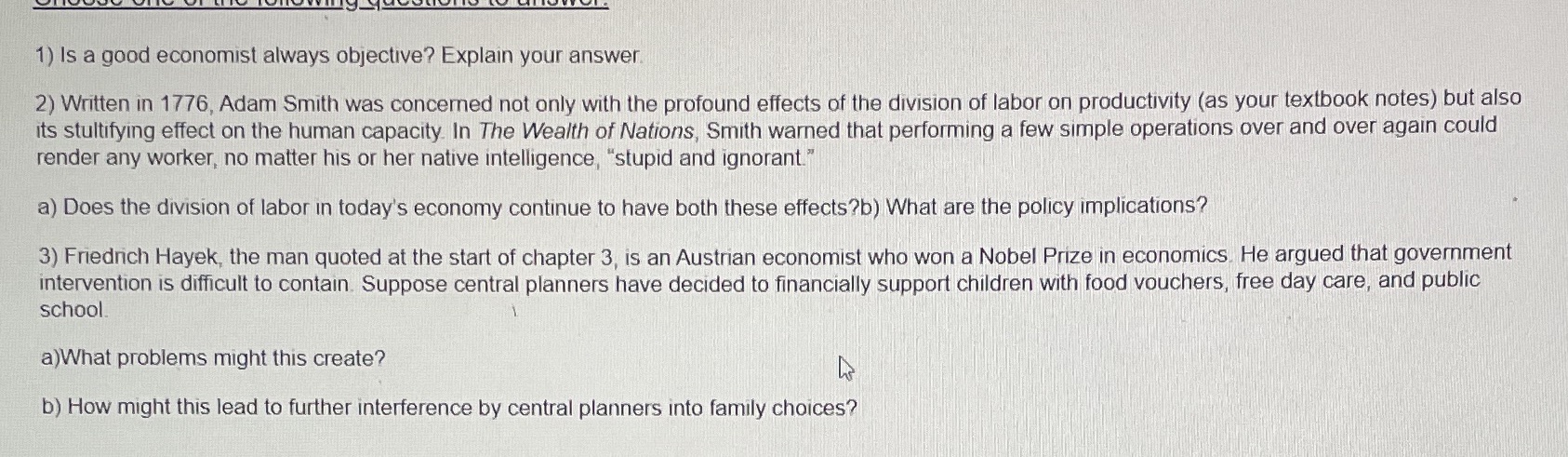
1) Is a good economist always objective? Explain your answer 2) Written in 1776, Adam Smith was concerned not only with the profound effects of the division of labor on productivity (as your textbook notes) but also its stultifying effect on the human capacity. In The Wealth of Nations, Smith warned that performing a few simple operations over and over again could render any worker, no matter his or her native intelligence, "stupid and ignorant." a) Does the division of labor in today's economy continue to have both these effects?b) What are the policy implications? 3) Friedrich Hayek, the man quoted at the start of chapter 3, is an Austrian economist who won a Nobel Prize in economics. He argued that government intervention is difficult to contain. Suppose central planners have decided to financially support children with food vouchers, free day care, and public school. a)What problems might this create? b) How might this lead to further interference by central planners into family choices
Step by Step Solution
There are 3 Steps involved in it

Get step-by-step solutions from verified subject matter experts
 Study Help