







Question: 1. Is the communication plan adopted in this project realistic enough in terms of communicating to all stakeholders of the project? 2. Publicly run projects
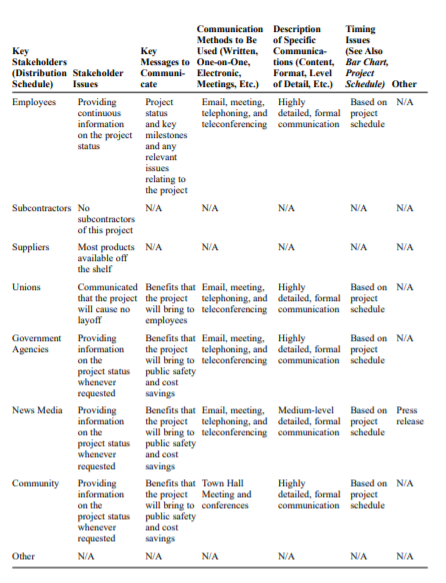
1. Is the communication plan adopted in this project realistic enough in terms of communicating to all stakeholders of the project?
2. Publicly run projects are quite different from privately run projects. Can you specify different communications that would be needed in a project involving, say, unions as opposed to a private project?
3. Are the communications plans compatible with PMBOK s Guide s Project Communication Management? Why?
Note: Need good explanation of these three questions according to case and provide references.
Thank You.
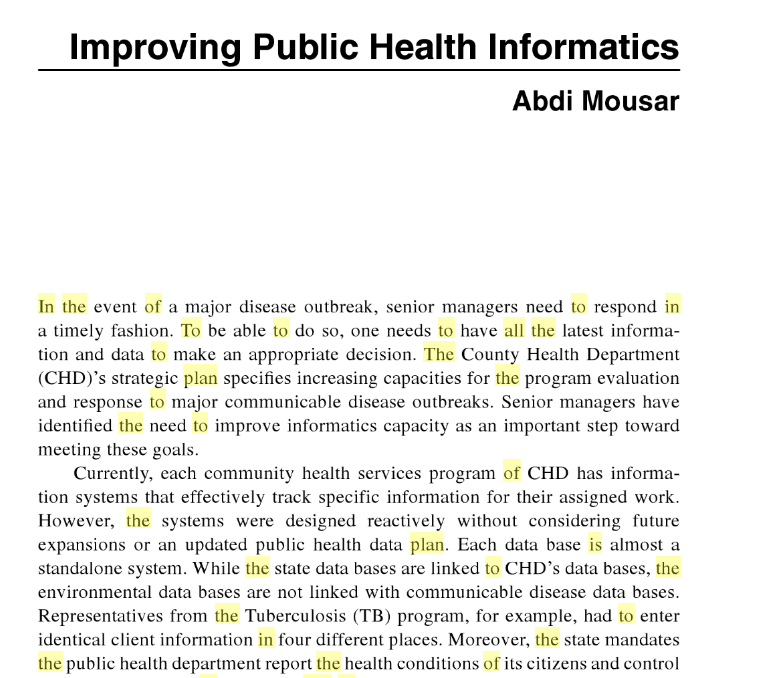
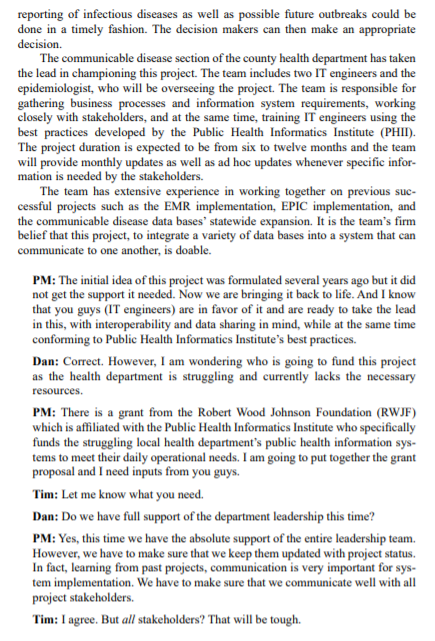
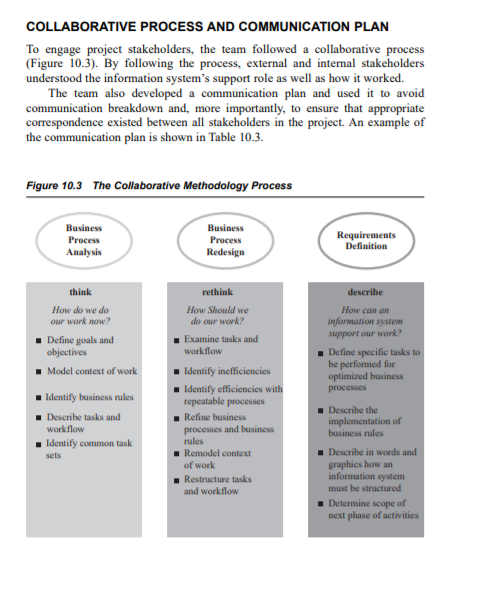
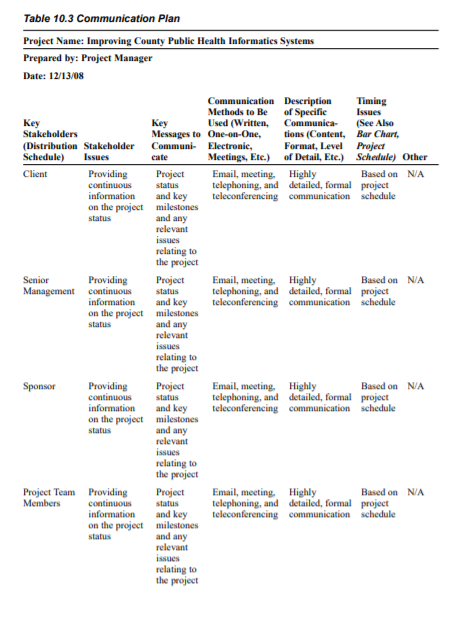
Improving Public Health Informatics Abdi Mousar In the event of a major disease outbreak, senior managers need to respond in a timely fashion. To be able to do so, one needs to have all the latest informa- tion and data to make an appropriate decision. The County Health Department (CHD)'s strategic plan specifies increasing capacities for the program evaluation and response to major communicable disease outbreaks. Senior managers have identified the need to improve informatics capacity as an important step toward meeting these goals. Currently, each community health services program of CHD has informa- tion systems that effectively track specific information for their assigned work. However, the systems were designed reactively without considering future expansions or an updated public health data plan. Each data base is almost a standalone system. While the state data bases are linked to CHD's data bases, the environmental data bases are not linked with communicable disease data bases. Representatives from the Tuberculosis (TB) program, for example, had to enter identical client information in four different places. Moreover, the state mandates the public health department report the health conditions of its citizens and control reporting of infectious diseases as well as possible future outbreaks could be done in a timely fashion. The decision makers can then make an appropriate decision. The communicable disease section of the county health department has taken the lead in championing this project. The team includes two IT engineers and the epidemiologist, who will be overseeing the project. The team is responsible for gathering business processes and information system requirements, working closely with stakeholders, and at the same time, training IT engineers using the best practices developed by the Public Health Informatics Institute (PHI). The project duration is expected to be from six to twelve months and the team will provide monthly updates as well as ad hoc updates whenever specific infor- mation is needed by the stakeholders. The team has extensive experience in working together on previous suc- cessful projects such as the EMR implementation, EPIC implementation, and the communicable disease data bases' statewide expansion. It is the team's firm belief that this project, to integrate a variety of data bases into a system that can communicate to one another, is doable. PM: The initial idea of this project was formulated several years ago but it did not get the support it needed. Now we are bringing it back to life. And I know that you guys (IT engineers) are in favor of it and are ready to take the lead in this, with interoperability and data sharing in mind, while at the same time conforming to Public Health Informatics Institute's best practices. Dan: Correct. However, I am wondering who is going to fund this project as the health department is struggling and currently lacks the necessary resources. PM: There is a grant from the Robert Wood Johnson Foundation (RWJF) which is affiliated with the Public Health Informatics Institute who specifically funds the struggling local health department's public health information sys- tems to meet their daily operational needs. I am going to put together the grant proposal and I need inputs from you guys. Tim: Let me know what you need. Dan: Do we have full support of the department leadership this time? PM: Yes, this time we have the absolute support of the entire leadership team. However, we have to make sure that we keep them updated with project status. In fact, learning from past projects, communication is very important for sys- tem implementation. We have to make sure that we communicate well with all project stakeholders. Tim: I agree. But all stakeholders? That will be tough. COLLABORATIVE PROCESS AND COMMUNICATION PLAN To engage project stakeholders, the team followed a collaborative process (Figure 10.3). By following the process, external and internal stakeholders understood the information system's support role as well as how it worked. The team also developed a communication plan and used it to avoid communication breakdown and, more importantly, to ensure that appropriate correspondence existed between all stakeholders in the project. An example of the communication plan is shown in Table 10.3. Figure 10.3 The Collaborative Methodology Process Business Process Analysis Business Process Redesign Requirements Definition think How do we do our work now? Define goals and objectives . Model context of work Identify business rules Describe tasks and workflow Identify common task rethink How Should we do our work? Examine tasks and workflow Identify inefficiencies Identify efficiencies with repeatable processes Refine business processes and business rules Remodel context of work Restructure tasks and workflow deseribe How can an information system support our work? Define specific tasks to be performed for optimized business processes Describe the implementation of business rules Describe in words and graphics how an information system must be structured Determine scope of next phase of activities Table 10.3 Communication Plan Project Name: Improving County Public Health Informatics Systems Prepared by: Project Manager Date: 12/13/08 Communication Description Timing Methods to Be of Specific Issues Key Used (Written, Communica (See Also Stakeholders Messages to One-on-One, tions (Content, Bar Chart, (Distribution Stakeholder Communi- Electronie, Format, Level Project Schedule) Issues cate Meetings, Etc.) of Detail, Etc.) Schedule) Other Client Providing Project Email, meeting, Highly Based on NA continuous status telephoning, and detailed, formal project information and key teleconferencing communication schedule on the project milestones status and any relevant issues relating to the project Senior Providing Project Email, meeting Highly Based on NA Management continuous status telephoning, and detailed, formal project information and key teleconferencing communication schedule on the project milestones status and any relevant issues relating to the project Sponsor Providing Project Email, meeting Highly Based on NA continuous status telephoning, and detailed, formal project information and key teleconferencing communication schedule on the project milestones status relevant issues relating to the project Project Team Providing Project Email, meeting Highly Based on NA Members continuous status telephoning, and detailed, formal project information and key teleconferencing communication schedule on the project milestones status and any relevant issues relating to the project and any Communication Description Timing Methods to Be of Specific Issues Key Key Used (Written, Communica- (See Also Stakeholders Messages to One-on-One, tions (Content, Bar Chart, (Distribution Stakeholder Communi- Electronic, Format, Level Project Schedule) Issues cate Meetings, Etc.) of Detail, Etc.) Schedule) Other Employees Providing Project Email, meeting. Highly Based on N/A continuous status telephoning, and detailed, formal project information and key teleconferencing communication schedule on the project milestones status and any relevant issues relating to the project Subcontractors No NA NA NA NA N/A subcontractors of this project Suppliers Most products NA NA N/A NA N/A available of the shelf Unions Communicated Benefits that Email, meeting, Highly Based on N/A that the project the project telephoning, and detailed, formal project will cause no will bring to teleconferencing communication schedule layoff employees Government Providing Benefits that Email, meeting, Highly Based on N/A Agencies information the project telephoning, and detailed, formal project on the will bring to teleconferencing communication schedule project status public safety whenever and cost requested savings News Media Providing Benefits that Email, meeting, Medium-level Based on Press information the project telephoning, and detailed, formal project release on the will bring to teleconferencing communication schedule project status public safety whenever and cost requested savings Community Providing Benefits that Town Hall Highly Based on N/A information the project Meeting and detailed, formal project will bring to conferences communication schedule project status public safety whenever and cost requested savings Other NA NA NA N/A NA N/A on the Improving Public Health Informatics Abdi Mousar In the event of a major disease outbreak, senior managers need to respond in a timely fashion. To be able to do so, one needs to have all the latest informa- tion and data to make an appropriate decision. The County Health Department (CHD)'s strategic plan specifies increasing capacities for the program evaluation and response to major communicable disease outbreaks. Senior managers have identified the need to improve informatics capacity as an important step toward meeting these goals. Currently, each community health services program of CHD has informa- tion systems that effectively track specific information for their assigned work. However, the systems were designed reactively without considering future expansions or an updated public health data plan. Each data base is almost a standalone system. While the state data bases are linked to CHD's data bases, the environmental data bases are not linked with communicable disease data bases. Representatives from the Tuberculosis (TB) program, for example, had to enter identical client information in four different places. Moreover, the state mandates the public health department report the health conditions of its citizens and control reporting of infectious diseases as well as possible future outbreaks could be done in a timely fashion. The decision makers can then make an appropriate decision. The communicable disease section of the county health department has taken the lead in championing this project. The team includes two IT engineers and the epidemiologist, who will be overseeing the project. The team is responsible for gathering business processes and information system requirements, working closely with stakeholders, and at the same time, training IT engineers using the best practices developed by the Public Health Informatics Institute (PHI). The project duration is expected to be from six to twelve months and the team will provide monthly updates as well as ad hoc updates whenever specific infor- mation is needed by the stakeholders. The team has extensive experience in working together on previous suc- cessful projects such as the EMR implementation, EPIC implementation, and the communicable disease data bases' statewide expansion. It is the team's firm belief that this project, to integrate a variety of data bases into a system that can communicate to one another, is doable. PM: The initial idea of this project was formulated several years ago but it did not get the support it needed. Now we are bringing it back to life. And I know that you guys (IT engineers) are in favor of it and are ready to take the lead in this, with interoperability and data sharing in mind, while at the same time conforming to Public Health Informatics Institute's best practices. Dan: Correct. However, I am wondering who is going to fund this project as the health department is struggling and currently lacks the necessary resources. PM: There is a grant from the Robert Wood Johnson Foundation (RWJF) which is affiliated with the Public Health Informatics Institute who specifically funds the struggling local health department's public health information sys- tems to meet their daily operational needs. I am going to put together the grant proposal and I need inputs from you guys. Tim: Let me know what you need. Dan: Do we have full support of the department leadership this time? PM: Yes, this time we have the absolute support of the entire leadership team. However, we have to make sure that we keep them updated with project status. In fact, learning from past projects, communication is very important for sys- tem implementation. We have to make sure that we communicate well with all project stakeholders. Tim: I agree. But all stakeholders? That will be tough. COLLABORATIVE PROCESS AND COMMUNICATION PLAN To engage project stakeholders, the team followed a collaborative process (Figure 10.3). By following the process, external and internal stakeholders understood the information system's support role as well as how it worked. The team also developed a communication plan and used it to avoid communication breakdown and, more importantly, to ensure that appropriate correspondence existed between all stakeholders in the project. An example of the communication plan is shown in Table 10.3. Figure 10.3 The Collaborative Methodology Process Business Process Analysis Business Process Redesign Requirements Definition think How do we do our work now? Define goals and objectives . Model context of work Identify business rules Describe tasks and workflow Identify common task rethink How Should we do our work? Examine tasks and workflow Identify inefficiencies Identify efficiencies with repeatable processes Refine business processes and business rules Remodel context of work Restructure tasks and workflow deseribe How can an information system support our work? Define specific tasks to be performed for optimized business processes Describe the implementation of business rules Describe in words and graphics how an information system must be structured Determine scope of next phase of activities Table 10.3 Communication Plan Project Name: Improving County Public Health Informatics Systems Prepared by: Project Manager Date: 12/13/08 Communication Description Timing Methods to Be of Specific Issues Key Used (Written, Communica (See Also Stakeholders Messages to One-on-One, tions (Content, Bar Chart, (Distribution Stakeholder Communi- Electronie, Format, Level Project Schedule) Issues cate Meetings, Etc.) of Detail, Etc.) Schedule) Other Client Providing Project Email, meeting, Highly Based on NA continuous status telephoning, and detailed, formal project information and key teleconferencing communication schedule on the project milestones status and any relevant issues relating to the project Senior Providing Project Email, meeting Highly Based on NA Management continuous status telephoning, and detailed, formal project information and key teleconferencing communication schedule on the project milestones status and any relevant issues relating to the project Sponsor Providing Project Email, meeting Highly Based on NA continuous status telephoning, and detailed, formal project information and key teleconferencing communication schedule on the project milestones status relevant issues relating to the project Project Team Providing Project Email, meeting Highly Based on NA Members continuous status telephoning, and detailed, formal project information and key teleconferencing communication schedule on the project milestones status and any relevant issues relating to the project and any Communication Description Timing Methods to Be of Specific Issues Key Key Used (Written, Communica- (See Also Stakeholders Messages to One-on-One, tions (Content, Bar Chart, (Distribution Stakeholder Communi- Electronic, Format, Level Project Schedule) Issues cate Meetings, Etc.) of Detail, Etc.) Schedule) Other Employees Providing Project Email, meeting. Highly Based on N/A continuous status telephoning, and detailed, formal project information and key teleconferencing communication schedule on the project milestones status and any relevant issues relating to the project Subcontractors No NA NA NA NA N/A subcontractors of this project Suppliers Most products NA NA N/A NA N/A available of the shelf Unions Communicated Benefits that Email, meeting, Highly Based on N/A that the project the project telephoning, and detailed, formal project will cause no will bring to teleconferencing communication schedule layoff employees Government Providing Benefits that Email, meeting, Highly Based on N/A Agencies information the project telephoning, and detailed, formal project on the will bring to teleconferencing communication schedule project status public safety whenever and cost requested savings News Media Providing Benefits that Email, meeting, Medium-level Based on Press information the project telephoning, and detailed, formal project release on the will bring to teleconferencing communication schedule project status public safety whenever and cost requested savings Community Providing Benefits that Town Hall Highly Based on N/A information the project Meeting and detailed, formal project will bring to conferences communication schedule project status public safety whenever and cost requested savings Other NA NA NA N/A NA N/A on theStep by Step Solution
There are 3 Steps involved in it
1 Expert Approved Answer
Step: 1 Unlock

Question Has Been Solved by an Expert!
Get step-by-step solutions from verified subject matter experts
Step: 2 Unlock
Step: 3 Unlock
 Study Help