







Question: 1. Is the relation represented by the set S a partial ordering? S = { ( a , a ), ( b , b ),
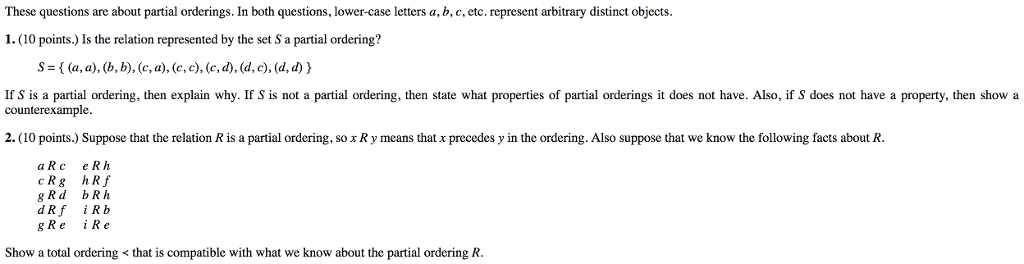
1. Is the relation represented by the set S a partial ordering?
S = { (a, a), (b, b), (c, a), (c, c), (c, d), (d, c), (d, d) }
If S is a partial ordering, then explain why. If S is not a partial ordering, then state what properties of partial orderings it does not have. Also, if S does not have a property, then show a counterexample.
2. Suppose that the relation R is a partial ordering, so x R y means that x precedes y in the ordering. Also suppose that we know the following facts about R.
aRc eRh
cRg hRf
gRd bRh
dRf iRb
gRe iRe
Show a total ordering ? that is compatible with what we know about the partial ordering R.
These questions are about partial orderings. In both questions, lower-case letters a, b, c, etc. represent arbitrary distinct objects. 1. (10 points.) Is the relation represented by the set S a partial ordering? If S is a partial ordering, then explain why. If S is not a partial ordering, then state what properties of partial orderings it does not have. Also, if S does not have a property, then show a counterexample. 2. (10 points.) Suppose that the relation R is a partial ordering, so x Ry means that x precedes y in the ordering. Also suppose that we know the following facts about R. a Rc eRh g Rd bRh dRf iRb gRe iRe Show a total ordering that is compatible with what we know about the partial ordering R
Step by Step Solution
There are 3 Steps involved in it

Get step-by-step solutions from verified subject matter experts
 Study Help