







Question: 1. I've written the program for a Picasso who lives only two periods (so makes a decision about how much to produce only twice).
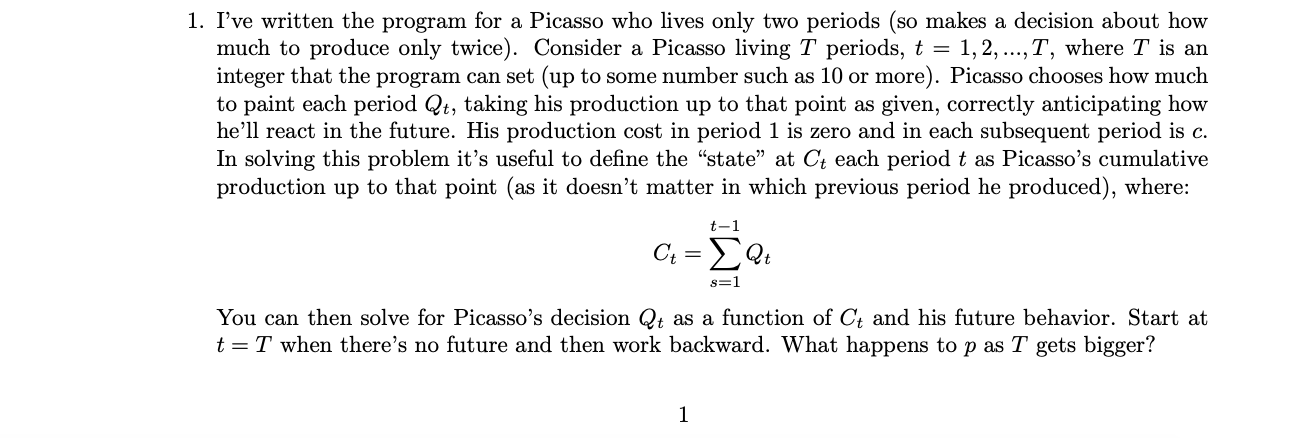
1. I've written the program for a Picasso who lives only two periods (so makes a decision about how much to produce only twice). Consider a Picasso living T periods, t = 1, 2, ..., T, where T is an integer that the program can set (up to some number such as 10 or more). Picasso chooses how much to paint each period Qt, taking his production up to that point as given, correctly anticipating how he'll react in the future. His production cost in period 1 is zero and in each subsequent period is c. In solving this problem it's useful to define the "state" at Ct each period t as Picasso's cumulative production up to that point (as it doesn't matter in which previous period he produced), where: t-1 t C = Qt s=1 You can then solve for Picasso's decision Qt as a function of Ct and his future behavior. Start at t = T when there's no future and then work backward. What happens to p as T gets bigger? 1
Step by Step Solution
There are 3 Steps involved in it

Get step-by-step solutions from verified subject matter experts
 Study Help