







Question: 1) Kyle is flying a helicopter when he drops a bag. When the bag has fallen 2.0s; a. What is the bag's velocity? b. How
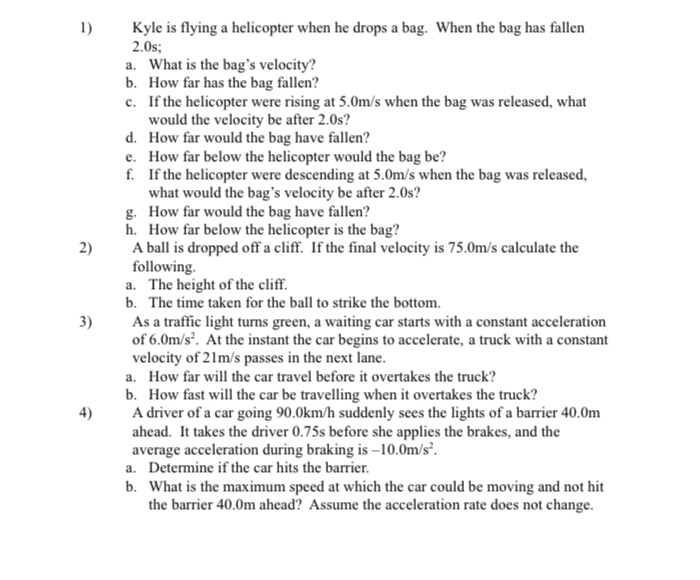
1) Kyle is flying a helicopter when he drops a bag. When the bag has fallen 2.0s; a. What is the bag's velocity? b. How far has the bag fallen? c. If the helicopter were rising at 5.0m/s when the bag was released, what would the velocity be after 2.0s? d. How far would the bag have fallen? c. How far below the helicopter would the bag be? f. If the helicopter were descending at 5.0m/s when the bag was released, what would the bag's velocity be after 2.0s? g. How far would the bag have fallen? h. How far below the helicopter is the bag? 2) A ball is dropped off a cliff. If the final velocity is 75.0m/s calculate the following. a. The height of the cliff. b. The time taken for the ball to strike the bottom. 3) As a traffic light turns green, a waiting car starts with a constant acceleration of 6.0m/s'. At the instant the car begins to accelerate, a truck with a constant velocity of 21m/s passes in the next lane. a. How far will the car travel before it overtakes the truck? b. How fast will the car be travelling when it overtakes the truck? 4) A driver of a car going 90.0km/h suddenly sees the lights of a barrier 40.0m ahead. It takes the driver 0.75s before she applies the brakes, and the average acceleration during braking is -10.0m/s'. a. Determine if the car hits the barrier. b. What is the maximum speed at which the car could be moving and not hit the barrier 40.0m ahead? Assume the acceleration rate does not change
Step by Step Solution
There are 3 Steps involved in it

Get step-by-step solutions from verified subject matter experts
 Study Help