







Question: 1. [Lab 2b] When Max's database had just two objects. Pitch and Meeting: a) She still discovered redundancy, this time in her contact info data,
![1. [Lab 2b] When Max's database had just two objects. Pitch](https://dsd5zvtm8ll6.cloudfront.net/si.experts.images/questions/2024/10/67013db218518_57767013db18b1ec.jpg)
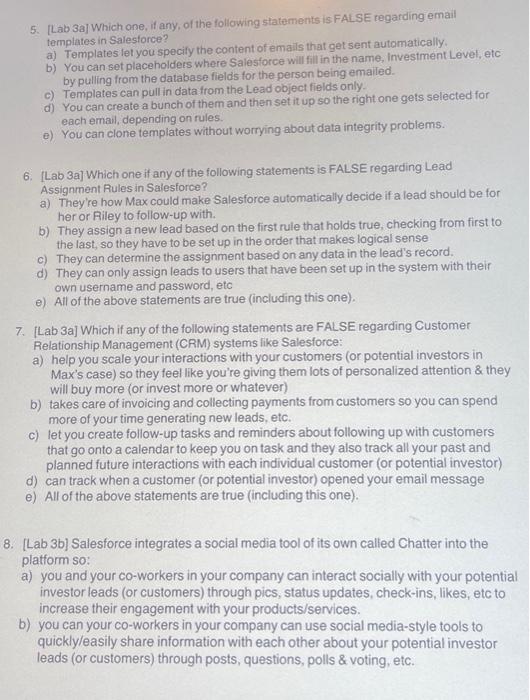
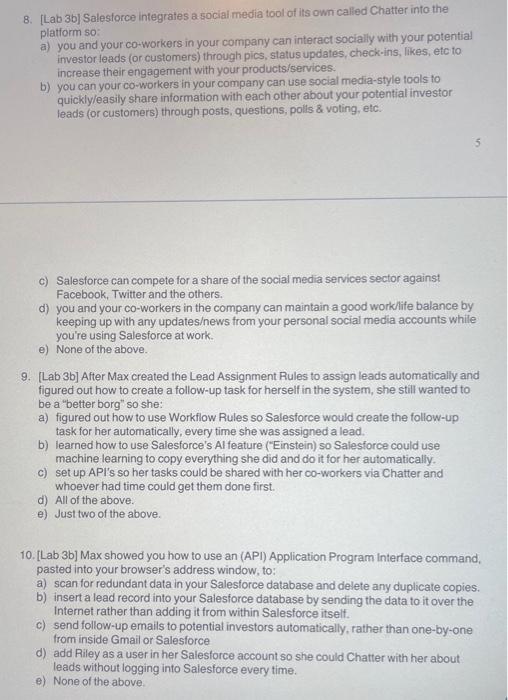
1. [Lab 2b] When Max's database had just two objects. Pitch and Meeting: a) She still discovered redundancy, this time in her contact info data, because one contact could attend many meetings b) she realized her data model was still not "normalized" c) she had to take the contact info fields (Email and Mobile) out of Meeting d) she realized Salesforce already had a built-in Contact object, so she just connecting Meeting to that by making Contact Name a Lookup field e) all of the above 2. [Lab 2b] When Max realized one contact could attend multiple meetings and one meeting could include multiple contacts, she realized: a) her data model was finally normalized already, with just Pitch. Meeting and Contact, so there would be no more data "duping". b) Contact and Meeting were in a many-to-many relationship, so she placed a new "junction" entity/object ("Meeting Attendance") between them, making two one-tomany relationships. c) she could eliminate Meeting and Contact objects and just put all the fields from both into a meta-object called Meeting Attendance. d) all of the above are true e) a and conly 3. [Lab 2b] When the data fields are all broken up into a bunch of different objects: a) the data can be recombined into a single record by using a formula field to trace across relationships, from one object to the next, to the next, connecting the corresponding records from each. b) it increases data redundancy and integrity at the same time. c) you can delete a record from any object without affecting the records in any other object-a huge advantage. d) you don't lose the data itself, but you lose the connections between the data. e) More than one of the above choices are true. 4. [Lab 2b] Once you got your data model fully normalized with Pitch, Meeting, Meeting Attendance and Contact, you used the Schema Builder, a tool for: a) browsing large lists of data visually to find trendlines, outliers, etc b) seeing a visual map of your objects \& their connections and move them around, zoom in and out, etc. c) verifying the structure of your database is fully normalized d) automatically building the interface between your users and the data they need e) all of the above 5. [Lab 3a] Which one, if any, of the following statements is FALSE regarding email templates in Salesforce? a) Templates let you specify the content of emails that get sent automatically. b) You can set placeholdets where Salesforce will fill in the name, Investment Level, etc by pulling from the database fields for the person being emailed. c) Templates can pull in data from the Lead object fields only. d) You can create a bunch of them and then set it up so the right one gets selected for each email, depending on rules. e) You can clone templates without worrying about data integrity problems. 6. [Lab 3a] Which one if any of the following statements is FALSE regarding Lead Assignment Rules in Salesforce? a) They're how Max could make Salesforce automatically decide if a lead should be for her or Riley to follow-up with. b) They assign a new lead based on the first rule that holds true, checking from first to the last, so they have to be set up in the order that makes logical sense c) They can determine the assignment based on any data in the lead's record. d) They can only assign leads to users that have been set up in the system with their own username and password, etc e) All of the above statements are true (including this one). 7. [Lab 3a] Which if any of the following statements are FALSE regarding Customer Relationship Management (CRM) systems like Salesforce: a) help you scale your interactions with your customers (or potential investors in Max's case) so they feel like you're giving them lots of personalized attention & they will buy more (or invest more or whatever) b) takes care of invoicing and collecting payments from customers so you can spend more of your time generating new leads, etc. c) let you create follow-up tasks and reminders about following up with customers that go onto a calendar to keep you on task and they also track all your past and planned future interactions with each individual customer (or potential investor) d) can track when a customer (or potential investor) opened your email message e) All of the above statements are true (including this one). 8. [Lab 3b] Salesforce integrates a social media tool of its own called Chatter into the platform so: a) you and your co-workers in your company can interact socially with your potential investor leads (or customers) through pics, status updates, check-ins, likes, etc to increase their engagement with your products/services. b) you can your co-workers in your company can use social media-style tools to quickly/easily share information with each other about your potential investor leads (or customers) through posts, questions, polls \& voting, etc. 8. [Lab 3b] Salesforce integrates a social media tool of its own called Chatter into the platiorm so: a) you and your co-workers in your company can interact socially with your potential investor leads (or customers) through pics, status updates, check-ins, likes, etc to increase their engagement with your products/services. b) you can your co-workers in your company can use social media-style tools to quickly/easily share information with each other about your potential investor leads (or customers) through posts, questions, polls \& voting, etc. 5 c) Salesforce can compete for a share of the social media services sector against Facebook, Twitter and the others. d) you and your co-workers in the company can maintain a good worklife balance by keeping up with any updatesews from your personal social media accounts while you're using Salesforce at work. e) None of the above. 9. [Lab 3b] After Max created the Lead Assignment Rules to assign leads automatically and figured out how to create a follow-up task for herself in the system, she still wanted to be a "better borg" so she: a) figured out how to use Workflow Rules so Salesforce would create the follow-up task for her automatically, every time she was assigned a lead. b) learned how to use Salesforce's Al feature ("Einstein) so Salesforce could use machine learning to copy everything she did and do it for her automatically. c) set up API's so her tasks could be shared with her co-workers via Chatter and whoever had time could get them done first. d) All of the above. e) Just two of the above. 10. [Lab 3b] Max showed you how to use an (API) Application Program Interface command, pasted into your browser's address window, to: a) scan for redundant data in your Salesforce database and delete any duplicate copies. b) insert a lead record into your Salesforce database by sending the data to it over the Internet rather than adding it from within Salesforce itself. c) send follow-up emails to potential investors automatically, rather than one-by-one from inside Gmail or Salesforce d) add Ailey as a user in her Salestorce account so she could Chatter with her about leads without logging into Salesforce every time. e) None of the above
Step by Step Solution
There are 3 Steps involved in it

Get step-by-step solutions from verified subject matter experts
 Study Help