







Question: 1. Let a = 1- 2j + k, b= -[+ 4j - 5k, c = 51 + J-2k & d = -21 - J +
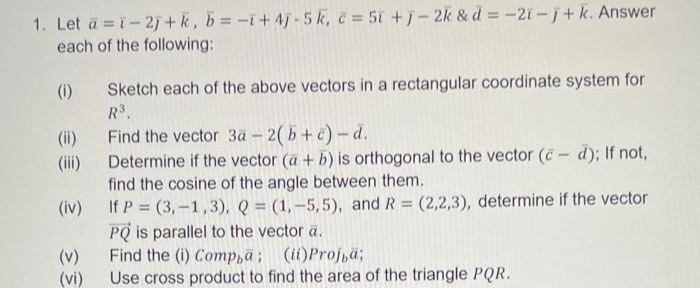
1. Let a = 1- 2j + k, b= -[+ 4j - 5k, c = 51 + J-2k & d = -21 - J + k. Answer each of the following: (i) Sketch each of the above vectors in a rectangular coordinate system for R3. (ii) Find the vector 3a - 2( b + c) - d. Determine if the vector (a + b) is orthogonal to the vector (c - d); If not, find the cosine of the angle between them. (iv) If P = (3, -1,3), Q = (1,-5,5), and R = (2,2,3), determine if the vector PQ is parallel to the vector a. (V) Find the (i) Compa ; (ii) Proja; (vi) Use cross product to find the area of the triangle PQR
Step by Step Solution
There are 3 Steps involved in it
1 Expert Approved Answer
Step: 1 Unlock

Question Has Been Solved by an Expert!
Get step-by-step solutions from verified subject matter experts
Step: 2 Unlock
Step: 3 Unlock
 Study Help