







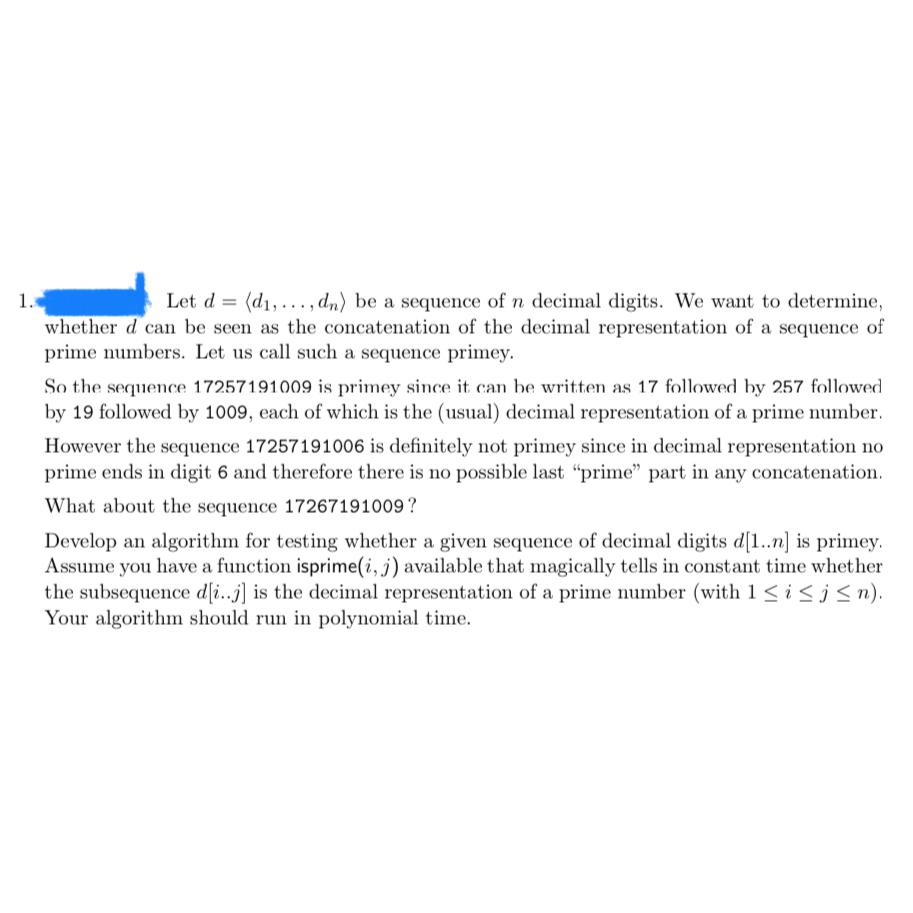
Question: 1 Let d = ( : d 1 , dots, d n : ) be a sequence of n decimal digits. We want to determine,
Let :dots,: be a sequence of decimal digits. We want to determine, whether can be seen as the concatenation of the decimal representation of a sequence of prime numbers. Let us call such a sequence primey.
So the sequence is primey since it can be written as followed by followed by followed by each of which is the usual decimal representation of a prime number.
However the sequence is definitely not primey since in decimal representation no prime ends in digit and therefore there is no possible last "prime" part in any concatenation.
What about the sequence
Develop an algorithm for testing whether a given sequence of decimal digits is primey. Assume you have a function isprime available that magically tells in constant time whether the subsequence is the decimal representation of a prime number with Your algorithm should run in polynomial time.
Step by Step Solution
There are 3 Steps involved in it
1 Expert Approved Answer
Step: 1 Unlock

Question Has Been Solved by an Expert!
Get step-by-step solutions from verified subject matter experts
Step: 2 Unlock
Step: 3 Unlock
 Study Help