







Question: 1. Let (,F,P) be a probability space where ={a,b,c,d,e,f} and F=2 (the power set of ). The probability function P satisfies: P({a})=P({b})=P({c})=2P({d})=2P({e})=2P({f}) Consider the following
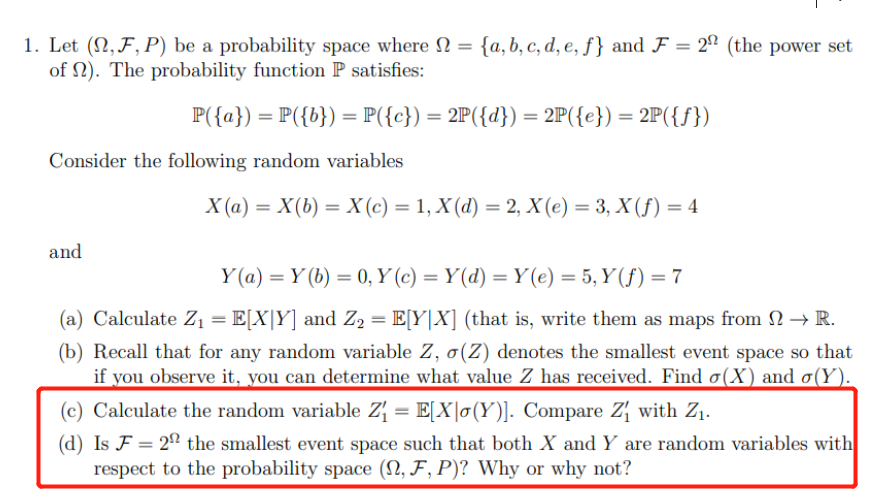
1. Let (,F,P) be a probability space where ={a,b,c,d,e,f} and F=2 (the power set of ). The probability function P satisfies: P({a})=P({b})=P({c})=2P({d})=2P({e})=2P({f}) Consider the following random variables X(a)=X(b)=X(c)=1,X(d)=2,X(e)=3,X(f)=4 and Y(a)=Y(b)=0,Y(c)=Y(d)=Y(e)=5,Y(f)=7 (a) Calculate Z1=E[XY] and Z2=E[YX] (that is, write them as maps from R. (b) Recall that for any random variable Z,(Z) denotes the smallest event space so that if you observe it, you can determine what value Z has received. Find (X) and (Y). (c) Calculate the random variable Z1=E[X(Y)]. Compare Z1 with Z1. (d) Is F=2 the smallest event space such that both X and Y are random variables with respect to the probability space (,F,P) ? Why or why not
Step by Step Solution
There are 3 Steps involved in it

Get step-by-step solutions from verified subject matter experts
 Study Help