







Question: 1. Let P(x) denote the statement x $ 4. What are these truth values? a. P(0) b. P(4) C. P(6) 2. Let P(x) be the
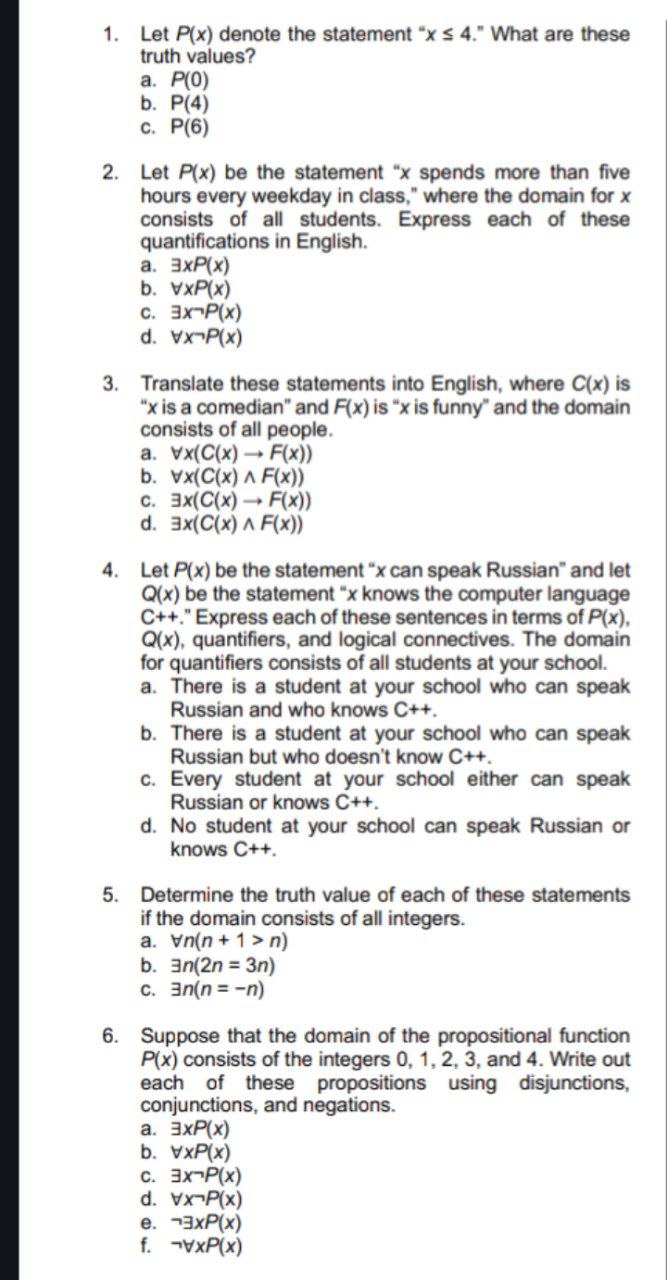
1. Let P(x) denote the statement "x $ 4." What are these truth values? a. P(0) b. P(4) C. P(6) 2. Let P(x) be the statement "x spends more than five hours every weekday in class," where the domain for x consists of all students. Express each of these quantifications in English. a. 3xP(x) (X)xA q c. 3x P(x) (X)duxA P 3. Translate these statements into English, where C(x) is "x is a comedian" and F(x) is "x is funny" and the domain consists of all people. ((X)+ (x)5)xA e ((x)-JV(x)5)xA q c. 3x(C(x) - F(x)) d. 3x(C(x) A F(x)) 4. Let P(x) be the statement "x can speak Russian" and let Q(x) be the statement "x knows the computer language C++." Express each of these sentences in terms of P(x), Q(x), quantifiers, and logical connectives. The domain for quantifiers consists of all students at your school. a. There is a student at your school who can speak Russian and who knows C++. b. There is a student at your school who can speak Russian but who doesn't know C++. c. Every student at your school either can speak Russian or knows C++. d. No student at your school can speak Russian or knows C++. 5. Determine the truth value of each of these statements if the domain consists of all integers. (U
Step by Step Solution
There are 3 Steps involved in it

Get step-by-step solutions from verified subject matter experts
 Study Help