



Question: 1. Let R be the relation on the set {0,1,2,3} containing the ordered pairs (0,1),(1,1),(1,2),(2, 0),(2,2), and (3,0). Find the a) reflexive closure of R.
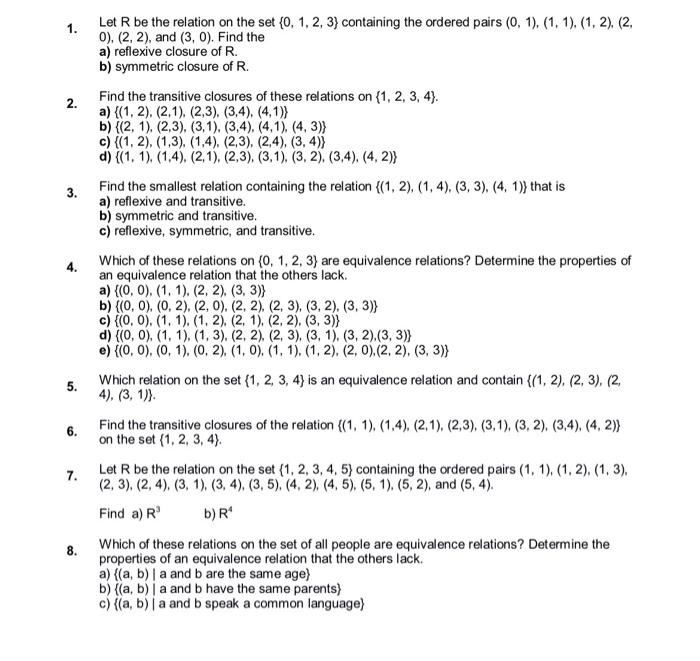
1. Let R be the relation on the set {0,1,2,3} containing the ordered pairs (0,1),(1,1),(1,2),(2, 0),(2,2), and (3,0). Find the a) reflexive closure of R. b) symmetric closure of R. 2. Find the transitive closures of these relations on {1,2,3,4}. a) {(1,2),(2,1),(2,3),(3,4),(4,1)} b) {(2,1),(2,3),(3,1),(3,4),(4,1),(4,3)} c) {(1,2),(1,3),(1,4),(2,3),(2,4),(3,4)} d) {(1,1),(1,4),(2,1),(2,3),(3,1),(3,2),(3,4),(4,2)} 3. Find the smallest relation containing the relation {(1,2),(1,4),(3,3),(4,1)} that is a) reflexive and transitive. b) symmetric and transitive. c) reflexive, symmetric, and transitive. 4. Which of these relations on {0,1,2,3} are equivalence relations? Determine the properties of an equivalence relation that the others lack. a) {(0,0),(1,1),(2,2),(3,3)} b) {(0,0),(0,2),(2,0),(2,2),(2,3),(3,2),(3,3)} c) {(0,0),(1,1),(1,2),(2,1),(2,2),(3,3)} d) {(0,0),(1,1),(1,3),(2,2),(2,3),(3,1),(3,2),(3,3)} e) {(0,0),(0,1),(0,2),(1,0),(1,1),(1,2),(2,0),(2,2),(3,3)} 5. Which relation on the set {1,2,3,4} is an equivalence relation and contain {(1,2),(2,3),(2, 4), (3,1)}. 6. Find the transitive closures of the relation {(1,1),(1,4),(2,1),(2,3),(3,1),(3,2),(3,4),(4,2)} on the set {1,2,3,4}. 7. Let R be the relation on the set {1,2,3,4,5} containing the ordered pairs (1,1),(1,2),(1,3), (2,3),(2,4),(3,1),(3,4),(3,5),(4,2),(4,5),(5,1),(5,2), and (5,4). Find a) R3 b) R4 8. Which of these relations on the set of all people are equivalence relations? Determine the properties of an equivalence relation that the others lack. a) {(a,b)a and b are the same age } b) {(a,b)a and b have the same parents } c) {(a,b) a and b speak a common language }
Step by Step Solution
There are 3 Steps involved in it

Get step-by-step solutions from verified subject matter experts