







Question: 1 . Let's consider an asymmetric Cournot example with 3 firms. You are free to use any of the formula from the slides, but please
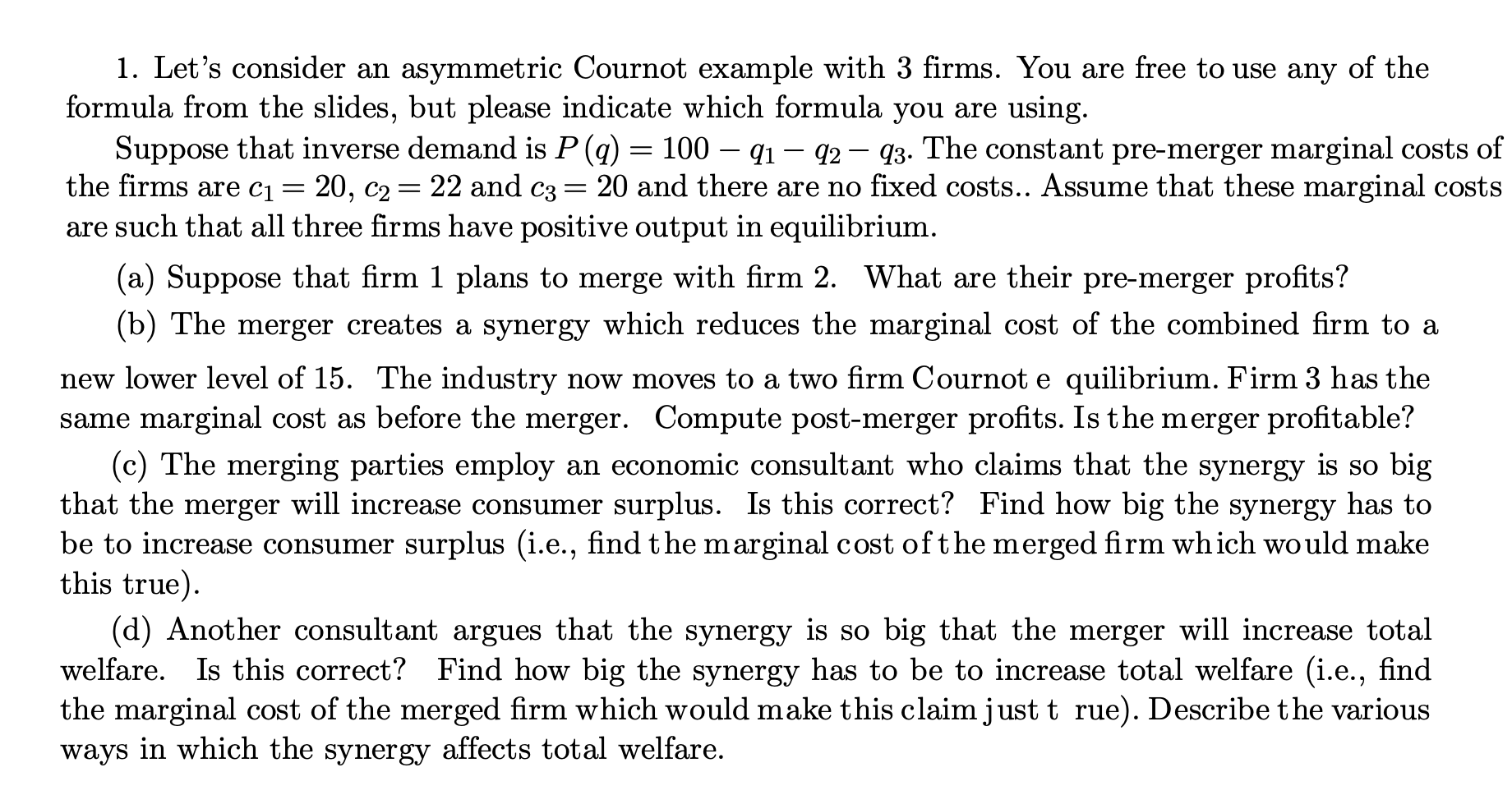
Let's consider an asymmetric Cournot example with firms. You are free to use any of the formula from the slides, but please indicate which formula you are using.
Suppose that inverse demand is Pqqqq The constant premerger marginal costs of the firms are c c and c and there are no fixed costs.. Assume that these marginal costs are such that all three firms have positive output in equilibrium.
a Suppose that firm plans to merge with firm What are their premerger profits?
b The merger creates a synergy which reduces the marginal cost of the combined firm to a new lower level of The industry now moves to a two firm Cournot e quilibrium. Firm has the same marginal cost as before the merger. Compute postmerger profits. Is the merger profitable?
c The merging parties employ an economic consultant who claims that the synergy is so big that the merger will increase consumer surplus. Is this correct? Find how big the synergy has to be to increase consumer surplus ie find the marginal cost of the merged firm which would make this true
d Another consultant argues that the synergy is so big that the merger will increase total welfare. Is this correct? Find how big the synergy has to be to increase total welfare ie find the marginal cost of the merged firm which would make this claim just t rue Describe the various ways in which the synergy affects total welfare.
Step by Step Solution
There are 3 Steps involved in it
1 Expert Approved Answer
Step: 1 Unlock

Question Has Been Solved by an Expert!
Get step-by-step solutions from verified subject matter experts
Step: 2 Unlock
Step: 3 Unlock
 Study Help