





Question: 1. Linear Programming In lectures we used a graphical procedure to solve for maximisation of an objective function in two unknowns (X1 and X2). In
1. Linear Programming In lectures we used a

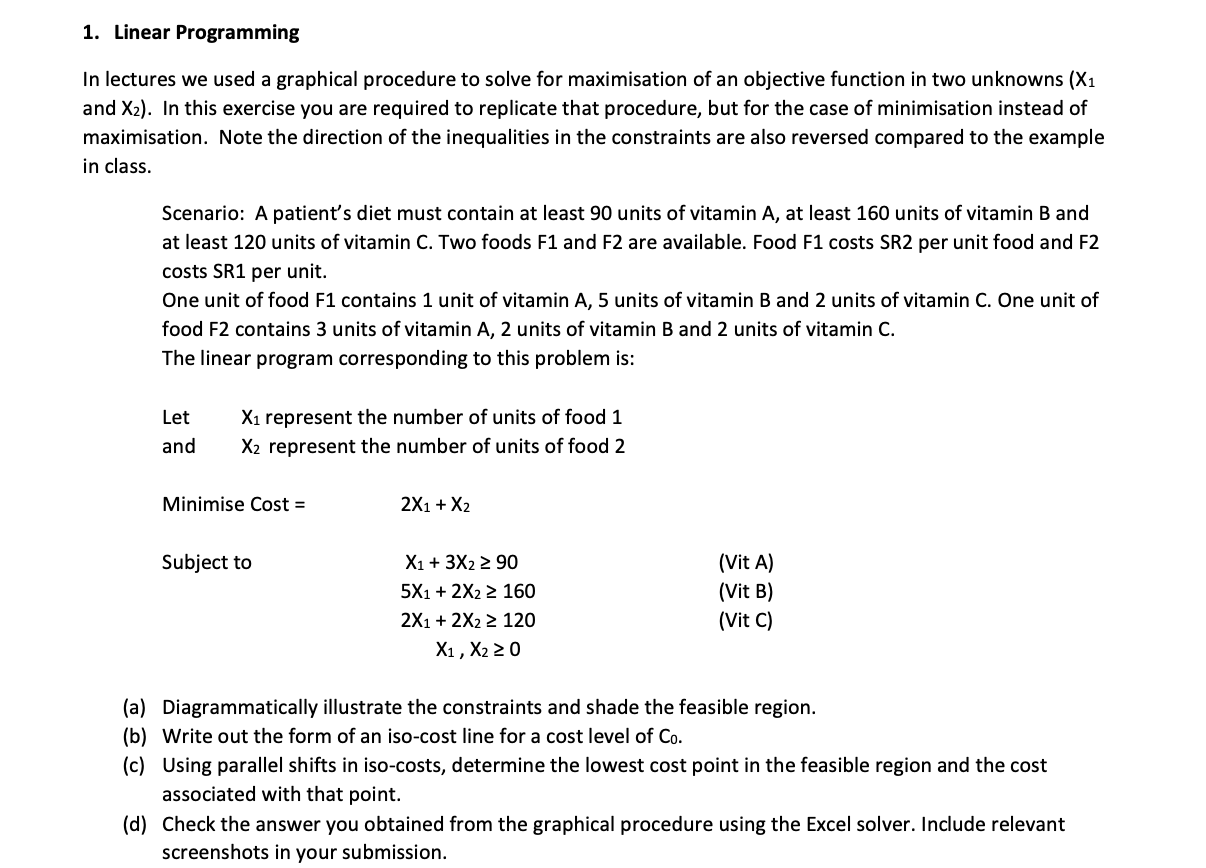
1. Linear Programming In lectures we used a graphical procedure to solve for maximisation of an objective function in two unknowns (X1 and X2). In this exercise you are required to replicate that procedure, but for the case of minimisation instead of maximisation. Note the direction of the inequalities in the constraints are also reversed compared to the example in class. Scenario: A patient's diet must contain at least 90 units of vitamin A, at least 160 units of vitamin B and at least 120 units of vitamin C. Two foods F1 and F2 are available. Food F1 costs SR2 per unit food and F2 costs SR1 per unit. One unit of food F1 contains 1 unit of vitamin A, 5 units of vitamin B and 2 units of vitamin C. One unit of food F2 contains 3 units of vitamin A, 2 units of vitamin B and 2 units of vitamin C. The linear program corresponding to this problem is: Let and X1 represent the number of units of food 1 X2 represent the number of units of food 2 Minimise Cost = 2X1 + X2 Subject to X1 + 3X2 2 90 5X1 + 2X2 2 160 2X1 + 2X2 2 120 X1, X220 (Vit A) (Vit B) (Vit C) (a) Diagrammatically illustrate the constraints and shade the feasible region. (b) Write out the form of an iso-cost line for a cost level of Co. (c) Using parallel shifts in iso-costs, determine the lowest cost point in the feasible region and the cost associated with that point. (d) Check the answer you obtained from the graphical procedure using the Excel solver. Include relevant screenshots in your submission

Step by Step Solution

There are 3 Steps involved in it

1 Expert Approved Answer
Step: 1 Unlock blur-text-image

Question Has Been Solved by an Expert!

Get step-by-step solutions from verified subject matter experts

Step: 2 Unlock
Step: 3 Unlock

Students Have Also Explored These Related General Management Questions!