







Question: 1. List all the potential users for the Case RELIABLE PHARMACEUTICAL SERVICE. 2. For each type of user, interview them to find a list of
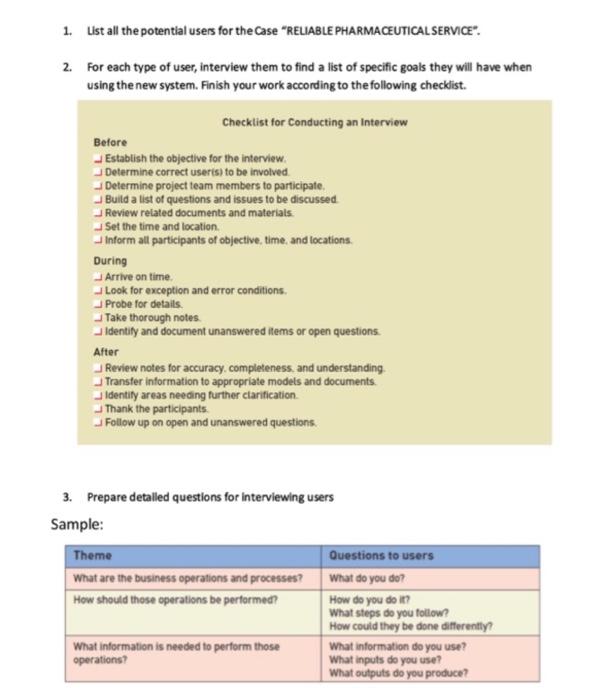
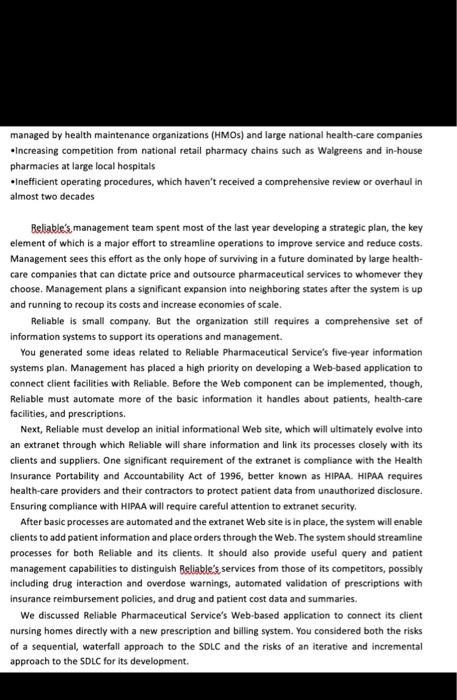
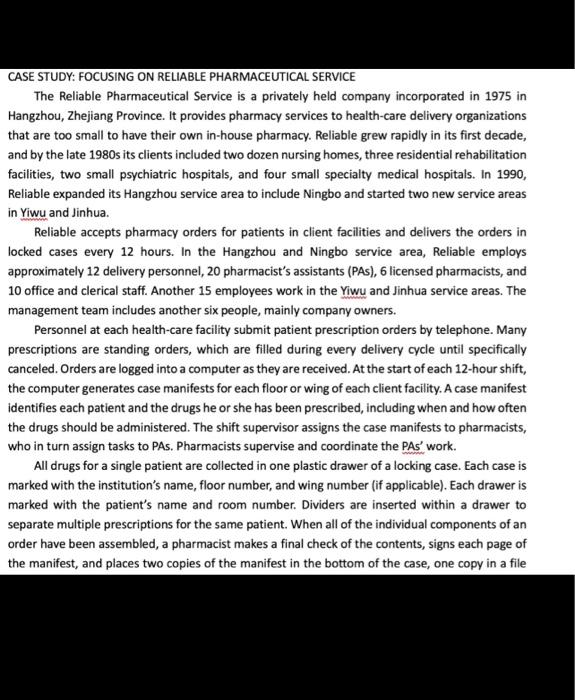
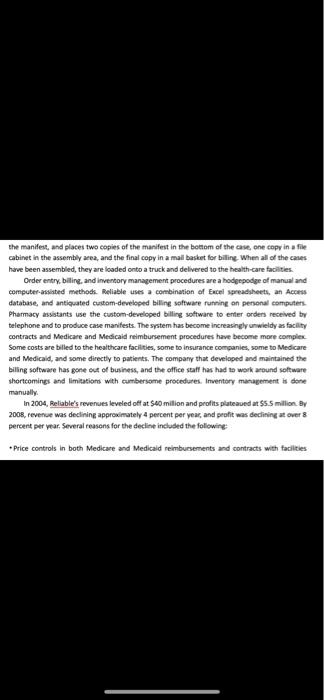
1. List all the potential users for the Case "RELIABLE PHARMACEUTICAL SERVICE". 2. For each type of user, interview them to find a list of specific goals they will have when using the new system. Finish your work according to the following checklist. Checklist for Conducting an interview Before Establish the objective for the interview. Determine correct useris) to be involved - Determine project team members to participate, Build a list of questions and issues to be discussed. Review related documents and materials. Set the time and location. Inform all participants of objective, time, and locations. During Arrive on time. Look for exception and error conditions Probe for details Take thorough notes. Identify and document unanswered items or open questions After Review notes for accuracy, completeness, and understanding Transfer information to appropriate models and documents. identity areas needing further clarification Thank the participants Follow up on open and unanswered questions 3. Prepare detalled questions for interviewing users Sample: Theme What are the business operations and processes? How should those operations be performed? Questions to users What do you do? How do you do it What steps do you follow? How could they be done differently What information do you use? What inputs do you use? What outputs do you produce? What information is needed to perform those operations? managed by health maintenance organizations (HMOs) and large national health-care companies Increasing competition from national retail pharmacy chains such as Walgreens and in-house pharmacies at large local hospitals Inefficient operating procedures, which haven't received a comprehensive review or overhaul in almost two decades Beliable's management team spent most of the last year developing a strategic plan, the key element of which is a major effort to streamline operations to improve service and reduce costs. Management sees this effort as the only hope of surviving in a future dominated by large health- care companies that can dictate price and outsource pharmaceutical services to whomever they choose. Management plans a significant expansion into neighboring states after the system is up and running to recoup its costs and increase economies of scale. Reliable is small company. But the organization still requires a comprehensive set of Information systems to support its operations and management. You generated some ideas related to Reliable Pharmaceutical Service's five-year information systems plan. Management has placed a high priority on developing a Web-based application to connect client facilities with Reliable. Before the Web component can be implemented, though, Reliable must automate more of the basic information it handles about patients, health-care facilities, and prescriptions. Next, Reliable must develop an initial informational Web site, which will ultimately evolve into an extranet through which Reliable will share information and link its processes closely with its clients and suppliers. One significant requirement of the extranet is compliance with the Health Insurance Portability and Accountability Act of 1996, better known as HIPAA. HIPAA requires health-care providers and their contractors to protect patient data from unauthorized disclosure. Ensuring compliance with HIPAA will require careful attention to extranet security. After basic processes are automated and the extranet Web site is in place, the system will enable clients to add patient information and place orders through the Web. The system should streamline processes for both Reliable and its clients. It should also provide useful query and patient management capabilities to distinguish Beliable's services from those of its competitors, possibly including drug interaction and overdose warnings, automated validation of prescriptions with insurance reimbursement policies, and drug and patient cost data and summaries. We discussed Reliable Pharmaceutical Service's Web-based application to connect its client nursing homes directly with a new prescription and billing system. You considered both the risks of a sequential, waterfall approach to the SDLC and the risks of an iterative and incremental approach to the SDLC for its development. CASE STUDY: FOCUSING ON RELIABLE PHARMACEUTICAL SERVICE The Reliable Pharmaceutical Service is a privately held company incorporated in 1975 in Hangzhou, Zhejiang Province. It provides pharmacy services to health-care delivery organizations that are too small to have their own in-house pharmacy. Reliable grew rapidly in its first decade, and by the late 1980s its clients included two dozen nursing homes, three residential rehabilitation facilities, two small psychiatric hospitals, and four small specialty medical hospitals. In 1990, Reliable expanded its Hangzhou service area to include Ningbo and started two new service areas in Yiwu and Jinhua. Reliable accepts pharmacy orders for patients in client facilities and delivers the orders in locked cases every 12 hours. In the Hangzhou and Ningbo service area, Reliable employs approximately 12 delivery personnel, 20 pharmacist's assistants (PAS), 6 licensed pharmacists, and 10 office and clerical staff. Another 15 employees work in the Yiwu and Jinhua service areas. The management team includes another six people, mainly company owners. Personnel at each health-care facility submit patient prescription orders by telephone. Many prescriptions are standing orders, which are filled during every delivery cycle until specifically canceled. Orders are logged into a computer as they are received. At the start of each 12-hour shift, the computer generates case manifests for each floor or wing of each client facility. A case manifest identifies each patient and the drugs he or she has been prescribed, including when and how often the drugs should be administered. The shift supervisor assigns the case manifests to pharmacists, who in turn assign tasks to PAs. Pharmacists supervise and coordinate the PAs' work. All drugs for a single patient are collected in one plastic drawer of a locking case. Each case is marked with the institution's name, floor number, and wing number (if applicable). Each drawer is marked with the patient's name and room number. Dividers are inserted within a drawer to separate multiple prescriptions for the same patient. When all of the individual components of an order have been assembled, a pharmacist makes a final check of the contents, signs each page of the manifest, and places two copies of the manifest in the bottom of the case, one copy in a file the manifest, and places two copies of the manifest in the bottom of the case, one copy in a file cabinet in the assembly ea, and the final copy in a mall basket for biling. When all of the cases have been assembled, they are loaded onto a truck and delivered to the health care facilities. Order entry, billing and inventory management procedures are a hodgepodge of manual and computer-assisted methods. Reliable uses a combination of Excel spreadsheets, an Access database, and antiquated custom-developed billing software running on personal computers Pharmacy assistants use the custom-developed billing software to enter orders received by telephone and to produce case manifests. The system has become increasingly unwieldy as facility contracts and Medicare and Medicaid reimbursement procedures have become more complex Some costs are billed to the healthcare facilities, some to insurance companies, some to Medicare and Medicaid, and some directly to patients. The company that developed and maintained the billing software has gone out of business, and the office staff has had to work around software shortcomings and limitations with cumbersome procedures. Inventory management is done manually In 2004, Reliable's revenues leveled off at $40 milion and profits plateaued at $5.5 million By 2008, revenue was declining approximately 4 percent per year, and profit was declining at over 8 percent per year. Several reasons for the decline included the following: Price controls in both Medicare and Medicaid reimbursements and contracts with facilities 1. List all the potential users for the Case "RELIABLE PHARMACEUTICAL SERVICE". 2. For each type of user, interview them to find a list of specific goals they will have when using the new system. Finish your work according to the following checklist. Checklist for Conducting an interview Before Establish the objective for the interview. Determine correct useris) to be involved - Determine project team members to participate, Build a list of questions and issues to be discussed. Review related documents and materials. Set the time and location. Inform all participants of objective, time, and locations. During Arrive on time. Look for exception and error conditions Probe for details Take thorough notes. Identify and document unanswered items or open questions After Review notes for accuracy, completeness, and understanding Transfer information to appropriate models and documents. identity areas needing further clarification Thank the participants Follow up on open and unanswered questions 3. Prepare detalled questions for interviewing users Sample: Theme What are the business operations and processes? How should those operations be performed? Questions to users What do you do? How do you do it What steps do you follow? How could they be done differently What information do you use? What inputs do you use? What outputs do you produce? What information is needed to perform those operations? managed by health maintenance organizations (HMOs) and large national health-care companies Increasing competition from national retail pharmacy chains such as Walgreens and in-house pharmacies at large local hospitals Inefficient operating procedures, which haven't received a comprehensive review or overhaul in almost two decades Beliable's management team spent most of the last year developing a strategic plan, the key element of which is a major effort to streamline operations to improve service and reduce costs. Management sees this effort as the only hope of surviving in a future dominated by large health- care companies that can dictate price and outsource pharmaceutical services to whomever they choose. Management plans a significant expansion into neighboring states after the system is up and running to recoup its costs and increase economies of scale. Reliable is small company. But the organization still requires a comprehensive set of Information systems to support its operations and management. You generated some ideas related to Reliable Pharmaceutical Service's five-year information systems plan. Management has placed a high priority on developing a Web-based application to connect client facilities with Reliable. Before the Web component can be implemented, though, Reliable must automate more of the basic information it handles about patients, health-care facilities, and prescriptions. Next, Reliable must develop an initial informational Web site, which will ultimately evolve into an extranet through which Reliable will share information and link its processes closely with its clients and suppliers. One significant requirement of the extranet is compliance with the Health Insurance Portability and Accountability Act of 1996, better known as HIPAA. HIPAA requires health-care providers and their contractors to protect patient data from unauthorized disclosure. Ensuring compliance with HIPAA will require careful attention to extranet security. After basic processes are automated and the extranet Web site is in place, the system will enable clients to add patient information and place orders through the Web. The system should streamline processes for both Reliable and its clients. It should also provide useful query and patient management capabilities to distinguish Beliable's services from those of its competitors, possibly including drug interaction and overdose warnings, automated validation of prescriptions with insurance reimbursement policies, and drug and patient cost data and summaries. We discussed Reliable Pharmaceutical Service's Web-based application to connect its client nursing homes directly with a new prescription and billing system. You considered both the risks of a sequential, waterfall approach to the SDLC and the risks of an iterative and incremental approach to the SDLC for its development. CASE STUDY: FOCUSING ON RELIABLE PHARMACEUTICAL SERVICE The Reliable Pharmaceutical Service is a privately held company incorporated in 1975 in Hangzhou, Zhejiang Province. It provides pharmacy services to health-care delivery organizations that are too small to have their own in-house pharmacy. Reliable grew rapidly in its first decade, and by the late 1980s its clients included two dozen nursing homes, three residential rehabilitation facilities, two small psychiatric hospitals, and four small specialty medical hospitals. In 1990, Reliable expanded its Hangzhou service area to include Ningbo and started two new service areas in Yiwu and Jinhua. Reliable accepts pharmacy orders for patients in client facilities and delivers the orders in locked cases every 12 hours. In the Hangzhou and Ningbo service area, Reliable employs approximately 12 delivery personnel, 20 pharmacist's assistants (PAS), 6 licensed pharmacists, and 10 office and clerical staff. Another 15 employees work in the Yiwu and Jinhua service areas. The management team includes another six people, mainly company owners. Personnel at each health-care facility submit patient prescription orders by telephone. Many prescriptions are standing orders, which are filled during every delivery cycle until specifically canceled. Orders are logged into a computer as they are received. At the start of each 12-hour shift, the computer generates case manifests for each floor or wing of each client facility. A case manifest identifies each patient and the drugs he or she has been prescribed, including when and how often the drugs should be administered. The shift supervisor assigns the case manifests to pharmacists, who in turn assign tasks to PAs. Pharmacists supervise and coordinate the PAs' work. All drugs for a single patient are collected in one plastic drawer of a locking case. Each case is marked with the institution's name, floor number, and wing number (if applicable). Each drawer is marked with the patient's name and room number. Dividers are inserted within a drawer to separate multiple prescriptions for the same patient. When all of the individual components of an order have been assembled, a pharmacist makes a final check of the contents, signs each page of the manifest, and places two copies of the manifest in the bottom of the case, one copy in a file the manifest, and places two copies of the manifest in the bottom of the case, one copy in a file cabinet in the assembly ea, and the final copy in a mall basket for biling. When all of the cases have been assembled, they are loaded onto a truck and delivered to the health care facilities. Order entry, billing and inventory management procedures are a hodgepodge of manual and computer-assisted methods. Reliable uses a combination of Excel spreadsheets, an Access database, and antiquated custom-developed billing software running on personal computers Pharmacy assistants use the custom-developed billing software to enter orders received by telephone and to produce case manifests. The system has become increasingly unwieldy as facility contracts and Medicare and Medicaid reimbursement procedures have become more complex Some costs are billed to the healthcare facilities, some to insurance companies, some to Medicare and Medicaid, and some directly to patients. The company that developed and maintained the billing software has gone out of business, and the office staff has had to work around software shortcomings and limitations with cumbersome procedures. Inventory management is done manually In 2004, Reliable's revenues leveled off at $40 milion and profits plateaued at $5.5 million By 2008, revenue was declining approximately 4 percent per year, and profit was declining at over 8 percent per year. Several reasons for the decline included the following: Price controls in both Medicare and Medicaid reimbursements and contracts with facilities
Step by Step Solution
There are 3 Steps involved in it

Get step-by-step solutions from verified subject matter experts
 Study Help