







Question: 1 . Load Rating: ( 1 0 points total ) You have been asked to design a scaffolding system for an existing building that has
Load Rating: points total
You have been asked to design a scaffolding system for an existing building that has a deteriorating brick wall that is ft long by ft tall. Your construction company needs to tuck point the mortar joints where mortar has become loose or is missing and replace broken or softened bricks. The average weight of all materials and workers over the whole bay area is what matters on the scaffold planks, not the individual weight of materials over their individual footprints. The scaffold planks will support an uneven distribution of loads.
Scaffolding has a width of ft for ft and each scaffold bay is ft long making it bays wide.
What scaffold load rating will be required for this construction project lightduty, medium duty, or heavydutyHint: Review slides in the referenced PowerPoint file. Justify your answer. points Provide answer in a complete sentence. point
What live load is required by the load rating answer you gave in part above psf psf or psf points Provide answer in a complete sentence. point
What is the maximum load capacity in pounds allowed on a bay that is ft wide x ft long? points
Bays with flat of brick on them: points total
Use all the information previously provided.
The schedule requires you to set up scaffolding for the whole length of the wall all in one build
so you can maximize your crew size and minimize your time on site.
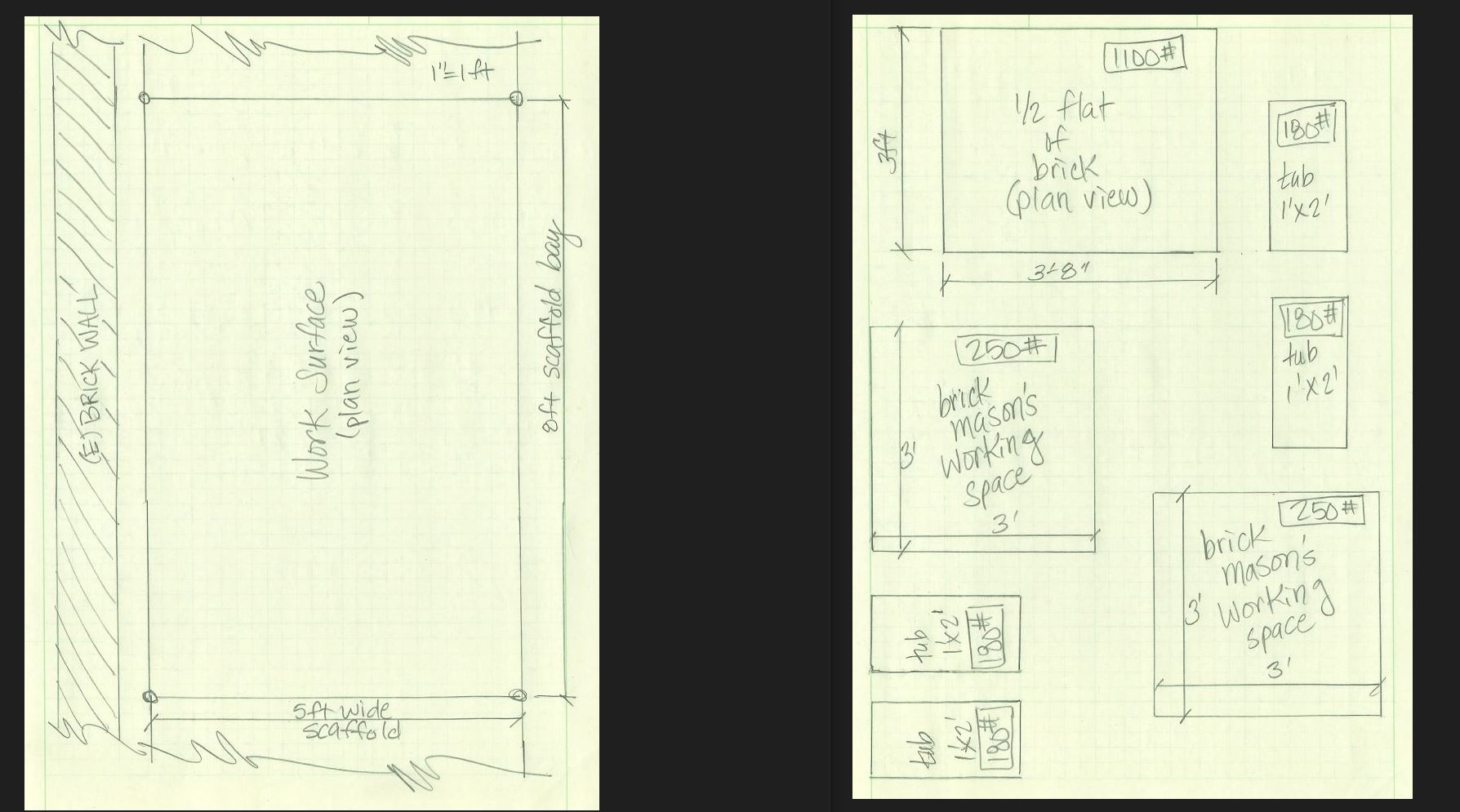
There is enough brick deteriorated that the whole wall will on average need only flats of new brick to replace bad bricks. A flat of brick about brick weighs lbs and takes up a footprint of x in plan. Assume that the brick flat can be placed such that the ft dimension is parallel to the wall.
Assume that on average each level and at each bay on that level the wall will require tubs of mortar weighing lbs each for the tuckpointing. Assume a tub requires an area of x next to a brick mason worker not in the same workspace.
Assume a brick mason worker plus their hand tools weighs lbs each and needs a plan area of ft x ft on the scaffold to work in AND they each must have ft of wall face to tuckpoint.
Helpful hint: Use the scale drawings of the plan elements described above I have provided a file attached to the end of this assignment so you can play with the objects in each bay to see what can fit spatially. Remember, other workers must be able to pass behind the brick masons work in progress on any given level and bay.
How many brick masons workers can work on a ft wide x ft long bay that also has flat of bricks on it points Provide answer in a complete sentence. point
Bays without flat of brick on them: points total
Use all the information previously provided.
How many workers can work on a ft wide x ft long bay that has tubs of mortar on it but no flat of brick? points Provide answer in a complete sentence. point
Is this limited by space or by the load capacity? points
Why might I want to plan for tubs of mortar instead of only the required tubs per bay? points
Transverse bracingtie offs: points total
The scaffolding has a width of ft for ft and each scaffold bay is ft long making it bays wide. Hint: If you have bays how many vertical frames are required?
The scaffolding levels occur every in elevation all above finished grade To reach the whole ft tall x ft long wall with scaffolding we need working levels with a handrail around the top level. Remember, level is not at ground level; its above it
Lateral bracing can only be placed where a level and vertical frame intersect so that the force can transfer directly into the frame where it has a horizontal support.
The ground works as a braced level because of the friction developed under the mudsill that the scaffold posts are connected to therefore you do not need any braces at the ground.
Hint: I have drawn an elevation of the scaffolding vs wall. Use the scale drawings of the scaffolding elevation described above so you can play with the locations.
If the bracingtieoffs to the building must occur at each frame ft oc and must occur vertically at not more than x its least dimension the smaller of the dimensions for width, w
ft and total length, L ft then what levels must be bracedtiedoff? points for correct answer plus point for showing your work Provide answer in a complete sentence. point
How many total braces are required in the entire elevation are required by OSHA for this system? Make sure you count the verticals. points for correct answer plus point for showing your work Provide answer in a complete sentence. point
Step by Step Solution
There are 3 Steps involved in it
1 Expert Approved Answer
Step: 1 Unlock

Question Has Been Solved by an Expert!
Get step-by-step solutions from verified subject matter experts
Step: 2 Unlock
Step: 3 Unlock
 Study Help