





Question: 1. Look at the cut DNA sequences shown below in i) and ii). a) What restriction enzyme(s) was/were used to create these sequences? b) Could
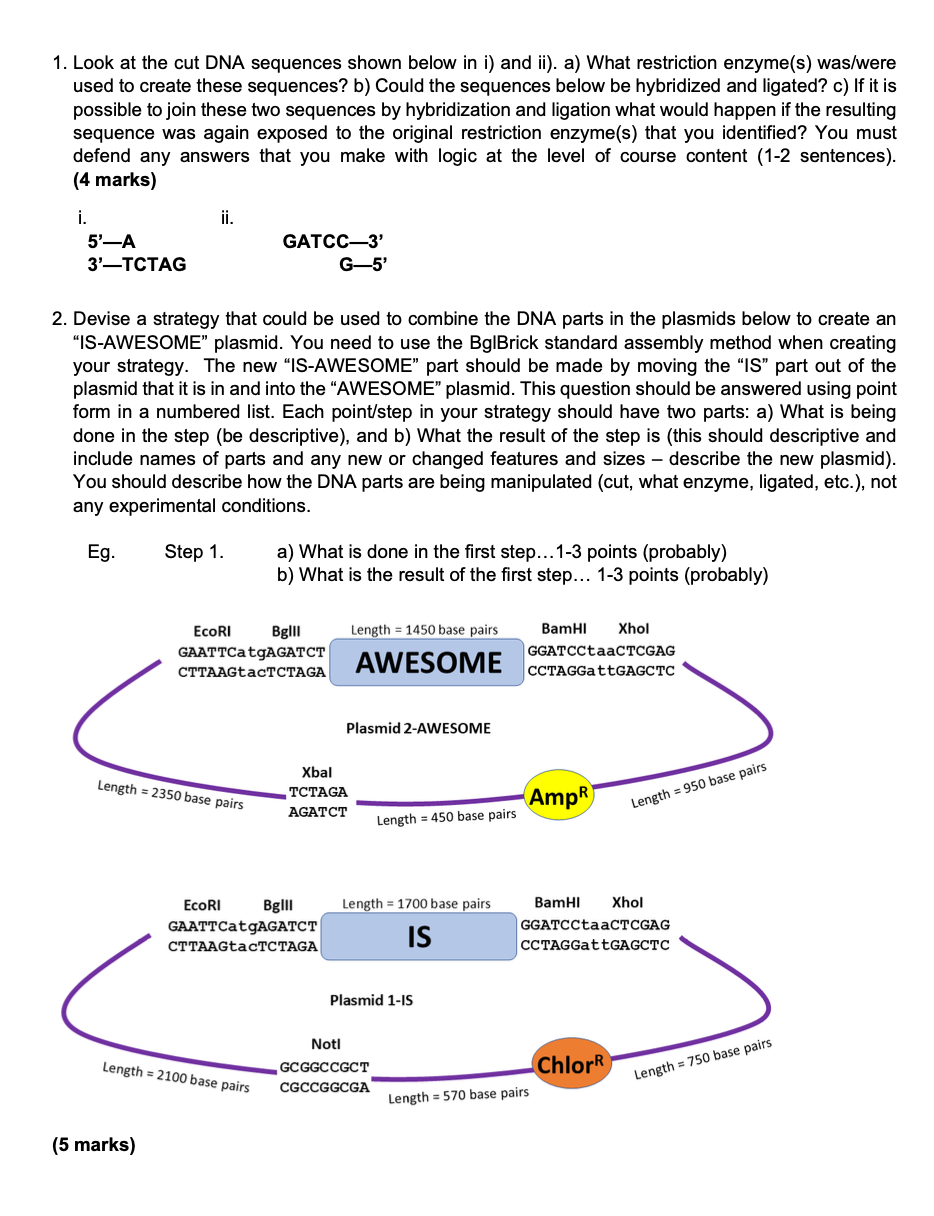
1. Look at the cut DNA sequences shown below in1. Look at the cut DNA sequences shown below in
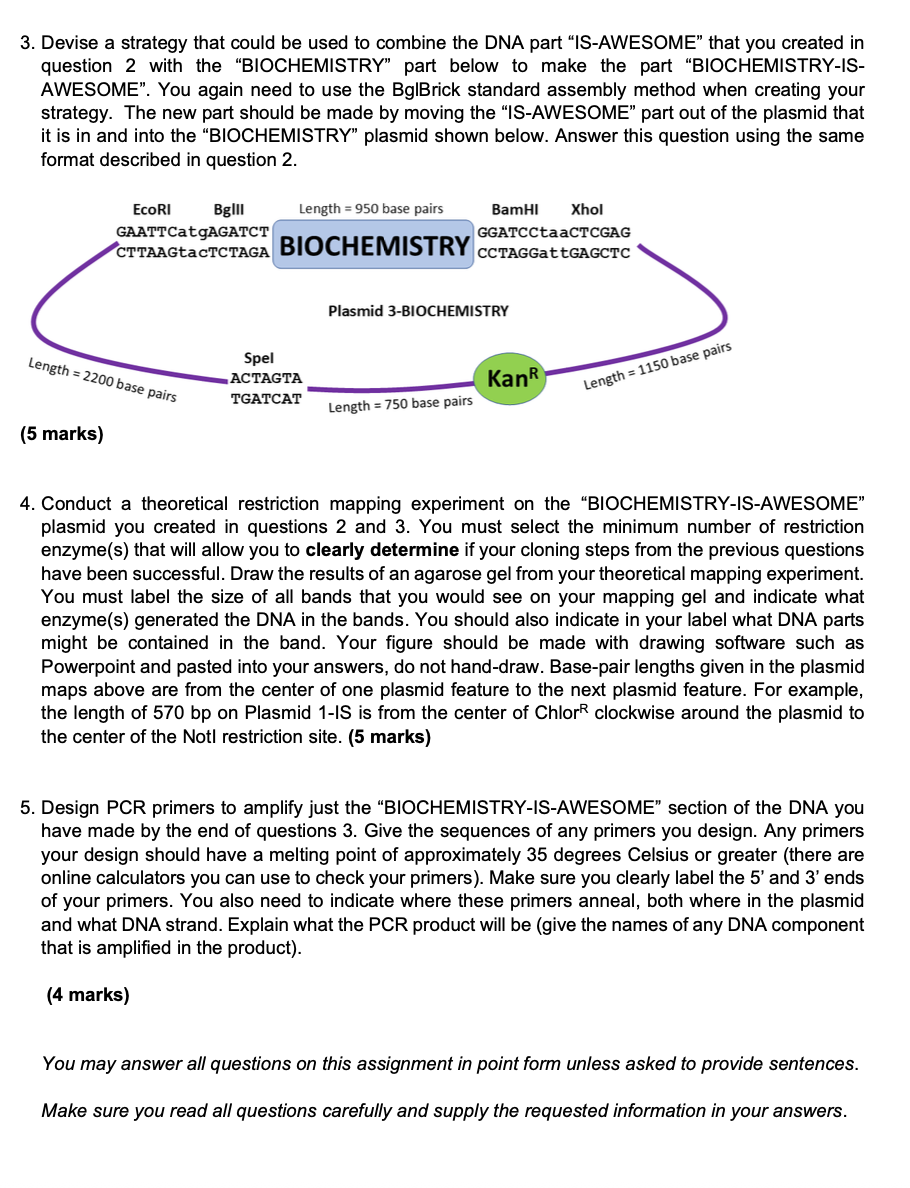
1. Look at the cut DNA sequences shown below in i) and ii). a) What restriction enzyme(s) was/were used to create these sequences? b) Could the sequences below be hybridized and ligated? c) If it is possible to join these two sequences by hybridization and ligation what would happen if the resulting sequence was again exposed to the original restriction enzyme(s) that you identified? You must defend any answers that you make with logic at the level of course content (1-2 sentences). (4 marks) i. ii. 5'-A GATCC-3' 3'-TCTAG G-5' 2. Devise a strategy that could be used to combine the DNA parts in the plasmids below to create an "IS-AWESOME" plasmid. You need to use the BglBrick standard assembly method when creating your strategy. The new "IS-AWESOME" part should be made by moving the "IS" part out of the plasmid that it is in and into the "AWESOME" plasmid. This question should be answered using point form in a numbered list. Each point/step in your strategy should have two parts: a) What is being done in the step (be descriptive), and b) What the result of the step is (this should descriptive and include names of parts and any new or changed features and sizes - describe the new plasmid). You should describe how the DNA parts are being manipulated (cut, what enzyme, ligated, etc.), not any experimental conditions. Eg. Step 1. a) What is done in the first step... 1-3 points (probably) b) What is the result of the first step... 1-3 points (probably) ECORI Bgill Length = 1450 base pairs BamHI Xhol GAATTCatgAGATCT CTTAAGtacTCTAGA AWESOME GGATCCtaaCTCGAG CCTAGGattGAGCTC Plasmid 2-AWESOME Xbal Length = 2350 base pairs TCTAGA AmpR Length = 950 base pairs AGATCT Length = 450 base pairs ECORI Bgill Length = 1700 base pairs BamHI Xhol GAATTCatgAGATCT IS GGATCCtaaCTCGAG CTTAAGtacTCTAGA CCTAGGattGAGCTC Plasmid 1-15 Notl GCGGCCGCT ChlorR Length = 750 base pairs Length = 2100 base pairs CGCCGGCGA Length = 570 base pairs (5 marks)3. Devise a strategy that could be used to combine the DNA part \"IS-AWESOME\" that you created in question 2 with the \"BIOCHEMISTRY\" part below to make the part \"BIOCHEMISTRY-IS- AWESOME\". You again need to use the BglBrick standard assembly method when creating your strategy. The new part should be made by moving the \"IS-AWESOME\" part out of the plasmid that it is in and into the \"BIOCHEMISTRY\" plasmid shown below. Answer this question using the same format described in question 2. EcoRI Bglll Length = 950 base pairs BamHI Xhol GAATTCatgAGATCT GGATCCtaaCTCGAG CTTAAGtacTCTAGA B 10 G H E M ISTRY CCTAGGattGAGCTC Plasmid 3-BIOCHEMISTRY (5 marks) 4. Conduct a theoretical restriction mapping experiment on the \"BIOCHEMISTRY-IS-AWESOME\" plasmid you created in questions 2 and 3. You must select the minimum number of restriction enzyme(s) that will allow you to clearly determine if your cloning steps from the previous questions have been successful. Draw the results of an agarose gel from your theoretical mapping experiment. You must label the size of all bands that you would see on your mapping gel and indicate what enzyme(s) generated the DNA in the bands. You should also indicate in your label what DNA parts might be contained in the band. Your figure should be made with drawing software such as Powerpoint and pasted into your answers, do not hand-draw. Base-pair lengths given in the plasmid maps above are from the center of one plasmid feature to the next plasmid feature. For example, the length of 570 bp on Plasmid 1-IS is from the center of Chlor clockwise around the plasmid to the center of the Notl restriction site. (5 marks) 5. Design PCR primers to amplify just the \"BIOCHEMISTRY-IS-AWESOME' section of the DNA you have made by the end of questions 3. Give the sequences of any primers you design. Any primers your design should have a melting point of approximately 35 degrees Celsius or greater (there are online calculators you can use to check your primers). Make sure you clearly label the 5' and 3' ends of your primers. You also need to indicate where these primers anneal, both where in the plasmid and what DNA strand. Explain what the PCR product will be (give the names of any DNA component that is amplified in the product). (4 marks) You may answer all questions on this assignment in point form unless asked to provide sentences. Make sure you read all questions carefully and supply the requested information in your answers

Step by Step Solution

There are 3 Steps involved in it

1 Expert Approved Answer
Step: 1 Unlock blur-text-image
Question Has Been Solved by an Expert!

Get step-by-step solutions from verified subject matter experts

Step: 2 Unlock
Step: 3 Unlock

Students Have Also Explored These Related Accounting Questions!