







Question: . 1. {l'rue or False {1} If f{x} has a minimum at xza, then there exists an e, such that x} > f{a} for every
.
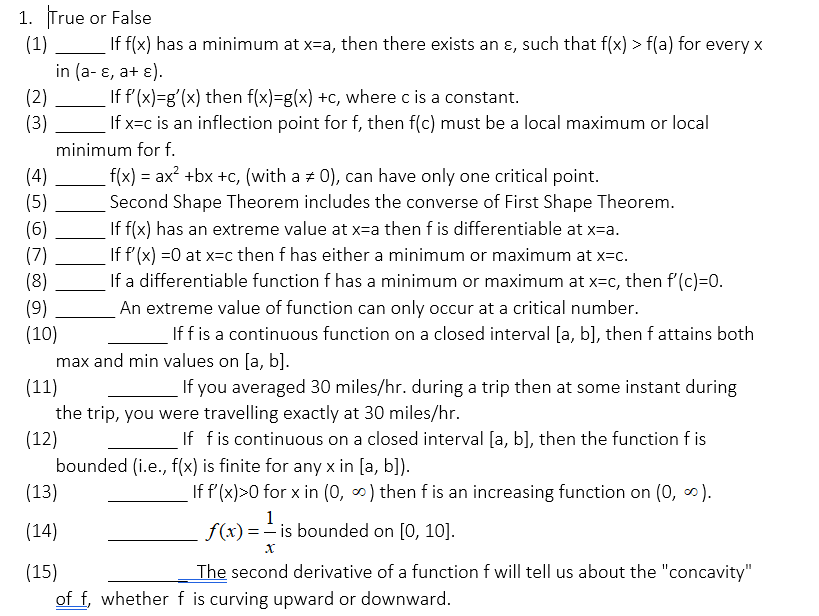
1. {l'rue or False {1} If f{x} has a minimum at xza, then there exists an e, such that x} > f{a} for every x in {a c, a+ E}. {2} 7 If f'{x}=g'[x} then f{x}=g{x} +c, where c is a constant. {3} If x=c is an inflection point for f, then f{c} must be a local maximum or local minimum for f. {4} 7f{x} = ax2 +bx +c, {with a i U}, can have only one critical point. {5} 7Second Shape Theorem includes the converse of First Shape Theorem. {6} 7 If f{x} has an extreme value at x=a then f is differentiable at x23. {7'} 7 If f'{x} 2C- at x=c then f has either a minimum or maximum at x=c. {8} 7 If a differentiable function f has a minimum or maximum at x=c, then f'{c}=0. {9} An extreme value of function can only occur at a critical number. {10} lff is a continuous function on a closed interval [a, b], then fattains both max and min values on [a, b]. {11} If you averaged 30 milesfhr. during a trip then at some instant during the trip, you were travelling exactly at 30 miles/hr. {12} If fis continuous on a closed interval [a, b], then the function f is bounded {i.e., x} is finite for any x in [a, b]}. {13} If f'{x}::O forx in {0, 00} then f is an increasing function on {0, 00}. {14} f(x) = l is bounded on [0, 10]. x {15} Lhe second derivative of a function fwill tell us about the "concavity" if, whether f is curving upward or downward
Step by Step Solution
There are 3 Steps involved in it

Get step-by-step solutions from verified subject matter experts
 Study Help